House of the Dragon: The Basarab Princes of Wallachia and the Legend of Count Dracula

One of the most persistent and popular legends in the history of eastern Europe, and in the steep Carpathian Mountains of Transylvania, is the story of an undead prince, a vampire, the ultimate blood-sucker, Count Dracula. His purported residence, Bran Castle, is the top tourist destination of Romania, with hundreds of thousands of visitors per year. Yet a quick scan of internet sites devoted to the famous prince of darkness reveals that the character created by the British novelist Bram Stoker in 1897 has almost no relation to either Bran Castle or with the notorious warrior prince, Vlad the Impaler, on which Stoker is thought to have based the character.

Bran Castle

So who was Vlad the Impaler? For starters, although much of his history is indeed connected to the Principality of Transylvania (about which I wrote two lengthy blog posts earlier this year), the main territory over which he ruled was the neighbouring Principality of Wallachia. As he is known in Romanian, Vlad Țepeș, or Vlad III, was Voivode (duke or prince) of Wallachia in the mid-15th century, and was infamous even in his own time as a particularly cruel warlord who beheaded and impaled his enemies by the thousands. The name Dracula came from his father, Vlad II ‘the Dragon’, and this branch of the family—the Basarab Dynasty—were known as the Drăculești, the House of the Dragon.

the most famous painting of Vlad III ‘the Impaler’

This post will focus on the Basarab Dynasty as rulers of Wallachia, one of the three principalities that eventually made up the Kingdom of Romania in the 19th and early 20th centuries. Over 300 years, from the early 14th century until they died out in the mid-17th century, the Basarabs were an incredibly violent dynasty in an incredibly turbulent region, on the front lines between the Christian West and the Islamic East, between the Kingdom of Hungary and the Ottoman Empire. Modern nationalist defenders of the extreme cruelties meted out by warlords like Vlad the Impaler and others of his family argue that such measures were essential in order to achieve regional independence in the face of much more powerful neighbours.

the three principalities in the late 16th century

Wallachia is the southernmost of the three Romanian principalities. Occupying a broad plain bounded on the north by the Carpathians and on the south by the broad river Danube, it formed part of the Ancient Roman province of Dacia, and retained a Latin-based Romance language through the centuries when most of the surrounding lands became increasingly Slavicised. In fact, their own name for this region is Țara Românească (‘the Romanian Land’); whereas Wallachia comes instead from the name given by non-Romanians to outsiders, from the ancient Germanic term for ‘other’ (walhaz—which also gives us Welsh and Walloon). In the past, the country was referred to as Vlahia, Wlachia, or Valahia, and the people as Vlachs. Bulgarian Slavs called it Vlashko, while Turks added a vowel at the start to form Eflak. The Hungarians—often the overlords, extending their rule across the mountains from Transylvania—called it Havasalföld, or ‘Snowy Lowlands’, or sometimes Ungrovlahia. Hungarian kings took control of this area of the lower Danube valley in the late 900s (from the Bulgarians), and ruled jointly with their Turkic allies who had settled from the eastern steppes, the Cumans (sometimes the King of Hungary also added the title ‘King of Cumania’). But this coalition was destroyed by the Mongol invasions of the 1240s, and afterwards the region was divided between Hungary north of the Danube and Bulgaria to the south. They appointed local Vlach lords to act as governors or voivodes. This Slavic term literally means ‘war lord’, but has also been translated as ‘duke’ (which also originally meant a leader of troops) and sometimes as ‘prince’. Wallachian rulers were also called hospodar, another Slavic word for lord, and in Romanian domn (from Latin dominus). All of these terms implied a degree of autonomous rule, but usually as a vassal to a greater power.

an illustration of the Wallachian countryside in a German travel book, 1480s

The first known Wallachian voivodes were appointed by the King of Hungary in the 1240s-1280s. Some ruled in the western part of the region, known as Oltenia (west of the River Olt); and others ruled in the east, Muntenia (‘mountains’). Historical records first refer to ‘Wallachia’ as a whole under the voivodeship of Seneslau, whose name is thought to be Slavic, Seneslav, but who is specifically referred to as a Vlach. Other Vlach names are similarly reflective of the mixed ethnicities in this region: Seneslau’s possible son, Tihomir (Thocomerius) could take his name from toq-tämar, Turkic (or Cuman) for ‘hardened steel’; while Tihomir’s son’s name, Basarab, could also be of Turkic origin, as basar aba, ‘ruling father’. Basarab is considered to be the first verifiable historical figure, appointed voivode in about 1310, but rebelling against Hungarian rule and establishing his own autonomy by about 1325. The King, Charles of Anjou, tried to retake the province by force in 1330, but was defeated at Posada, in the mountains separating Transylvania from Wallachia, in one of those epic nation-building foundational battles in which a small force of local warriors and peasants fight off a much larger foreign army. Basarab is therefore known as ‘the Founder’ and gave his name to the Wallachian dynasty that followed (and also, more tangentially, to the region further to the east known as Bessarabia, now Moldova).

Bsarab I ‘the Founder’, Voivode of Wallachia
the Battle of Posada, 1330–with Vlach peasants throwing rocks at Hungarian knights

Basarab may also be the historical version of a more legendary figure, Radu Negru (‘the Black’), who supposedly founded a new Wallachian capital at Câmpulung—‘long field’, the site of an ancient Roman colony, Campus Longus. Radu itself comes from the Romanian word for ‘joy’ and it will be one of the most common names used in the dynasty (and indeed throughout Romania today). Not much is known about Basarab I. Was he Orthodox, in opposition to Hungary’s Catholic king? For about 25 years, he ruled Wallachia as an ally of Bulgaria, against its enemies the Serbs and the Byzantines. This alliance was sealed through marriage, and his daughter was first known as Theodora, Tsarina of the Bulgarians, and later as the nun Theophana—since 2022 recognised by the Romanian Orthodox Church as a saint. The Prince developed a new capital in the 1340s, at Curtea de Argeş, ‘the court on the Argeş’, the latter being one of the main tributaries that flows south from the Carpathians into the Danube. This town was located close to the Bran Pass, which connected Wallachia to Transylvania, and in particular to Romanian settlements north of the mountains and the significant trading city of Kronstadt (‘crown city’), founded by Hungarian kings and populated by Saxon/German colonists in the 12th and 13th centuries (today’s Braşov).

remains of the ‘court’, Curtea de Argeş

Basarab also built the Princely Church of St Nicholas, with its amazing painted interiors, and by the 1350s, in the reign of his son and successor, Nicolae Alexandru, had attracted the Metropolitan of the Orthodox Church to relocate his seat to the new capital. A monastery was built for him, which became the dynastic necropolis; re-founded as a cathedral in the early 16th century. The cathedral of Curtea de Argeş was re-appointed as a dynastic  burial place, fully royal once Romania became an independent kingdom in the 19th century, and it remains so today.

St Nicholas Basilica (Photo Alexandru Baboş)
St Nicholas, interior (photo, Fusion of Horizons)
the Cathedral at Curtea de Argeş (photo Alexandru Baboş)

Prince Nicolae Alexandru made a deal with the Hungarian king in 1354, recognising him as overlord and allowing him to send Catholic missions to Wallachia and to establish a Catholic diocese, to operate alongside the Orthodox churches and serve an increasing number of Saxon merchants settling south of the Carpathians and along the Danube Valley. Their presence would become a source of conflict later, as we shall see when we return to the story of Vlad the Impaler.

Successive voivodes, Vladislav I, Radu I, re-affirmed their loyalty to Hungarian kings, in exchange for a more secure title to the Romanian exclaves north of the Carpathians in Transylvania (Amlaş and Făgăraş). They married Hungarian noblewomen from Transylvania, but their daughters continued to make kinship ties with their other (Slavic) neighbours, resulting in another Bulgarian tsarina and a tsarina of the Serbs. Voivode Dan I tried to extend his rule south into Bulgaria but was defeated and killed in 1386.

Radu I and his wife showing their patronage for the church in Curtea

His brother Mircea I was more successful, and earned the nickname ‘Mare’ (‘the Great’). He gained the territory at the mouth of the Danube on the Black Sea (Dobruja) in 1388, as well as the region bordering Serbia and Hungary, the Banat of Severin, in 1389. He strengthened the army and the Principality’s borders, brought in increased trade and developed a court culture to rival other princes. In 1394, Prince Mircea went to the aid of the Bulgarians now that the Ottoman Turks had arrived in the Balkans led by Sultan Bayezid. At first he repulsed the Ottoman attack in the valiant Battle of Rovine (another of these David vs Goliath moments celebrated in song and story), but was later chased out and replaced as voivode (or bey in Turkish) by Vlad I. Mircea joined the grand western crusade against the Turks in 1396, which culminated in their defeat at the Battle of Nicopolis, a severe blow to Christian power in the Balkans. But he reclaimed his throne in 1397, defeated the Turks again in 1400, and even intervened in Ottoman internal politics in the confused dynastic succession of 1403-06.

Mircea the Great

Prince Mircea also moved the capital of Wallachia once more, to the town of Târgoviște, to be a bit more central to the region. This town, which takes its name from the old Slavic word for ‘marketplace’ and had been settled by Saxon traders emigrating from Transylvania in the early 14th century. Mircea began the transfer of the princely court in about 1400, and fortified his residence—its grand tower, the Chindia Tower, was added later in the century by Vlad III.

ruins of the voivode’s court in Târgoviște (photo Nicubunu)
Chindia Tower (photo Nicubunu)

Mircea the Great ruled peacefully until 1418 when he was succeeded by his son Mihail then his brother Radu II. Things start to get really messy again in the 1420s, as the dynasty split into two branches: the descendants of Mircea’s brother Dan I (the Dănești), and the family of Mircea’s illegitimate son, Vlad II ‘Dracul’ (the Drăculești). Different cousins competed for the throne with a variety of supporters, sometimes the local Romanian boyars, or nobles, and sometimes the Ottoman sultan, who first started demanding tribute in this period. Dan II re-asserted Wallachian independence, but was deposed and killed by invading Ottoman forces who placed his cousin, Alexandru I Aldea on the throne in 1432. Alexandru thus acknowledged the suzerainty of the Sultan and did formal homage to him in Adrianople.

When he died in 1436, Alexandru was succeeded by his brother, Vlad II. Vlad had been sent by his father to be raised at the court of Sigismund of Luxembourg, King of Hungary—initially as a hostage, and later as a guest and friend—and he was granted membership in the King’s new order of chivalry, the Order of the Dragon. When he returned to Wallachia at the head of a Hungarian army to take up his brother’s throne, he wore the badge of this order and thus was given the nickname ‘Dragon’ or ‘Dracul’. But Sigismund died in 1437, and, finding himself without a powerful patron, Vlad II turned to the Ottomans and agreed to do homage and pay a tribute. A few years later, in 1441, he changed his spots again and supported the invasion of Ottoman territory by the Hungarian prince of Transylvania (János Hunyadi), for which he was deposed and imprisoned by the Sultan. He was replaced by his cousin from the rival Dănești branch, Basarab II. But only a year later Vlad II was put back in charge of Wallachia, though he had to leave two of his younger sons, Vlad and Radu, in Ottoman hands as hostages, and agreed to send 500 Vlach boys to the Sultan’s court to be trained as Janissaries. Yet again, in the same year (1443), he turned against the Sultan and joined the crusade of western princes who invaded Bulgaria, and were badly defeated at Varna in November 1444. Vlad II Dracul made a separate peace with the Sultan in 1446, prompting his former ally Hunyadi to invade Wallachia in 1447; Vlad was captured and executed just outside the new capital at Târgoviște.

Vlad II, Dracul

Vlad’s eldest son, Mircea II, had been a leader of his father’s troops in the Crusade of Varna; at the time of the invasion of 1447 by Hunyadi, he was captured by the frightened Wallachian boyars, who poked his eyes out and buried him alive. The horrors of this century were really starting to intensify. Again, a prince from the rival branch, Vladislav II, was named voivode, probably by Hunyadi, and ruled peaceably for several years. In 1455, however, he decided to bite the hand that fed him, and invaded Transylvania to lay claim to the Romanian settlements there and the key trading city of Kronstadt/Braşov; Hunyadi responded by supporting a coup by one of those two sons of Vlad II Dracul that had been left as Ottoman hostages back in the 1440s: Vlad III, the future Impaler. The cousins met for single combat in August 1456 and Vladislav was killed. Vlad Dracula (or Drakulya, ie, son of Dracul) soon revealed himself to be one of the most intensely ruthless rulers this part of the world had ever seen. In the face of ongoing opposition to his rule by Vladislav’s brother, Dan III, he staked his claim in the capital by rounding up Wallachian boyars and Saxon merchants who supported his rival, and impaled them on stakes all around the city. Dan led an invasion, with Hungarian support, in 1460, but was defeated in the Bran Pass, forced to dig his own grave, and beheaded. His supporters were impaled. Two years later, the Ottoman Sultan sent envoys, and (so the story goes) Vlad nailed their turbans to their heads, since they were ‘so attached’ to them that they wouldn’t remove them in his presence (a sign of honour). The Impaler reportedly created a ‘forest’ of 20,000 impaled bodies all around the city of Târgoviște to frighten Ottoman troops sent to avenge the ambassadors.

a contemporary German woodcut illustrating Vlad III in a history about him:
Die geschicht dracole waide

Already Vlad III was getting a reputation for extraordinary cruelty—real or exaggerated. Contemporary writers spread tales of his excesses across Europe. As the years went by, these stories grew: a German woodcut from 1499 shows ‘Dracule waide’ (voivode) dining casually amongst his impaled victims. As noted above, later Romanian nationalist historians would defend this reputation, seeing his severe acts as necessary in the goal of securing Wallachian autonomy in the face of two powerful neighbours and the internal self-interested treachery of the boyars. He is also seen by some as a crusader for the Orthodox Church.

another woodcut from the period

Dracul does mean ‘devil’ (not ‘dragon’) in modern Romanian, but there is no indication that Vlad Țepeș (Romanian for ‘the Impaler’) was ever connected with local legends of vampirism, undead demons who survive by drinking human blood, until the era of the novel Dracula by Bram Stoker—and even here the link is only indirect. Stoker also used the name Nosferatu, thinking (probably incorrectly) that it was a Romanian term for ‘undead’.

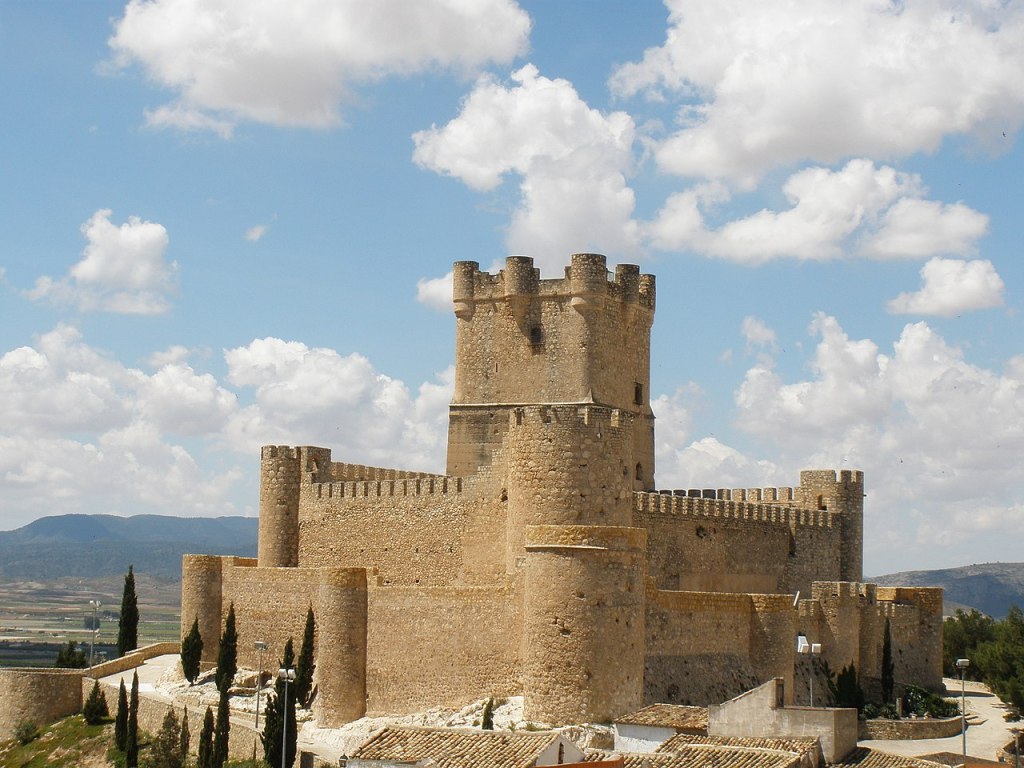
Bran Castle (perhaps due to the closeness of the name to Bram?) is today marketed as ‘Dracula’s Castle’ to foreign tourists, though it does not fit the description in Stoker’s novel very well, and really had very little connection to the historic Vlad the Impaler. It was built in the 1370s by the Saxon merchants of the town of Kronstadt (Braşov) and was maintained by them for centuries as the key defence of the mountain pass between Wallachia and Transylvania. Bran Castle became a royal residence in the 1920s, and was significantly renovated by the Romanian royal family; it was confiscated by the Communists in 1948, then restored to the family in 2006, in the person of Princess Ileana of Romania’s son, Archduke Dominic of Austria.

Bran Pass

Dracula’s actual castle is high in the mountains of the upper Argeş valley: Poenari Castle, perched on a rocky spur. It had been the chief stronghold of the Basarab lords in the 13th and 14th centuries, and was rebuilt by Vlad III in the 1450s, supposedly using the slave labour of those same Wallachian boyars he so persecuted at the time of his accession to power.

Poenari Castle (photo Nicubunu)

Eventually, and unsurprisingly, these Wallachian boyars turned against him, and in 1462 compelled him to cross into Transylvania to seek help from the Hungarian king, Matthias Corvinus, who imprisoned him instead, in his castle at Visegrad for thirteen years. While there, some think he became a Catholic, and gradually earned Corvinus’ trust, and so he was again placed at the head of a Hungarian army to attack Ottoman troops first in Bosnia in 1476, then in Wallachia to reclaim his throne.

Back in 1462, the post of Wallachian voivode had at first been given, by the Ottomans, to Vlad’s younger brother, Radu III ‘the Handsome’ (‘Frumos’). Like Vlad, Radu had also been sent to the Ottoman court as a child hostage, but became more acclimated, and a very close friend to the Sultan’s son, Prince Mehmet. It is thought the teen boys became lovers, and Radu may have converted to Islam. Once Mehmet became Sultan (Mehmet II) in his own right in 1451, Radu was given a place of honour in his court (perhaps as a Janissary commander), and took part in the conquest of Constantinople (1453). Ten years later he was named voivode of Wallachia, promising to restore the privileges of the urban boyars and merchants in Târgoviște and Braşov that his brother had so brutally repressed. His reign was troubled, however, and he was deposed and restored several times, including by his son-in-law, Prince Stefan III of Moldavia, who was opposed to Radu’s loyalty to the Sultan. He died sometime in 1475 and was replaced as voivode by his cousin (from the Dan branch), Basarab III ‘Laiota’. It was this ruler Vlad the Impaler unseated in 1476; but by the end of the next year, the latter returned with Ottoman support, and drove Vlad from power once more. He was killed in battle in early 1477, probably on the outskirts of Bucharest.

Basarab III Laiota.

Accounts vary about Vlad the Impaler’s death; one Italian diplomatic source says his body was cut into pieces and his head sent to Mehmet II and impaled (fittingly) on a high stake in Constantinople. One of his possible burial sites is Comana Monastery, to the south of Bucharest, which had been built by Prince Vlad in 1461. It was demolished and rebuilt in 1589, but the crypt remained, where archaeologists in the 1970s claimed to have found the headless body of a prince.

Comana church and monastery (photo Marius Lucian Andrei)

The city of Bucharest, or București, was at this time starting to be regarded as the new princely capital. A relatively new settlement, possibly taking its name from the Romanian word for ‘joy’ (bucurie), it was the preferred summer residence of Vlad III who built what later became known as the Curtea Veche (‘Old Court’) sometime before 1460. The palace was extended and renovated in the late 17th century, but was replaced with a ‘New Court’ in 1775. A church was added to the princely complex in the mid-16th century, with tombs associated with the Basaraba dynasty in this period. București and Târgoviște alternated as Wallachian capitals, with the former predominating in periods of more pro-Ottoman relations due to its proximity, then formally becoming the sole capital towards the end of the 17th century.

Curtea Veche, Bucharest, with a bust of Vlad III (photo Stefan Jurca)
the church at Curtea Veche (photo Valerii Ded)

The successors of Vlad III came and went in quick succession, with the two branches of the family continuing to vie for power with or without Ottoman support. Basarab IV, from the Dănești branch, was in a way the inheritor of The Impaler’s mantle, known as Țepeluș, ‘the Little Impaler’ (how sweet!). He ruled as voivode twice in the late 1470s-80s and sided with the Ottomans in a great clash with the Hungarians in 1479. He was killed in 1482, either in battle or in a boyar conspiracy. His successor was again from the Drăculești branch, an illegitimate half-brother of Vlad III, known as Vlad IV ‘the Monk’, put on the throne by the neighbouring Prince of Moldavia, but soon forced to accept Ottoman suzerainty once more. Strangely, he seems to have died in his bed, of old age, in 1495, and even was succeeded peacefully by his own son, Radu IV ‘the Great’, who ruled for another decade, and also seems to have died peacefully. His epithet ‘the Great’ refers not to any great victories, but to his position as a great patron of the arts and protector of the Orthodox Church, not just in Wallachia, but across the Orthodox world.

Radu the Great was succeeded by his cousin, Vlad the Impaler’s son Mihnea, who, like his father, pressed for Wallachian independence but was challenged by boyars who enjoyed the favour of the Ottoman court and the profits to be gained from being part of that vast eastern empire (which makes sense to a non-nationalist historian like me). Mihnea was given the nickname ‘the Wicked’ by his enemies, including one of these boyar families, the Craioveşti, who would later take on the role of voivode themselves. Prince Mihnea was run out after only a year, followed only a few months later by his son, Mircea III Dracul.

Radu the Geat

He was succeeded by yet another cousin, Vlad V ‘the Younger’ (a son of Vlad ‘the Monk’), in 1510, placed on the throne by the increasingly powerful Craioveşti family with Ottoman support. But a year later, he switched allegiances and swore fealty to the King of Hungary—this of course led to his deposition the following year by the same boyars and Ottoman soldiers, and he was decapitated. A different kind of ruler succeeded in 1512: Neagoe, who claimed to be from the Dănești line, a son of Basarab IV, and not his mother’s husband, one of the Craioveşti boyars. He was voivode for nearly a decade, and proved to be a capable administrator and a skilled diplomat, desiring to act as mediator between eastern and western branches of Christianity. He sponsored the building of Curtea de Argeş Monastery (1517) and the Metropolitan Cathedral in Târgoviște. He was also a scholar, and published a Romanian translation of the Gospels in 1512. He was canonised by the Orthodox Church in 2008.

Neagoe Basarab

The sixteenth century continued in much the same fashion: princes named either Vlad or Radu had relatively short reigns, either with support or in defiance of the Ottomans. The principality was basically independent but paid heavy tributes to the Sultan. Prince Patrascu ‘the Good’ (‘Bun’) ruled in the 1550s and helped the Ottomans restore John Sigismund Zápolya as Prince of Transylvania in defiance of the Habsburgs. His cousin Alexandru II was raised at the Turkish court and put on the throne in the 1570s, but like his great-grandfather Vlad the Impaler, he soon became known for his cruelty and was deposed and murdered by his boyars. His son followed in the 1580s, Mihnea II ‘Turcitul’ (‘turned Turk’) who earned his nickname late in life by converting to Islam (having been thrown out of Wallachia in 1591), and accepting an appointment as sanjak (governor) of Nikopolis in Bulgaria (as Mehmet Bey).

the coat of arms of Wallachia was a black (later golden) eagle, with e cross, the sun and the moon
(this still features as one of the quarters of the modern Romanian seal)

By the mid-1590s, the voivode of Wallachia was no longer appointed exclusively from within the Basarab family, with other local families filling the post. But the dynasty had one more burst of glory in the person of Michael ‘the Brave’ (or Mihail ‘Viteazul’), who not only restored Wallachia’s autonomy, but briefly united all three Romanian principalities for the first time in their history. He is thus seen as one of the major national heroes of Romania and a symbol of unity. He is described as a son of Patrascu the Good, but some claimed he only assumed that kinship to hide his more plebeian origins. Michael was first a regional governor in Ottoman service, then invested as Voivode of Wallachia by the Sultan, Murad III, in 1593. In 1595, he renounced this loyalty, declared Wallachian independence, and defeated a much larger Ottoman army at Călugăreni, near the Danube, allied with Emperor Rudolf II of Austria (as King of Hungary) and Sigismund Báthory, the Prince of Transylvania. He also defeated the Turks at an important crossing of the river, near Giurgiu. Peace was brokered with the Ottomans in June 1599, and Michael (encouraged by Rudolf) turned on and defeated Sigismund’s successor, András Báthory in October. Rudolf named him governor, not prince, of Transylvania, but he was de facto its ruler, following a triumphal entry into its capital of Alba Julia. In the spring of 1600, Michael travelled east to Moldavia and deposed his rival from the Movilă family, and named himself prince there as well.

Michael the Brave

This unity did not last long, and by the end of 1600, the Transylvanian nobles, unnerved by Michael’s ambitions, threw him out. He was then defeated in Moldavia by troops sent by the king of Poland, and was even chased out of most of Wallachia. Prince Michael went to Prague to the court of Rudolf II to plead for Imperial support; eventually given Habsburg funds and supplies, he re-took Wallachia, then Moldavia, but when he tried to retake Transylvania in 1601, Rudolf thought it was too far and sent orders for the Vlach prince to be murdered. Nice.

Though it was short, under Michael the Brave’s reign, boyar power in Wallachia increased and serf freedoms were curtailed—as a result voivoides in the 17th century had much less autonomy, and were made and unmade by Ottoman sultans from multiple boyar families, never allowing any one to gain too much power or stability. Yet Michael’s memory remains solid in Romania, as responsible for strengthening the authority of the Romanian Orthodox Church in all three principalities, and awakening (it is claimed) some form of early Romanian nationalism. Centuries later, a new royal order of chivalry was created by King Ferdinand of Romania during World War I: the Order of Michael the Brave.

crosses of the Order of Michael the Brave / Mihai Viteazul

Michael’s immediate successor was Radu IX Mihnea, who ruled on and off in both Wallachia and Moldavia—at one point trying to control both by installing himself in the Moldavian capital of Iaşi (Jassy), and his son Alexandru in Bucharest. This Radu was a reformer, of government and of foreign policy, trying to align with the leading mercantile power in the east, Venice. His son Alexandru was nicknamed ‘Coconul’ (‘the Cocoon’) because he began his reign at such a young age. He ruled at times both Wallachia and Moldavia in the 1620s, sometimes paying large sums to obtain his appointment, but never proving to be that effective as a ruler. He was removed from power in 1630 and died in Istanbul in 1632. He was the last of the direct descendants of Vlad Țepeș, the last of the House of the Dragon.

Alexandru Coconul–last of the dragons

There were others who claimed affiliation with the Basarab family in the 17th century. Many of these were in fact from the Craioveşti family (or the related Brâncovenești family), as above, including Radu Şerban, one of the better rulers of the period (1602-11), preserving Wallachian independence and reforming the government. Matei Basarab, with one of the longest reigns (1632-54), adopted this dynastic name to associate himself more securely with Wallachian identity, in competition with the increasing number of outsiders, especially Greeks, being appointed by the Ottomans as voivodes. He was an enlightened ruler, introducing the printing press, codifying the laws and founding schools. He also allied with the Prince of Transylvania, George II Rákóczi, with an aim to create an independent state, but this idea was crushed in the next reign (Constantin II, son of Radu Şerban) by the troops of Sultan Mehmet IV in 1658. The Sultan therefore appointed Mihnea III Radu, who claimed to be a son of Radu IX, but many said he was a Greek money lender from Constantinople and had agreed to pay the Sultan a rather large sum for the privilege of serving as voivode—but only for a year.

Matei and his wife Alina, as patrons of the Arnota Monastery
the Arnota Monastery in the hills of northwest Wallachia (photo Țetcu Mircea Rareș)

After this point, appointments to the post of voivode were much more clearly servants of the Ottoman court, often noblemen from Greek families known as Phanariots. These families, notably Cantacuzenos and Mavrocordatos, will be the topic of a future blog post on their own. Wallachian autonomy continued to decline, and after 1716, the Ottomans no longer even pretended the post of voivode was an elective position, depriving the local boyars of even the pretence of self-rule. The idea of a united state of the two Romanian principalities of Wallachia and Moldavia was revived in the 1820s, in the wake of the Greek War of Independence, and although they were formally tied together in 1859, Romania remained nominally a vassal state of the Ottoman Empire until formally proclaiming its sovereignty in 1877 (with Transylvania remaining a part of Hungary until after the First World War). Twenty years later Bram Stoker would popularise the name Dracula and its association with Transylvania and the Carpathian Mountains, but it was not until the cinematic versions of the story were produced that people began to associate the Prince of Darkness with Vlad III, voivode of Wallachia.

(images Wikimedia Commons)

Basarab Dynasty, simplified

Lost Princes of France: The Courtenays, from Latin Emperors to Earls of Devon

This is the story of a family that rose to great heights as princes and emperors in the eastern Mediterranean, then slowly declined over several centuries in rural France, before attempting to restore their former position in the line of succession to the French throne in the 17th century. An offshoot branch had established itself in England in the Middle Ages and by the 16th century were potential claimants to the throne there too. In an alternative reality, it is not impossible that, had the wheel of fate turned a bit differently, there could have been two royal Courtenay dynasties, facing each other across the Channel.

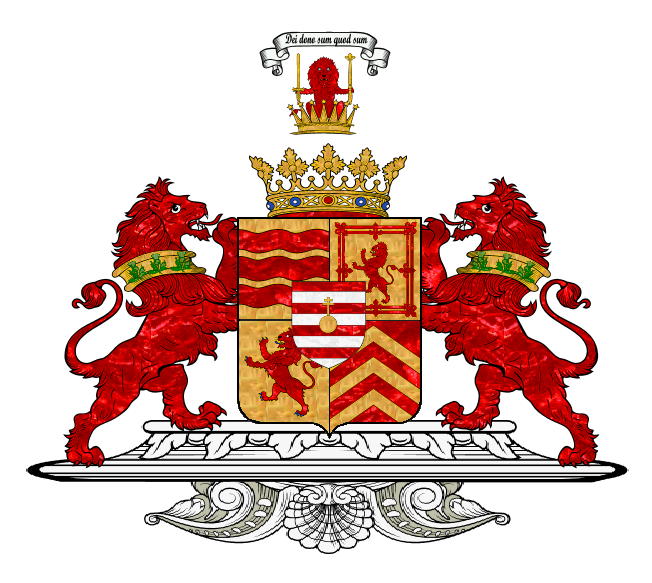
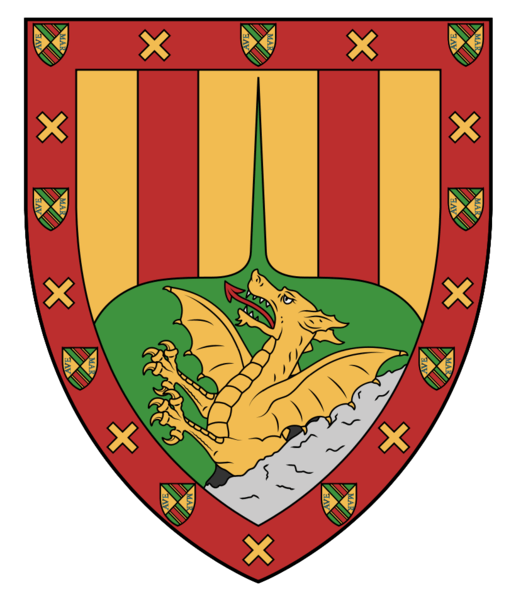
Arms of the House of Courtenay in France and England

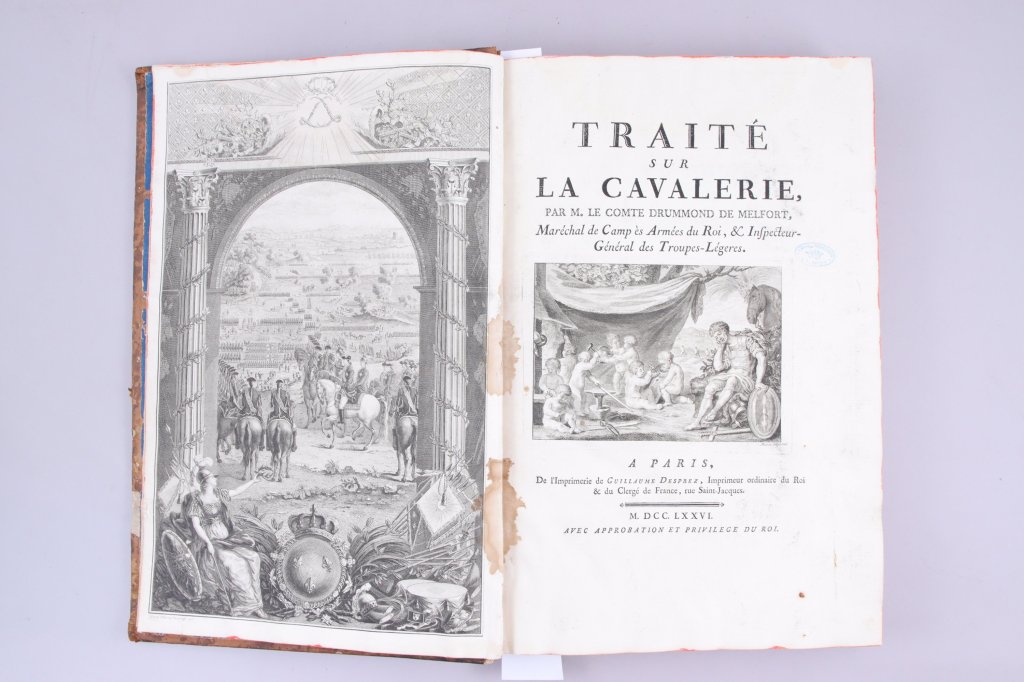
The English succession potential of the Courtenays was fairly close, as nieces and nephews of the last of the Yorkist kings. Had Edward, Earl of Devon not died suddenly in 1556, some consider he might have married Elizabeth I and united the rival Plantagenet and Tudor claims in a royal Courtenay dynasty. The French succession potential for the Courtenays was much more remote: the entire Bourbon Dynasty would have needed to suddenly disappear to establish the reign of royal Courtenays in the mid-seventeenth century. More importantly, Louis de Courtenay-Chevillon (who assumed the title ‘Prince of Courtenay’) had to overcome five centuries of his family’s relative obscurity and poverty in order to convince the French elites to accept his candidacy for the throne should such a dynastic cataclysm occur. This he attempted to do, commissioning a massive and elaborately detailed ‘genealogical history’, which he presented to Louis XIV in 1661. In it, the author makes the case that the Courtenays should enjoy the same privileges as any prince of the blood, and that, should the main line fail, and those of the Bourbon cadet branches as well, the Courtenays must be recognised as next in line for the throne. This wasn’t as outrageous as it sounds: in 1663, besides the King and his brother Philippe, and the two-year-old Dauphin, the only males of the house of Bourbon were the Prince of Condé and his brother the Prince of Conti, Condé’s son Enghien, and Conti’s infant son. That’s only five adult males—it still may seem like a lot, but considering how many Bourbons were wiped out by smallpox in 1711-12, it’s not outside the realms of possibility.

frontispiece of the grand genealogical history of 1661

The two Courtenay families were actually not the same family by strict male-line succession—both probably inheriting the name from a female heiress—though they had the same origins and bore variations of the same coat-of arms for many centuries. It’s not even really certain how exactly they connect, and there are several legends surrounding the connection in the mid-12th century, when the original noble House of Courtenay died out. From this point, one member established a branch in England and rose to be the powerful earls of Devon, one of the oldest continually held earldoms in the United Kingdom (and surely one of those families most deserving of a dukedom that never got one—see Stanley); while another member headed east and established the Imperial House of Courtenay in Constantinople (see below).

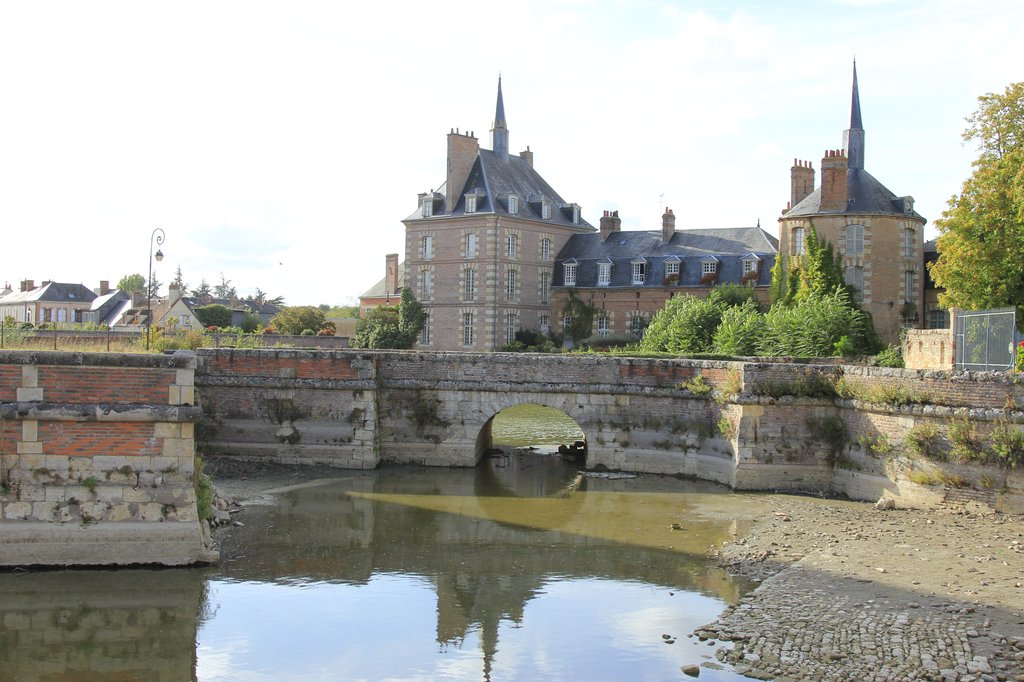
The original Courtenays were servants of the Capetian monarchy in the central provinces of France: regions known as the Gâtinais and the Puisaye, neither very well known provincial names today, but rich agricultural lands and key territories in the struggle between the royal house in the Île de France and their chief vassals and rivals the dukes of Burgundy. Gâtanais and Puisaye lie in the zone between these two regions, and between the major waterways the Loire and the Seine. At the end of the 10th century, a lord known as Atto, Athon or Hutton was given several castles in this area to re-fortify and defend in the name of the king, notably the castle of Courtenay, watching over the valley of the Cléry river which feeds into the Seine, and guarding an important road between the key agricultural centres of the Loire Valley and the markets of Champagne.

The Clery river at Courtenay in the Gatinais (photo by Basicdesign)

Lord Atto’s son Josselin consolidated his family’s power in the region through marriage to the daughter of the local count of Gâtinais, and their son, Miles (or Milon), rooted the family firmly in these lands by founding a Cistercian abbey nearby at Fontaine-Jean (in about 1124), bringing in twelve monks from the parent abbey of Cîteaux, in which the family mausoleum would be established for many generations. Nothing remains today of the castle of Courtenay, but the 12th-century church of St-Pierre and St-Paul remains in Fontainejean. Once the Courtenay family became connected to the royal house, the abbey was raised to the status of a ‘royal abbey’, and it grew: by 1200 there were about 200 monks and 400 students. Its buildings were mostly destroyed by ravaging English troops in 1359, and again in 1422. Rebuilt, its abbot in the 1560s converted to Calvinism and participated in a massacre of his brother monks. Yet the buildings remained and were again restored; the Courtenays were still burying their dead here in the 1630s—in fact, a particularly large monument was erected here in 1637 as part of the process of gaining recognition as princes of the blood. The very last member of the French Courtenays deposited her heart here in 1768, but the chapel did not survive the Revolution: the abbey lands were sold and the buildings, and its tombs, destroyed.

an early 19th-century print of the ruined abbey of Fontaine-Jean

The two younger brothers of Miles, Lord of Courtenay, Josselin and Geoffroy, headed east to stake their claim to glory in the First Crusade. Josselin was a successful warrior companion of Baldwin I, King of Jerusalem, who gave him the lordship of Tiberias, on the Sea of Galilee, from which he took the grand title ‘Prince of Galilee and Tiberias’ in 1113. A few years later, Baldwin II assigned him the lesser title but more significant territory of the County of Edessa in the northern parts of Syria (today Urfa in Turkey). Josselin ruled here until he died in 1131 and his son Josselin II took over. Just under fifteen years later, he lost Edessa, and was taken to a prison by the Emir of Aleppo where he died.

Meanwhile, back in France, Miles had three sons—maybe: Guillaume, Josselin and Renaud. The eldest died on the Second Crusade, about the same time as his cousin the Count of Edessa. Josselin may be imaginary, and is given in some English sources as the founder of the house of Courtenay in England and Lord of Sutton (in Berkshire, near Abingdon, today called Sutton Courtenay; see below). Some French sources suggest they did have lands there this early, as one of Atto’s brothers (or perhaps sons) had accompanied William of Normandy in the conquest of 1066. Other sources say they did not come over in the Conquest, but later, in the suite of Eleanor of Aquitaine following her marriage to Henry II in 1152. It is confusing.

Certainly by about the 1170s, a Sir Reginald (or Renaud II) de Courtenay was established at Sutton. If he was a son of Josselin, all subsequent Courtenays in England were direct male descendants of Lord Atto; but he may have been a nephew via a sister of the last Courtenays in France and took their name to establish himself across the Channel. He certainly did so, but not in Berkshire: he married the heiress of Okehampton, in Devon, and established the family’s position in the southwest of England which persist still today. We will return to them in the second half of this piece.

Whatever the case in England, by the 1170s, there were no more male Courtenays in France, and Renaud I’s daughter, Elisabeth, took the family’s name and French estates to her husband (since about 1150), Pierre de France, 6th son of King Louis VI (‘the Fat’). Louis VI (reigned 1108-1137) was one of the first to re-assert the power of the French Crown—pretty weak since the days of Charlemagne—and wanted to centralise, not continue to subdivide the kingdom for his heirs as was traditional. But he had a lot of sons, and did need to provide for all of them. The eldest two sons were lined up as the heir and spare, the third son became archbishop of Reims, and a fourth son died young, leaving Robert and Pierre (and one further son who came along a bit later). Neither Robert nor Pierre were given large parts of the patrimony and were expected to marry heiresses. Robert was given the small county of Dreux, southwest of Paris, and married an heiress of a larger neighbouring county, Perche. Pierre was given nothing, but when he was on Crusade in 1147 with his brothers Louis VII and Robert of Dreux, he met Renaud de Courtenay, and soon married his daughter, heiress of large estates in the Gâtinais. He took on her name—as was customary at the time, even for sons of kings—and her arms, three red balls, or bezons, on gold. Pierre went on Crusade again in the 1170s, and died in Palestine.

Pierre I, from a Capetian family tree

Pierre and Elisabeth restarted a dynasty in great style: they had five sons, and many daughters who married the cream of the French nobility. One of these, Alix, married the Count of Angoulême, and their daughter would become Queen of England (Isabella of Angoulême, wife of King John). Of the sons, the eldest, Pierre II, made a spectacular marriage to the heiress of the counties of Nevers and Auxerre (conveniently adjoining Courtenay lands), and then another, to Yolande of Flanders, which lead to much grander things, as we shall see. Robert was given the family lordship of Champignelles and acquired the important court office of Grand Butler of France, which kept him close to his cousin the King, whom he accompanied in his abortive invasion of England (1217), then in the conquest of Languedoc and other territories in the far south of France (1226). He married an heiress of lands in Berry (again, not far from Courtenay lands), but not such a major one, and founded the secondary line of Courtenay-Champignelles.

Pierre II de Courtenay earned his spurs on the battlefield, first fighting against the Albigensian heretics in France in 1210, then at the major European confrontation involving France, England, Germany and the lords of the Low Countries, the Battle of Bouvines, 1214—at which Philip II of France crushed all of these allied opponents. In 1216, Henry of Flanders, Latin Emperor of the East, died, and the remaining Crusader elites in Constantinople looked to Henry’s brother-in-law, Pierre de Courtenay. He was duly elected as emperor, and travelled east with his wife and children in 1217, stopping in Rome to be crowned by the Pope on the way. But he never made it to Constantinople—pausing to try to help the Venetians take the city of Durazzo (today’s Durrës in Albania), he was captured by the Despot of Epirus and died in his prison in 1219. His wife, Empress Yolande, had arrived in Constantinople in 1217 and ably set up the family’s rule there, until she too died in 1219, leaving their sons as successors. The eldest declined to take up the imperial throne (choosing to focus on claiming his mother’s lands in the Low Countries instead), so the second son, Robert, became Emperor of the East.

Pierre II, Latin Emperor of the East

I should step back a moment and explain what this title meant. The Fourth Crusade was launched to try to help those Christian lords and their troops remaining in Palestine retake the city of Jerusalem. Financial troubles and a willingness to get involved in internal Byzantine dynastic power struggles led them to Constantinople instead, which led to the deposition of emperors Alexios IV and Alexios V in quick succession in Spring 1204, and the takeover of the city and its empire by the Crusaders themselves. This was a major blow to Christian unity—east and west had already been at each other’s throats for two centuries—and it never recovered. The new rulers called their state the ‘Empire of the Romans’, while the Greeks called it the ‘Frankokratia’. The Latins (or ‘Franks’) ruled most of modern Greece and northwest Anatolia.

The Latin Empire of the East

Baldwin, Count of Flanders, was chosen to be emperor in 1204, but he died just a year later, defeated in battle by the Bulgarians. His brother Henry ruled for a decade, continually battling the Bulgarians and the rival state the Greeks set up in Anatolia based in the city of Nicaea. The throne then passed as we’ve seen to Henry’s brother-in-law, Pierre de Courtenay, and a regency by his sister, Yolande. Their son Robert was in France in 1219, and didn’t arrive in Constantinople until 1221, when he was crowned in Hagia Sophia. He was immediately engulfed in war on two fronts, versus Nicaea in the east and Epirus in the west; and he died in 1228. His younger brother, now Emperor Baldwin II, was a minor until 1237, so the Empire was ruled by regents. With all of its neighbours now allied against him and seizing ever more bits of his territory, Baldwin (or Baudouin) was forced to travel extensively in western Europe, begging for financial or military support. At the court of his cousin Louis IX of France, he sold him one of the greatest of Byzantine treasures, the Crown of Thorns, but obtained only weak promises for support. In desperation, the Emperor made an alliance with the Turks in Anatolia (enemies of the Greeks), and raised funds by selling the lead on the roof of the Great Palace in Constantinople. By 1247, his rule extended really only to the city itself, and by 1261 the Latin Empire was forced to yield when a small force of Greek soldiers easily retook Constantinople and installed Michael Palaiologos, ruler of Nicaea, as the new Emperor of the (once again Byzantine) East. The exiled Baldwin de Courtenay continued to visit courts of various Mediterranean kings seeking new alliances (even ransoming his son Philip to some Venetian merchants to guarantee a new loan). He very nearly convinced Charles of Anjou, king of Sicily and Naples to launch a new Crusade, but he died, in 1273, in Naples, with this plan unfulfilled.

a gold coin for Emperor Baldwin II

Thus the great empire of the Courtenays in the East died with a whimper. Baldwin’s son, Philip, continued to call himself emperor, married the daughter of the king of Naples, and even organised a new crusading alliance in 1281, but he too died before it could launch, in 1285. His daughter, the titular ‘Empress Catherine’, was raised at the court of Naples, and was sought in marriage by various princes, including a son of the Byzantine emperor Andronikos. In 1300, she married Charles de France, Count of Valois, brother of King Philip IV, and donated the lands of the lordship of Courtenay to her new husband. Their eldest daughter, ‘Empress Catherine II’ took her claims to the Empire of the East to her husband, Philippe, Prince of Tarento, son of the King of Naples. Their descendants continued to claim the imperial title until about 1430, when the very last of the Crusader principalities in Greece, Achaea, finally succumbed to Byzantine rule (and then soon after, Ottoman). Meanwhile, the lordship of Courtenay passed into the royal domain when the Count of Valois’s son became King Philip VI. It was given to various and sundry princes in the 14th and 15th centuries, until it was erected by Charles IX as a county for the Boulainvilliers family in 1563, and then on and on passing to other noble families Rambures, La Roche-Fontenilles), for the rest of the old regime.

Empress Catherine II

With the death of Philip of Courtenay, titular emperor, in 1285, the senior male representative of the family became Robert de Courtenay-Champignelles, a cleric (and future archbishop), and Pierre, Lord of Champignelles. This estate was a bit to the south of Courtenay, towards the Loire. These lands were fertile, so the family prospered, though as mere ‘lords’, not counts or even viscounts, as you might expect cousins of the king to be. Indeed the first generation of the Champignelles branch, Robert and Pierre’s uncles, was quite prominent. Several accompanied kings on trips to the Holy Land or to North Africa. Raoul accompanied Charles of Anjou in his conquest of Naples, 1269, and was given the County of Chietti in Abruzzo. The fourth and fifth sons, Robert and Jean, became bishop of Orléans and archbishop of Reims, respectively. Both accompanied Saint-Louis on his expedition to North Africa in 1270, where Archbishop Jean died. finally, it was the sixth son, Guillaume, who married and continued the lineage. Robert and Pierre came from an impressive first marriage to the daughter of the Count of Burgundy; and Robert leveraged this association to succeed to his uncle’s former post as archbishop of Reims in 1299—he became one of the leading powers in the reigns of several Valois kings of the early 14th century.

Their half-brother Jean took over in Chempignelles, married and carried on the lineage, but the subsequent generations struggled to keep up a princely lifestyle or reputation. Three of his sons were set up as canons in Reims Cathedral, ready to succeed their uncle and great-uncle, and although the youngest, Etienne, was elected in 1352, he died before he could take up the post. The eldest two sons served the monarchy as regular noblemen, not magnates ‘of royal extraction’ (as one legal document defined them). The elder was Lord of Champignelles and acquired the neighbouring lordship of Bléneau in marriage, while the younger was given the lordship of La Ferté-Loupière (also nearby) in a family partition. Two branches then ran parallel for the next century, with a third emerging at Bléneau.

The lands of the lordship of Champignelles were devastated by the English armies that frequently passed through this area in the Hundred Years War. They served their by now distant royal cousins in the wars of the 14th and 15th centuries—occasionally being recognised formally in feudal documents as ‘cousin’ by the French king. In the 1450s, Jean IV de Courtenay-Champignelles dissipated most of his fortune in equipping himself to fight in the wars in Italy, and sold most of his properties (earning the name ‘Jean Sans Terre’) and died with no legitimate direct heirs. Part of the lordship was bought back by the next branch of the family, but a significant portion passed to other families and was raised to a marquisate in the late 17th century for Charles-Louis de Rogres de Lusignan. The castle was destroyed during the French Revolution, but today there remains the fortified manor house of the ‘Old Park’ (Parc Vieil), which was built in the 16th and 17th centuries. It is private.

The Parc Vieil at Champignelles

The cadet branches of La Ferté-Loupière and Bléneau were both based in the district called La Puisaye, to the southeast of the Gâtinais. Pierre de Courtenay built a new château at La Ferté in the late 15th century (leaving the remains of the medieval fortress at the top of the nearby hill). In the middle of the next century, this castle passed into the hands of another local family.

the remains of the castle at La Ferté-Loupière (photo François Goglins)

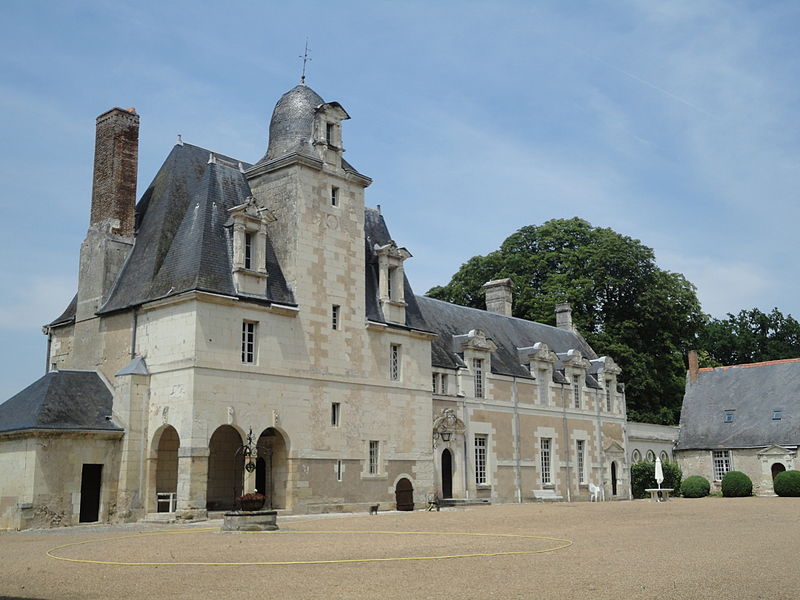
Another cadet line, based at Bontin, close to La Ferté, held yet another medieval Courtenay castle. In the Wars of Religion there were interesting divisions: François de Courtenay de Bontin was a Protestant, whereas his cousin Louis de Courtenay de la Ferté-Loupière was a Catholic and a follower of the Duc de Guise. As a Protestant stronghold, the castle of Bontin briefly made a mark in national history as the site of the marriage of Henry of Navarre’s top advisor (and future premier minister), Maximilien de Béthune, Marquis de Rosny (the future Duc de Sully), in 1583, and it was his residence in the years leading up to the accession of his patron Navarre’s accession to the throne as King Henry IV. The castle seen at Bontin today, however, was built by another family in the late 17th century.

the castle of Bontin (photo Chateau de Bontin)

The castle at Bléneau was a bit more significant, guarding a key crossing point on the river Loing, useful to both French and English troops in the Hundred Years War, notably Joan of Arc in 1428. Several centuries later, it was again a key crossing point, and the site of an important battle at the end of the civil war known as the Fronde where the rebel prince, Condé, successfully evaded the royal army, in 1652. Today a moated manor house remains on the edge of the village.

the castle at Bleneau

The branch of Courtenay-Bléneau tried to re-attach itself to the French court in the early 16th century. François, seigneur de Bléneau, served with King Francis I at the Battle of Marignano in 1515, married the daughter of one of the King’s favourites in 1527, and was named to a top household position of the new queen, Eleanor of Austria in 1530, then governor of the children of King Henri II. His younger brother, Edmé, held a senior post in the royal stables and a Gentleman of the Chamber. Yet neither was raised to a higher rank like count. François’ son from a second marriage, Gaspard, as an old man decided to press harder for his family’s position within the French royal family, partly inspired by his family’s poverty—they were too poor to appear at court or hold offices there, and desired the significant pensions the new Bourbon king was handing out to those who qualified as ‘princes of the blood’. In 1603, he and his sons commissioned a historian to publish a grand genealogical history, and a few years later (1608) they sent a formal legal request to King Henry IV. He and his cousins from the Chevillon branch stopped using qualification ‘noble seigneur’ and instead used ‘illustre prince du sang royal’ on official documents. They now quartered the Courtenay arms (the three red bezons) with arms of France (differenced with an indented red border) and topped with a princely crown. But Gaspard died in 1609 without having any decision from the King; his son Edmé had a more pressing need: he had killed another nobleman in a duel and fled France. He claimed he could only be tried as a prince of the blood, and sent this formal demand to Parlement of Paris where the King’s Attorney-General refused to accept the case. The King himself was assassinated the following year. Edmé joined up with another prince of the blood, the Prince of Condé, who was then in rebellion, and when this prince rebelled against the new Regent (the Queen-Mother, Marie de Medici) in 1616, Courtenay joined him—but was ‘forgotten’ in the list of demands Condé presented when reconciling with the Regent. Edmé went to England and was well received by the court of James I. He continued to send requests for recognition to the Chancellor of France in the 1620s, and hoped to win the favour of Cardinal Richelieu, a fairly close cousin (their grandmothers were sisters). But no luck. he died in 1640, and his son Gaspard II died with no legitimate heirs in 1655.

the new royal arms of the Courtenays of the 17th C

The lordship of Bléneau passed to the next cadet line, Chevillon, which took up the cause for princely recognition of the Courtenay family later in that decade. The castle and town of Chevillon was also just around the corner from La Ferté-Loupière—it is interesting to see how a noble family often stays roughly in the same spot established as a base by their ancestors, six-hundred years before. There was a very nice moated castle at Chevillon, built in the 14th century, which actually survives today, and is now used as a holiday rental.

the castle at Chevillon (photo ABC Salles)

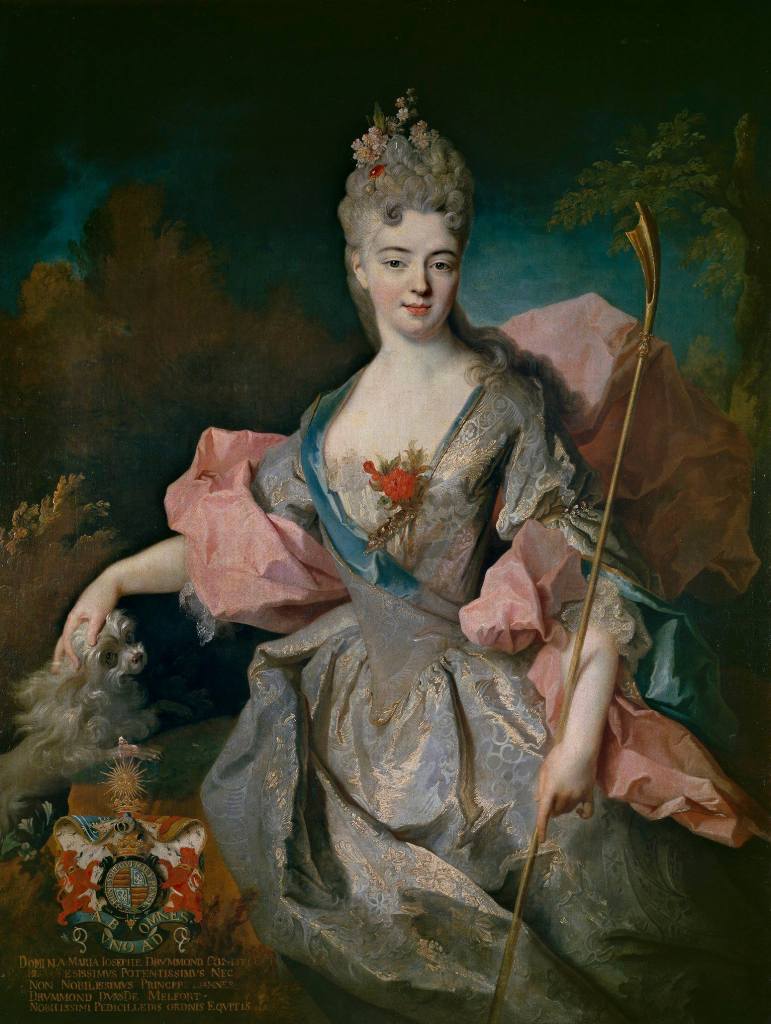
Louis de Courtenay-Chevillon started to take the title ‘Prince of Courtenay’ in the later 1650s when he became head of the family. He legitimately acquired a higher title than Lord of Chevillon by marrying the heiress of the County of Cesy, located, conveniently, just a few miles to the northeast (today’s Cézy). This marriage also brought him within the orbit of the powerful Parisian parliamentary family of Harlay, which could only be a good thing. The man running the government for the young Louis XIV, Cardinal Mazarin, contemplated formalising Courtenay’s status as a prince of the blood, but only gave vague promises for future action. According to the famous memoir writer the Duke of Saint-Simon, Prince Louis offered to marry his son to Mazarin’s niece Hortense Mancini (knowing that this was a sure manner to gain the Cardinal’s favours); the memoirist also describes a scenario in which the younger Courtenay (Louis-Charles) was taken by Mazarin in his carriage to Saint-Jean de Luz on the border with Spain for the peace talks for the Pyrenees—but did not know how to behave as a grandee and spent his time with the pages.

In February 1662, a strange diplomatic event occurred that placed the Courtenay status claim on the table again. By the Treaty of the Pyrenees of 1659 between France and Spain, Louis XIV agreed to restore the Duke of Lorraine to his territories which had been occupied by France since the 1630s. But Louis really didn’t want to lose control of the strategic duchy of Lorraine so he proposed that the Duke and his entire family could be ‘merged’ into the House of France, and would be in line for the throne if all of the current princes of the blood—meaning the Bourbons—became extinct. The Duke of Lorraine was poised to accept this (and to enjoy retirement and a huge pension), and the Prince of Courtenay, seeing his family potentially pushed to the back of the line behind several Lorraine and Lorraine-Guise princes, sent a alarmed letter directly to the King reminding him that his family had recently been confirmed (they hadn’t) in their status as princes of the royal house, legally able to succeed the Bourbons, as direct male line descendants of King Louis VI. He also reminded him that his grandfather, Henri IV, had himself succeeded to the throne based on claims of patrilineal descent stretching across ten degrees, suggesting that the ‘ancient and natural laws of the kingdom’ were not concerned with how far the gap might become, as long as the patrilineage remained unbroken. The Treaty of Montmartre of February 1662 collapsed almost immediately, as other significant people protested, including the people of Lorraine themselves and the Chancellor of France who quipped that the king of France could only create princes of the blood in bed, with his wife the queen. The urgency for the Courtenay case was again dropped—though another large-scale book was published only one year later, at great expense, to once again demonstrate the proper place of the Courtenay family within the court hierarchy of France. The volume was dedicated to the King, who smiled and ignored it.
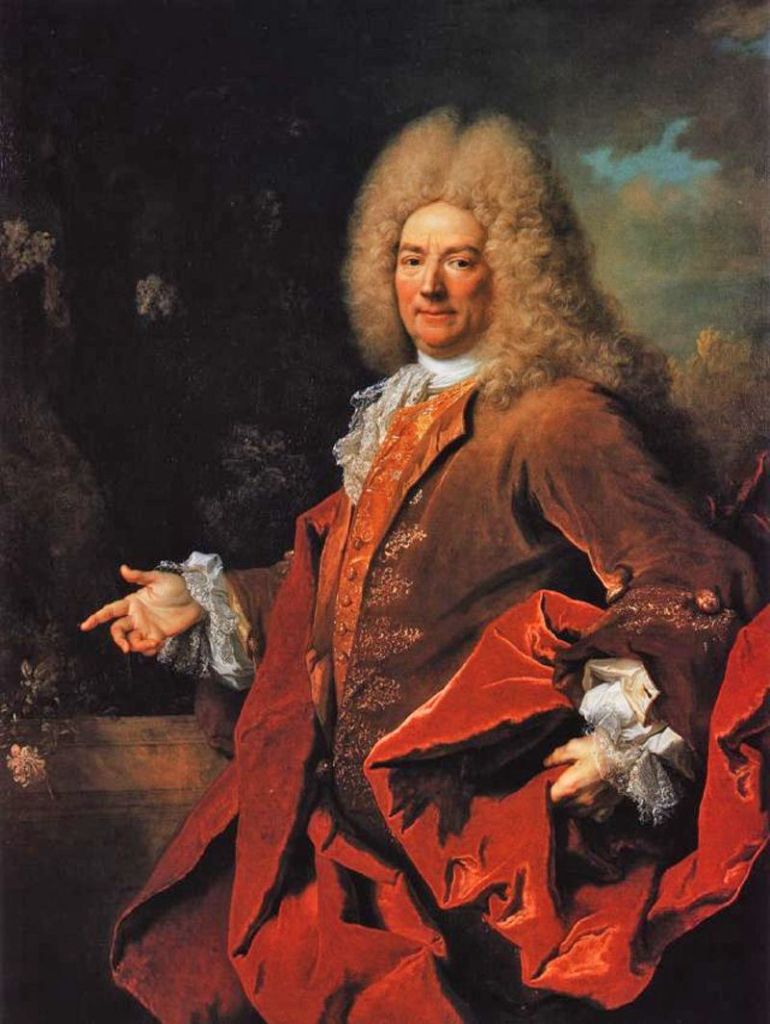
Prince Louis was succeeded in 1672 by his son Louis-Charles. He served Louis XIV in various military campaigns of the 1660s and early 1670s. He was quietly tolerated by the King, but still denied formal status of prince of the blood. His status is notable in his two marriages, both good, and useful in solidifying alliances in his family’s traditional base on the borders between Burgundy and the Orléannais, but not what one would expect of a prince of the blood. Nevertheless, in a formal document from 1675, we can see him style himself ‘très-haut & très-illustre Prince du Sang Royal de France, Monseigneur Louis de Courtenay’. Saint-Simon wrote about him that he even made a point of paying the capitation tax at the level of a prince du sang, despite it being financially crippling for him to do so. Having a keen interest in history, and in an aristocratic family’s longevity in particular—and notably being very much obsessed with his own—Saint-Simon considered that the Courtenay had suffered from having nothing for centuries but poverty and mésalliance, but should be considered honourable due to their descent from the crusader emperors in Constantinople in the 13th century. The one signal of hope the family got in the later decades of the 17th century was when Louis-Charles’ eldest son, Louis-Gaston, was killed at the siege of Mons in 1691, and the King paid a visit of condolence to Louis-Charles, something the Sun King only did for princes of the blood.

Louis-Charles de Courtenay, by Rigaud, 1699

In 1714, Louis XIV, seeing multiple generations of his family decimated by smallpox, formally placed his bastard sons in the line of succession. Immediately following the King’s death the following year, the Prince de Courtenay protested to the Regent—again contemporary writers like Saint-Simon felt it was a real crime that they were continually ignored. Charles-Roger succeeded as head of the family in 1723. In 1703 he had finally made a marriage more suited to a member of the top court aristocracy, to Marie-Claire de Bretagne d’Avaugour. Coincidentally—or was it?—her family also had long association with the royal house of France, as offshoots (illegitimate) from the dukes of Brittany, themselves formally part of the House of France as descendants of the Count of Dreux: Robert of France, the immediate older brother of none other than Pierre, first lord of Courtenay. Like his father and brother, Prince Charles-Roger also served in the French army, and rose to the rank of Captain of the Dragoons of the Queen’s Regiment. Saint-Simon thought he was crazy, and he killed himself in 1730. His uncle Roger, abbot of Écharlis in the ancient Courtenay heartland (in fact, the family had provided its abbots continually for over a century), was the last male of the family. When he died in 1733, his niece Hélène took the princely title by marriage to the Bauffremont family, a family from eastern France already building themselves into a ‘princely’ house through other inheritances (and later would get a French duchy). Princess Hélène made a final remonstrance in 1737 to the King. Still today, her descendants boast the title ‘Prince of Bauffremont-Courtenay’.

In 1735, just after the family in France became extinct in the male line, a large book was published in England, similar to that of 1661 (and using it as its source), which aimed to demonstrate to the author’s Courtenay pupil that his family was quite ancient and connected to royalty. So let’s turn back to England.

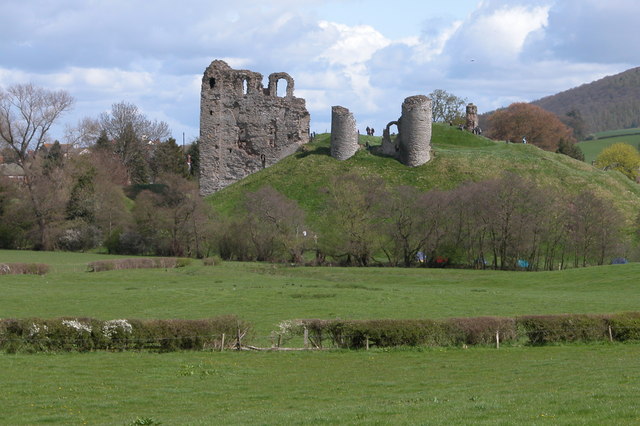
As seen at the very start of this piece, Sir Reginald (or Renaud) de Courtenay married the heiress of the feudal barony of Okehampton. His wife, Hawise, was a cousin of the Norman kings of England, and brought with her the important administrative and defensive offices of the county of Devon, such as sheriff of Exeter Castle and sometimes ‘vice-count’ of Devonshire. The barony of Okehampton was one of the eight large feudal divisions of Devon, located on the northern edge of Dartmoor. The castle was built in the 1070s-80s to guard a crossing of the river Okement. It was redeveloped by the family in the 13th century as a hunting lodge, with a large deer park. After its confiscation by the Crown in 1538, the castle was left to ruin and the park rented out to various local magnates. It was formally given over the state’s care in 1967, and today is maintained by English Heritage, one of the top attractions of central Devon.

the ruined Okehampton Castle in Devon (photo Kicior99)

Reginald’s son Robert also married well, in about 1215, to Mary de Redvers, daughter of the Earl of Devon. The Redvers family (aka Rivers or Reviers) had come over from Normandy at the Conquest, and became very rich through their support of King Henry I and then Henry’s daughter, the Empress Matilda, who raised them to the rank of Earl of Devon (circa 1141). The last earl, Mary’s great-nephew Baldwin, died in 1262, followed by his sister, Isabel, 8th Countess of Devon in her own right, in 1293. The Redvers estates were divided, but the bulk of the Devonshire patrimony came to Mary’s great-grandson, Sir Hugh de Courtenay of Okehampton. He already had a prominent position at court of Edward I, as maternal grandson of the King’s Justiciar, Hugh le Despencer (whose son would become more famous as the favourite of Edward II), and was soon created 1st Baron de Courtenay, 1299, and eventually, 9th (or some reckon 1st, a new creation) Earl of Devon.

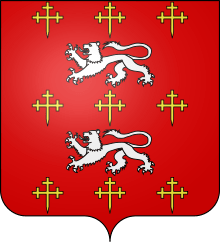
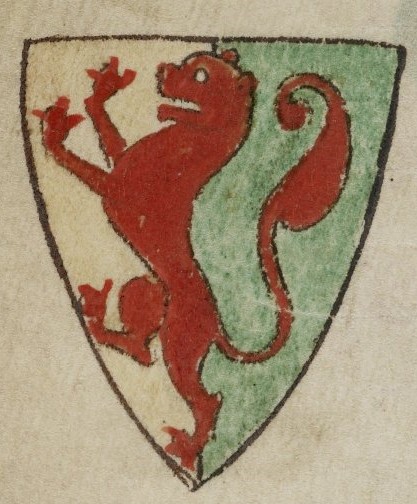
Hugh’s descendants would quarter the arms of Courtenay (the three red balls on a golden field, with a blue three-point label to indicate they are the junior branch) with those of Redvers, a blue rampant lion on a golden field. From the Redvers family, they inherited their new principal seat, Tiverton Castle, which dominated the eastern part of the county, on the River Exe, as well as Plympton Castle, the caput of one of the other feudal baronies of Devon, this one in the far southwest of the county, near Plymouth. The Courtenays now dominated the east, west and north of Devon.

Plympton Castle (photo Tony Atkin)

Tiverton had been built as a Norman motte by the Redvers in about 1106. It was turned into a more sophisticated defensive fortification, overlooking the River Exe (just north of the city of Exeter), in the 14th century. It became the principal seat of the Courtenays from the 1290s, who also built the church of St Peter’s which became their main place of burial. Towards the end of the 15th century, it was the chief residence of Princess Catherine, the daughter of Edward IV and sister of Henry VII’s queen, Elizabeth of York. After her son’s attainder in 1538 (see below), the Courtenay properties were confiscated: Tiverton was given to various Tudor lords, then finally restored by Queen Mary to the 11th Earl. When he died in 1556, his estates were divided between his female cousins. Tiverton became the seat of the Giffards then the Wests—who added a more modern mansion house on the site in the early 18th century—then the Carews in the 18th and 19th centuries, and finally the Campbells since the 1960s. It remains in private hands and is open to tourists only on select days in the summer. Most of the defensive structures were dismantled in the English Civil War in the mid-17th century, but some of the medieval walls and towers remain.

Tiverton Castle, the medieval great tower and some of the newer buildings (photo Humphrey Bolton)

About 20 miles to the southeast was another main property of the Courtenays, Colcombe Castle, acquired by marriage to the Bassett heiress back in the 13th century, with the manor and estate of Colyford, on the coast near the border with Dorset. The 1st Earl of Devon built a manor house here, and it remained a secondary residence until the 10th Earl turned it into a ‘magnificent’ Tudor residence following his rise in status as 1st Marquess of Exeter in 1525. Colcombe too passed to various female relatives in 1556 and was rebuilt by the Pole family, then completely destroyed in the Civil War. Little remains today but some farm buildings.

a watercolor of the ruins of Colcombe

The rise and fall of this senior line of the Courtenays in England is one of the great stories of the Wars of the Roses and the Tudor era, so I will just summarise it here. Thomas, 5th Earl of Devon, married into the Beaufort family and was therefore allied by blood to the House of Lancaster (though not always loyal to them), and joined the Queen, Margaret of Anjou, at the first Battle of Saint-Albans, 1455, at the start of the Wars of the Roses. He died in 1458 and was succeeded by his son, Thomas, who fought with the Lancastrians at Towton in 1461, was captured and taken to York where he was beheaded. He was declared a traitor and his lands and titles attainted. His brother Henry was therefore only earl of Devon in name to the Lancastrians (and the earldom was briefly re-created by the Yorkists for Humphrey Stafford), and was also beheaded for treason, in 1469. The third brother, John, returned from exile with Queen Margaret and was restored as 8th Earl (or maybe 7th, or indeed the 15th if you count from the first Redvers creation which some genealogists do) in 1470, then killed a year later at the battle of Tewkesbury.

The last earl’s cousin, Edward Courtenay of Bocconoc (in Cornwall) continued the family support of the Lancastrian cause. He acted as a go-between for several royal exiles in the reign of Richard III, and served with Henry Tudor at Bosworth, 1485, for which he was restored, or perhaps created anew, to the earldom of Devon. He remained in royal favour in the new regime, and in 1495 secured for his son and heir the great prize of the hand of Princess Catherine of York, daughter of Edward IV and sister of the Queen,—part of Henry VII’s goals of reconciling the feuding factions of the Wars of the Roses. William of Tiverton was thus a member of the royal family and poised for great things. In 1504, however, he took part in the plot by Edmund de la Pole, Duke of Suffolk, Yorkist claimant to the throne; so he was once again attainted and unable to succeed his father in 1509. But that was the year of the accession of Henry VIII, who restored William Courtenay to favour, though it is not clear whether he was fully restored to the earldom (paperwork, you know) before he died suddenly in 1511. His young son Henry therefore is called the 2nd Earl of Devon, or 10th or 18th. As a descendant of Edward IV, he added the royal arms to his own—not always a wise thing to do in the world of Henry VIII, but for the time being, he was one of the bosom buddies of his athletic cousin the King and his pals, like Brandon and Compton.

Courtenay and Royal arms together, Exeter Cathedral (the Redvers lion should be blue not black)

Henry Courtenay became a Gentleman of the Bedchamber and member of the Privy Council in 1520, and a year later was granted some of the lands of the recently executed Duke of Buckingham, and his place in the Order of the Garter. He was High Steward of the Duchy of Cornwall from 1523, and appointed Constable of Windsor Castle in 1525. Later that year he was promoted: Marquess of Exeter, to remind people of his family’s near complete dominance of the far southwest of England. Over the next ten years he was one of Henry VIII’s right hand men, participating in legal procedures for the annulment of the marriage to Catherine of Aragon, and of the trial and execution of Anne Boleyn. He was granted even more lands due to the dissolution of the monasteries. By the late 1530s, however, the Marquess of Exeter clashed with Thomas Cromwell, and began to associate more with the Pole family (who shared his Plantagenet blood) and with more conservative Catholicism. He was arrested in 1538, put in the Tower of London, and a few months later executed for treason (though scholars have found very little evidence of an actual ‘Exeter Conspiracy’).

The Marquess of Exeter in a procession of the Knights of the Garter, at left, identifiable by his arms on his cloak

As we have seen, Henry Courtenay’s estates at Okehampton, Tiverton and Colcombe were confiscated, but restored to his only son, Edward, in 1553. Following his father’s execution, young Edward had been considered too much of a threat to the Tudors due to his Plantagenet blood, and was kept in the Tower for the next fifteen years (not even benefitting from the general amnesty granted on the accession of his second cousin, Edward VI in 1547). Finally, Queen Mary, close to Courtenay’s Catholic mother Gertrude, released him from prison, restored him to the earldom of Devon, and may have considered marrying him, to best unify the two main royal bloodlines of England. She married instead Philip of Spain in 1554, an unpopular choice, so Courtenay considered his options with her younger half-sister, Princess Elizabeth. Both he and Elizabeth were caught up in Wyatt’s Rebellion later that year and he was incarcerated once more in the Tower. He was released in 1555 and exiled—first residing in the Low Countries, then Venice, where he died rather suddenly in 1556. Some suspected poison, others reported a severe illness brought on by hunting with falcons in the rain. Having no siblings or even near cousins, the main Courtenay properties were dispersed amongst the descendants of the sisters of his great-grandfather.

Edward Courtenay, Earl of Devon

A cadet branch of the family remained however: that of Powderham Castle in Devon. The founder of this line, Sir Philip Courtenay of Powderham (d. 1406), was the fifth son of the 2nd Earl of Devon (of the Courtenay line; or 10th overall). He received this property near the mouth of the river Exe in Devon, from his mother, Margaret de Bohun, from whom he also received an earlier injection of royal blood (from her mother, Princess Elizabeth of England, daughter of Edward I). Due to this royal blood, his family were at this point as close to monarchical power as they would be until they again became so connected in the Tudor era (as above)—Philip’s older brother William was Archbishop of Canterbury under Richard II, while his son Richard of Powderham would become Bishop of Norwich and a chief advisor to Henry V. Philip himself was a skilled commander, especially on the sea, and he was appointed Admiral of the Western Coasts in 1372, then Lord Lieutenant of Ireland in 1383.

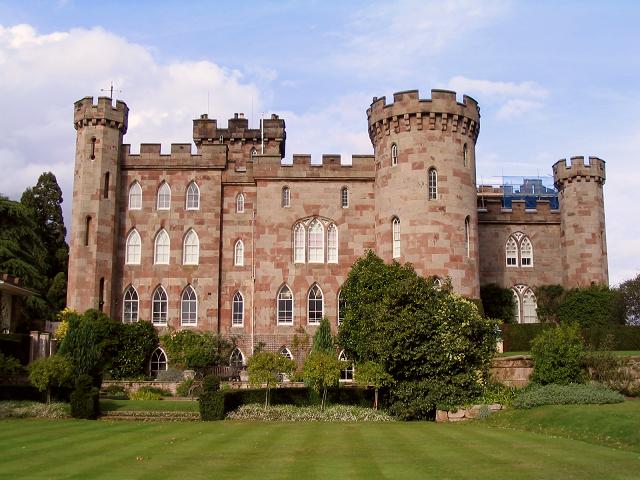
His sons and grandsons made Powderham Castle into another Courtenay (or sometimes spelled Courtney by this branch) stronghold in the southwest. It wasn’t really a castle in the usual sense, but a fortified manor house, on the flat lands where the river Exe broadened out before entering the sea. In fact, these flat, marshy lands, otherwise called a ‘polder’ (or ‘powder’) gave the settlement its name. The castle was built by Sir Philip in the 1390s, and maintained its basic form until significant rebuilding and landscaping in the 18th century. It was re-developed again in the 19th century, with a deliberate attempt to make it look more ‘castle-like’—with a very Victorian Gothic dining room which is a high point of a tourist’s visit still today. Since the mid-16th century it has been the main seat of the Courtenay family and the earls of Devon continue to reside here.

Powderham Castle (photo Raymond Cocks)
the heraldic fireplace at Powderham (photo Manfred Heyde)

In 1556, Sir William Courtenay of Powderham became head of the family, succeeding his by now quite distant cousin, the 1st Earl of Devon of the 1553 re-creation (aka the 11th Earl). But this claim was not put forward at the time, and none of the Courtenays of this line were recognised as earls until 1831, when an act of Parliament recognised Sir William retrospectively as de jure the 2nd Earl of the 1553 creation. At the time, however, his son William remained a commoner and served as an MP in the 1580s-90s—he was also involved in the plantation schemes for Ireland (to settle it with loyal Protestants), and was granted, in 1591, some of the lands of the defeated Irish lord, Gerald Fitzgerald, Earl of Desmond, including Desmond Castle in County Limerick. Over time, his descendants improved the estates here and built a new residence, ‘Newcastle’, sometimes called ‘Courtenay Castle’. By the late 18th century, the Irish lands—about 85,000 acres, the largest estates in Limerick—would bring the family £90,000 a year. There’s little left of their presence in Ireland, though: the new castle burned down in the War of Independence, circa 1920 (some of the ruins of the old castle were recently restored however), and the lands were sold off in the early 20th century. There remains a Devon Inn Hotel in West Limerick, and a Courtney’s Bar and Guesthouse across the border in County Kerry. Strange legacy of a French name from the Gâtinais!

The Courtenay legacy in County Limerick

Another William of Powderham was created baronet in 1644, as a supporter of King Charles I. He married an heiress of the Waller family of Devon, and took over their seat, the Jacobean manor Forde House, near Newton Abbot, since his own residence, Powderham, had been damaged during the Civil War. He threw a lavish reception here for William of Orange in 1688 shortly after he arrived at nearby Brixham, at the start of the Glorious Revolution. Once Powderham was restored in the 1750s, Forde House was let out to successive local families, and then sold outright in 1936. Today it serves as a conference and office space for the local council.

Forde House (photo Lobsterthermidor)

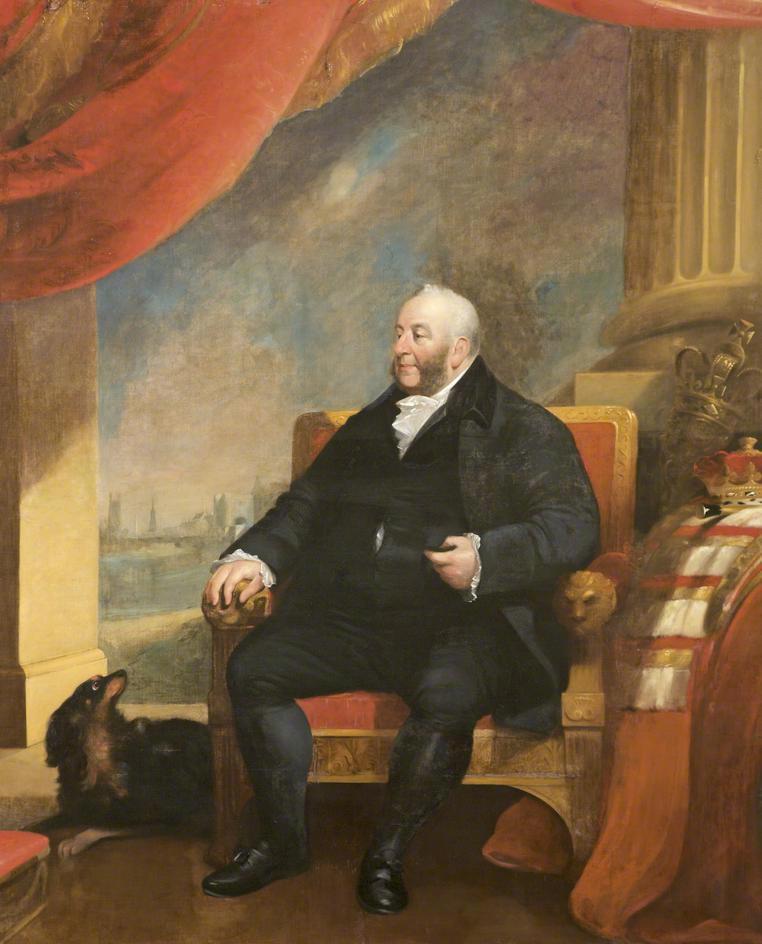
Another William, 3rd baronet, after serving as an MP for nearly 30 years was created Viscount Courtenay of Powderham (1762). It was with his grandson, the 3rd Viscount, that the story starts to get really interesting again. This William Courtenay, known as ‘Kitty’, became involved in a public scandal as a teenager in the 1780s due to his homosexual affair with an older man (the art collector and novelist William Beckford). He lived abroad after that, first in New York, then in Paris and a castle to the southeast of the city.

William, 3rd Viscount Courtenay (‘Kitty’), later Earl of Devon

By the late 1820s, aging and unmarried, he realised the viscounty would become extinct, and seems to have hatched a plan with his cousin and heir William—a former MP who had a fairly senior post in the Houses of Parliament and thus access to records and legal officials—to revive the family’s claims to the title Earl of Devon. Most legal scholars would have said that the earldom was long extinct, and indeed it had been re-granted to different people in the intervening three centuries: Charles Blount in 1603, and William Cavendish in 1618 (this earldom, and the subsequent dukedom, is usually referred to as Devonshire, not Devon, to avoid confusion). But William Courtenay convinced the House of Lords that the letters patent of 1553 created the earldom of Devon for all heirs male of the grantee, not just his direct descendants, and so therefore, any collaterals, however distant, could claim it. So, oddly, Kitty Courtenay, living in France for so many years, became entitled to call himself the 9th Earl of Devon in 1831, and when he died four years later, his cousin William became the 10th Earl and took up his seat in the House of Lords.

William, 10th Earl of Devon

William’s son William, the 11th Earl (known as the ‘Good Earl’ for his devotion to charities in Devon and working to bring the railroad to the Southwest), became a prominent politician in the Conservative governments of the 1860s. His younger brother had previously held a role at court, as chaplain to Queen Victoria in the 1840s, and later a canon at Windsor. After this generation, however, the family played little role in political or social life. Several younger brothers succeeded as earl (often already holding posts as clergy), and the 14th, 15th and 16th earls were all in a row—and died inconveniently close together, between 1927 and 1935, causing great financial hardship for the family in covering death duties in such quick succession. Charles, the 17th Earl of Devon, considered giving Powderham Castle to the National Trust, but backed out in 1957, opening up the house to tourism for the first time himself. His son Hugh, who was known as ‘Lord Courtenay’ for many decades before becoming the 18th Earl in 1998, did much to improve the estates: rearing cattle, improving the Exe waterfront and developing a shellfish business, and hosting large pop concerts in the restored gardens, including big-name performers like Elton John and Tom Jones. He was the last of the hereditary peers to make a ‘maiden speech’ in the House of Lords, before the rights of the hereditary peerage were modified in 1999. Charles Courtenay is the current Earl of Devon, having lived in Los Angeles where he practiced law and married an American actress, before he moved back to the UK on the death of his father in 2014.

Hugh Courtenay, 18th Earl of Devon (photo APEX)

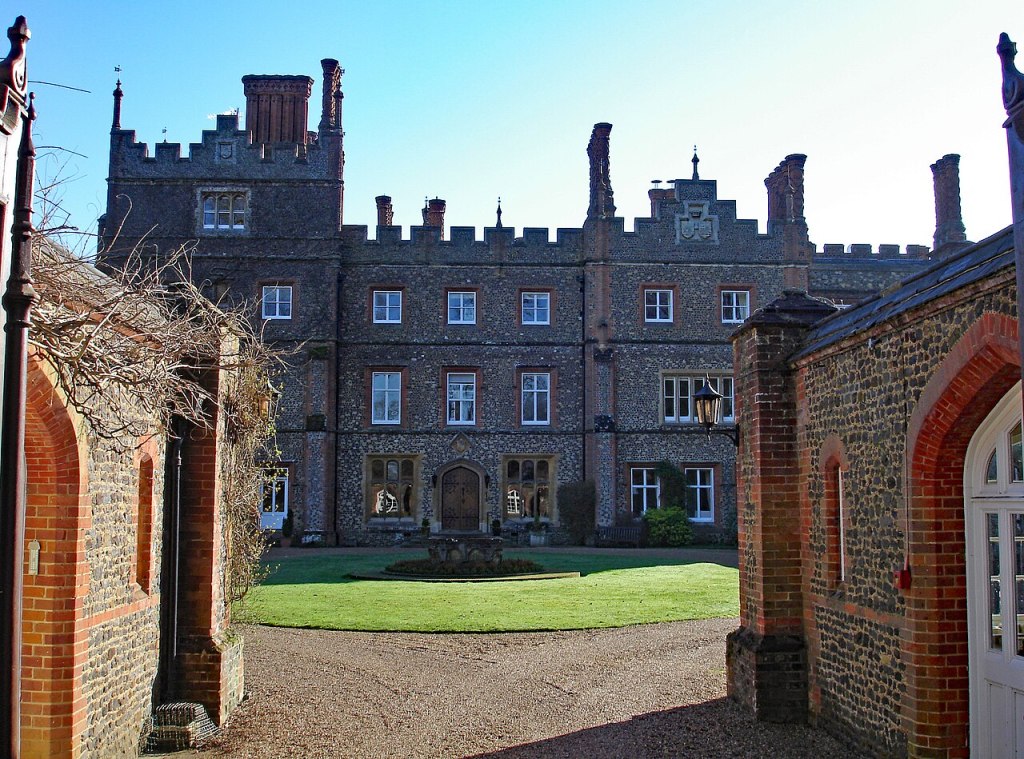
As a postscript, we can return to the name Sutton Courtenay, and to another manor across the river, Nuneham Courtenay, to underscore the extent of how much this family left its mark on various landscapes, even though they only held these lands for a short time. Sutton had been a royal residence in the middle Thames valley since the 7th century, with a nearby royal endowed monastery. For centuries it was in Berkshire, but with the boundary changes of the 1970s, it became part of Oxfordshire. The Courtenays were granted the manor by Henry II in the 1170s, but soon after they succeeded as earls of Devon in the 1290s it was sold to the Brunce (or Brouns) family, and from them to different families. It is still a private residence; across the street is the old rectory of Abingdon Abbey, which since the 1980s has housed a prominent new age spiritual retreat.

Sutton Courtenay (photo Jonathan A Jones)

Across the Thames is the village of Nuneham Courtenay. As ‘Newenham’ it was a manor of the Redvers family which passed to the Courtenays with the earldom of Devon. In the late 14th century it was sold to the Segrave family, and then passed through a number of eminent families, including that of Geoffrey Chaucer and later the La Pole dukes of Suffolk and Sir Charles Brandon. Finally, in 1710, it was acquired by the Harcourt family—an interesting coincidence considering they are the other great Norman dynasty who established long-lived branches on both sides of the Channel (dukes in France, earls in England). Today this property is owned by Oxford University, the gardens as part of the Botanical Gardens and the house (18th-century Palladian) occupied by the Brahma Kumaris World Spiritual University. The Courtenay name’s reach to the East now goes beyond Constantinople to India.


(images Wikimedia Commons)

Courtenay genealogy, simplified:

The Anglo-Dutch Moment: the Bentinck dukes of Portland

The year 1688-1689 has been called by historians the ‘Anglo-Dutch Moment’, as the year when the ideas of English and Dutch limited monarchy came together in the person of William, Prince of Orange: King William III. Over three centuries later, one family, the Bentincks, still benefit from this relatively brief merging of national interests. Hans Willem Bentinck was one of the leading supporters of William’s accession to the English and Scottish thrones; created earl of Portland, his son was elevated further as duke of Portland in 1716. The dukedom became extinct in 1990, but not the earldom, which, by the terms of its creation passed to a collateral branch which had continued to reside in the Netherlands in the 18th and 19th centuries. The English ducal branch added the historic name ‘Cavendish’ in the early 19th century, and one of its daughters, Nina Cecilia Cavendish-Bentinck, became the much lesser known grandmother of Queen Elizabeth II.

Hans Willem Bentinck, 1st Earl of Portland

The Dutch noble family Bentinck is one of the oldest in the Low Countries, based mostly in the eastern part of the country, in the provinces of Gelderland and Overijssel. They are not a ‘van’ family since there’s no place or castle with that name; instead the surname derives as a sort of patronymic from a probable early founder named Bento. The first documented ancestor is Johan or Jan Bentinck, who owned land in a region known as the Veluwe, a gentle hilly region that formed the northern part of the duchy of Gelderland (or Guelders). Its territory was sandy and marshy and full of woods and heath, so was often a preferred hunting ground for Dutch nobles. Het Loo, for example, has been a hunting lodge for the princely (then royal) House of Orange for centuries.

By the 15th century, the Bentincks were members of the Ridderschap, or noble estate, of the Veluwe, and in about 1502, divided into two main branches. The senior line became lords of Aller, and became extinct at the end of the 18th century. The junior line, lords of ‘t Velde, got a step up as its founder, Hendrick, acted as Steward of the lands of the Duke of Guelders in the Veluwe. His residence, Huis ‘t Velde, was an old moated manor house rebuilt by the Bentincks, located east of Warnsveld in another region of Gelderland, Zutphen. It was acquired in the late 17th century by the Van Keppel family (interestingly, rivals of the Bentincks in England), and today serves as a conference centre for the regional police service.

Huis ‘t Velde in the 18th century

Hendrick Bentinck ‘t Velde’s sons and grandsons married heiresses and founded several different branches that co-existed well into the 19th century (though interestingly some of them remained Catholic after the Reformation while others firmly embraced Calvinism). Another Hendrick shifted his branch’s centre somewhat to the north, acquiring the lordships of Diepenheim and Schoonheten in the 1630s, both in the province of Overijssel. This province, which for centuries was not independent, but property of the bishops of Utrecht, takes its name from the fact that it is across the River IJssel. It is made up of several districts, including Twente in the east (where Diepenheim is located), and Salland in the west (where Schoonheten is). Hendrick also took on the important post of Drost of Salland, sort of equivalent in English to a local sheriff or seneschal.

Schoonheten Castle has been, and remains, the main seat of the Bentincks in the Netherlands. There has been a moated manor house here, near the town of Raalte, since the 1380s. Hendrick Bentinck rebuilt and enlarged it in the 1630s. It was enlarged again in the late 18th century with the addition of an English-style garden. In the late 19th century it took on its modern appearance, as its white plaster walls were re-covered (on three sides) with red brick. The local town retains a memory of its long British connections, with a pub named the ‘Duke of Portland’.

Schoonheten today

One of Hendrick’s grandsons, Eusebius, carried on the branch of Diepenheim and Schoonheten in the province of Overijssel, and we will return to them later on; a younger son, Hans Willem (1649-1709), became a favourite and protégé of William III, Prince of Orange and Stadtholder of the Dutch Republic. In the 1670s, to get closer to the seats of power in the province of Holland, he acquired the lordships of Rhoon and Pendrecht. Both are located on a sandy island in the delta of the River Mass, just south of the city of Rotterdam. Rhoon Castle was built on a sandbank in about 1200, then rebuilt in the 1420s. It gave Hans Willem and his successors a seat in the local estates and house of lords of Holland. But it is no longer Bentinck property, having been sold to a local shipping family (Van Hoboken) in 1830.

Rhoon Castle

Hans Willem, Lord of Rhoon’s connections to England started earlier than the ‘Anglo-Dutch Moment’ of 1688-89. He had been appointed a page and chamberlain in the household of Prince William as a young man, and crucially, nursed him back to health after an attack of smallpox in 1675. Their intense friendship deepened from then, though the jury is still out over whether this developed into a sexual relationship. In 1677, he was sent to England to formally ask for the hand of Princess Mary, daughter of the Duke of York (and his first cousin), and a year later Hans Willem himself married an English woman, Anne Villiers, a cousin of the King’s favourite, the Duke of Buckingham. Her mother, Lady Frances Howard, had been governess of the princesses Mary and Anne, and Anne Villiers and her sisters (and a brother) accompanied Princess Mary to The Hague after her wedding to the Prince of Orange. Bentinck would later deliver important messages from William to his uncle (and now father-in-law) King James in the 1680s, and was key in organising ships and funds for William to mount his ‘invasion’ of Britain in November 1688. Once William and Mary were formally proclaimed king and queen of England, Scotland and Ireland, Bentinck was appointed Groom of the Stole (one of the most intimate court offices, in charge of the King’s private spaces within the palace), First Gentleman of the Bedchamber, and was given the titles Earl of Portland, Viscount Woodstock and Baron Cirencester. He served with William in battle in Ireland and in the Low Countries, then acted as ambassador to France, 1698, representing the King’s interests in the all-important question of the Spanish Succession.

the Earl of Portland, by Rigaud

But by this point, Portland had been supplanted as the King’s favourite by another Dutchman, Arnold van Keppel, and he resigned his court offices in 1699, and he mostly retired to his country estate at Bulstrode Park, though he did continue to carry out duties in the next reign, that of Queen Anne. The family’s prominence at court was maintained after his death by his second wife (Jane Temple), who was appointed governess of the daughters of the Prince of Wales (the future King George II), and by his son, the 1st Duke of Portland (below). Bulstrude Park is located in Buckinghamshire, not far from Beaconsfield (and surprisingly close to the M40 motorway!). This was a new house built in the 1680s by the Lord Chancellor, George Jeffreys, and soon after sold to Lord Portland. It was significantly altered by the 2nd Duke of Portland in the 1740s, and by his wife who transformed its gardens into one of the most famous botanical gardens of its day, renowned for its rare exotic plants. The 4th Duke sold Bulstrode Park in 1811, to the Duke of Somerset. His successor completely rebuilt the house in the 1860s, and it then passed to the Ramsden family who later sold it in the 1950s. Today it is in private hands and not open to visitors.

Bulstrode Park (rebuilt in the 19th century)

Hans Willem Bentinck’s eldest surviving son, Henry, carried on the family legacy as a chief supporter of the Whig political agenda in Britain—that is a limited, Protestant monarchy—and was therefore created 1st Duke of Portland by the new Hanoverian regime in 1716. William III had created many new dukes for this reason, so it seemed natural; plus, Henry Bentinck was now even wealthier than his father, as he had married a significant heiress, Lady Elizabeth Noel, daughter of the Earl of Gainsborough and heiress of Titchfield Abbey and its estates in Hampshire. His subsidiary titles created in 1716 included Marquess of Titchfield, to be used for the heir. The new Duke was named a Gentleman of the Bedchamber in 1717, and Governor of Jamaica in 1722, where he died in 1726.

Henry, 1st Duke of Portland

Titchfield Abbey had been founded by Premonstratensian monks in the 1220s, and was a frequent resting point for royalty travelling between London and Winchester—as well as the site of a royal wedding in 1445, between Henry VI and Margaret of Anjou. When the monasteries were dissolved in the 1530s, one of Henry VIII’s henchmen, er, courtiers…, Thomas Wriothesley acquired the property and converted it into a residence. By the 17th century it was known as Place House. The Bentincks did not hold on to it very long and sold it in the 1740s. It was soon abandoned and partly demolished. Today it is in government ownership and cared for by English Heritage.

Place House, aka Titchfield Abbey

Part of the reason for selling the Titchfield estate was the acquisition in the 1730s of a much more extensive portfolio by the 2nd Duke of Portland. In 1734, the Duke married the richest heiress of the day, Lady Margaret Cavendish-Harley (or Cavendish-Holles-Harley), the daughter of Edward Harley, Earl of Oxford and Mortimer and Lady Henrietta Holles, herself a major heiress. This double windfall of two generations of heiresses brought two major new properties from the Cavendish family, in Derbyshire and Nottinghamshire: Bolsover Castle and Welbeck Abbey. The Cavendish family, founded on Tudor wealth in the 16th century (Welbeck was of course another dissolved abbey) had been divided in the early 17th century into the Devonshire line and the Newcastle line—both of these were dukedoms and will be explored in a separate post for the mighty Cavendish family. The Newcastle line ended in the male line in 1690, and its chief heiress, Margaret, married the politician John Holles, Earl of Clare, for whom the Newcastle title was revived in 1694. When he died in 1711, his estates went to his daughter Henrietta who married another politician, Edward Harley, 2nd Earl of Oxford and Mortimer (son of the more famous first minister of Queen Anne), though the name Holles and the title Newcastle went to his nephew, Thomas Pelham. It was thus a Cavendish-Holles-Harley heiress who became the 2nd Duchess of Portland.

Margaret Harley, 2nd Duchess of Portland

To entangle the estates and castles of this vast and complicated succession, let’s start at the end and work backwards. The Harleys were a Herefordshire gentry family. In 1601, they acquired the mostly ruined castle of Wigmore in that county, the former seat of the mighty medieval Mortimer lords who used this castle in their defence of the borders between England and Wales. The Harley’s main residence was the more modern Brampton Bryan Hall (also in Herefordshire). At the 2nd Earl of Oxford and Mortimer’s death, Brampton Bryan passed to a collateral branch of his family, but I think (and happy to be corrected) that the Wigmore estate came to the Bentincks. Today it is a ruin, looked after by English Heritage.

Wigmore Castle ruins

The Holles succession might have included the very grand Wimpole Hall in Cambridgeshire, purchased by John Holles in 1710, but it was sold by his son-in-law the 2nd Earl of Oxford in 1740 to pay off debts. His daughter Henrietta Holles did, however, inherit the manor of Marylebone, then on the outskirts of London, and today reflecting past ownership in the names of its streets: Harley Street, Oxford Street, Henrietta Street, Wimpole Street, Wigmore Street (and Wigmore Hall); as well as Cavendish Square, Great Portland Street and so on. The Bentinck family vault was established in the parish church of Marylebone, first in a new church built in the 1740s, at the northern end of Marylebone High Street (demolished in 1949), and then in a newer church built by celebrated architect Thomas Hardwick in about 1815.

Henrietta Holles, Countess of Oxford and Mortimer
the ‘new’ church in Marylebone

It was the Cavendish succession in the north of England that was the most significant, and caused the family to take on the double-barrelled surname Cavendish-Bentinck by the end of the century.

The Portland cross quartered with the Cavendish stags’ heads

Bolsover Castle is associated most with the 1st Duke of Newcastle, so will be looked at more closely in a different blog post. It was a medieval fortress built to overlook the Scarsdale and the eastern edges of the Derbyshire dales (what today we might call the valley of the M1). Edward VI gave the crumbling ruins to George Talbot, 6th Earl of Shrewsbury; his son, the 7th Earl, sold it in 1590 to his half-brother, Sir Charles Cavendish (son of the celebrated Bess of Hardwick). Cavendish set about rebuilding the castle, more as a pleasure palace than a defensive structure, but it was his son, William, who turned Bolsover into the real gem we see today. The Duke of Newcastle was incredibly interested in the equestrian arts, and it has been exciting to see English Heritage restoring and recreating his horse riding school at Bolsover in the past two decades. The Portland family took over the property in the 1730s, but by the late 19th century rarely lived there, and in 1945, the 7th Duke gave it to the nation. It is one of the jewels in the crown of English Heritage.

Bolsover Castle

Much further to the north, Bothal Castle was part of the Ogle succession that had fallen to the Cavendishes by marriage in the 1590s. The Castle, fortified even before the Norman conquest, is located near Morpeth in Northumberland (north of the city of Newcastle). It was the seat of the Ogle family for about two centuries (created barons in 1461), then passed via Cavendish to Cavendish-Bentinck, who restored it in the mid-19th century. It is still a residence of the Bentinck family, though not open to the public.

Bothal Castle

The Cavendish property that became the main seat of the dukes of Portland was Welbeck Abbey. Located only a few miles east of Bolsover, it is across the county line in Nottinghamshire, and is one of the four ducal residences that gave the name ‘the Dukeries’ to this area (Portland, Newcastle, Norfolk and Kingston). It is frustratingly closed to visitors. Like Titchfield Abbey it was also built by Premonstratensians, in about 1140—and by the 16th century it was the head of this Order of monks. Over the centuries it was heavily endowed by noble families and by King Edward I. In 1538, the monastery was dissolved and given by the Crown to Richard Walley of Screveton, and was later purchased (1599) by the 7th Earl of Shrewsbury and resold in 1607 to his half-brother Charles Cavendish. It became the chief residence of the dukes of Portland after the sale of Bulstrode in 1811, and then significantly altered by the 5th Duke, as we shall see below. Much of the oldest parts burned in 1900 and were rebuilt. After World War II Welbeck was leased to the Ministry of Defence who operated an army training college there. In 2005 it returned to use as a private residence by the heirs of the last duke of Portland, the Anglo-Italian William Parente, Prince of Castel Viscardo. Only the garden centre and a newly built art gallery is open to the public.

Welbeck Abbey from the air

The 2nd Duke and Duchess of Portland were thus astronomically wealthy (though as per normal with the English aristocracy, their land holdings had very little to do with the actual place Portland, in Dorset). The Duchess, Margaret Harley, was better known than her husband, as a prominent ‘bluestocking’ (the name for a circle of women intellectuals in this period) famous for her botanical gardens and her museum at Bulstrode, noted above. The modern Harley Gallery at Welbeck is named for her. Just before she died, in 1786, the Duchess acquired one of the most famous pieces of glass in the world, a 1st-century Roman vase now known as the ‘Portland Vase’, deposited in the British Museum for safe keeping by her son the 3rd Duke, and finally sold to the Museum by the 7th Duke in 1945.

The Portland Vase

William Henry Cavendish-Bentinck, 3rd Duke of Portland carried the family line forward, and became its most famous politician. He stayed in the family tradition a supporter of the Whigs in government, and was named Lord Lieutenant (or viceroy) of Ireland, briefly, during the ministry of Lord Rockingham in 1782. In the next year, he lent his name to a Whig coalition led by Charles James Fox and Lord North as titular Prime Minister (actually First Lord of the Treasury) for 8 months—though significantly, it was during this year (1783) that his government signed the Treaty of Paris recognising the independence of the United States of America. Following the French Revolution, the Whig Party fractured, and those who were not in favour of such rapid liberal advances shifted to support the more conservative William Pitt, led by the Duke of Portland (these became known as the ‘Portland Faction’). The Duke served in Pitt’s administration as Secretary of State, Home Department, from 1794, and oversaw the Act of Union with Ireland in 1800. He was Lord President of the Council, 1801-1805, then a few years later (1807) took up the mantle once more of Prime Minister of the United Kingdom, again as a figurehead leader of a coalition of Pittites (Canning, Castlereagh, Perceval, etc). He resigned in 1809 due to ill health and died soon after. Besides the streets and squares in London bearing his family names, he also gave his name to Portland Inlet and Bentinck Channel along the coast of British Columbia.

William Henry Cavendish-Bentinck, 3rd Duke of Portland, by Thomas Lawrence

In the next generation, the 4th Duke, another William Henry, continued to hold high political office, as Lord Privy Seal in the administration of his brother-in-law George Canning, 1827, then Lord President of the Council in the administration of Canning’s replacement Viscount Goderich, until the government fell in early 1828. He was Lord Lieutenant of Middlesex for nearly a half century, and married a Scottish heiress, Henrietta Scott (so added another name to his surname), and purchased Fullarton House in Ayrshire, 1805, as his Scottish residence, and invested in the nearby port of Troon.

It was the 4th Duke’s younger brother, Lord William Bentinck, who was the more fascinating figure, however. Almost all the males in the family were named William (in honour of their original patron in England), but usually went by their second name; in this case he used William, while his older brother the Duke was William Henry, and his younger brother, William Charles, used Charles (see below). Lord William was appointed at a young age as governor of Madras in India, 1803-07, but was pulled back to Europe at the height of the Napoleonic wars and given command as Lieutenant-General of British troops in Sicily and representative of British interests on that island—notably to keep it out of the hands of Napoleon’s sister and brother-in-law, the Murats, now occupying the throne of Naples just across the straits. Lord William took it upon himself to encourage the liberal aspirations of the people of Sicily, much to the annoyance of their Bourbon king and queen, Ferdinand and Maria Carolina. Against the wishes of his own British government, he helped a group of Sicilian nobles take control of the court of Palermo in1812, forcing the King to abdicate in favour of his son Francis, and even introduced a liberal constitution (which, amongst other things, abolished feudalism…finally). In 1814, his superiors, supporting a full Bourbon restoration, sent him away from Sicily, north towards Tuscany where he was tasked with pushing out another of Napoleon’s sisters (Elisa) from her rule there. Again, he exceeded his orders and encouraged the locals to consider adopting a more liberal form of government, ie, not restoring the Habsburg grand dukes, and even preaching Italian unification—something that definitely would annoy Britain’s allies, Sardinia and Austria. He drove the French out of Genoa and restored its ancient republic (again, instead of returning it to the king of Sardinia, as instructed). He was recalled to Britain but surprisingly went unpunished. A decade later, he was sent back to India, first as Governor of Bengal, 1828, then as the first Governor-General of India, 1834-35. In this short time, he managed to modernise the government administration of Bengal and abolish the monopoly of trade enjoyed the East India Company. He criminalised the practice of sati (a widow’s self-immolation on her husband’s funeral pyre) and female infanticide; passed stronger laws against organised crime; passed the English Education Act (replacing Persian as the language of high courts); and founded the Calcutta Medical College. He died in Paris only a few years later. Fascinating.

Lord William Bentinck
an old postcard from Calcutta

Of the sons of the 4th Duke, the eldest, the Marquess of Titchfield, was expected to have a brilliant career, smart and well placed. But he died of a brain abscess before he reached thirty. The younger sons, Lord George and Lord Henry both became fairly influential members of the newly founded Conservative Party in the 1840s. But it was the second son, Lord John, who succeeded as 5th Duke of Portland in 1854, who captures the imagination of the most eccentric of the great aristocratic eccentrics of this period. Unlike most of his family, he had little interest in politics, and it soon became apparent that he didn’t like people at all. He became a famous recluse, retreating to Welbeck Abbey where he spent years constructing the most elaborate tunnel system—thought to be about 15 miles in total—connecting various parts of the house and the estate. The tunnels connected the main house to the kitchen gardens, stables and a large riding house—equipped with gas lighting! There was also gas lighting in the tunnels themselves, as well as some skylights. There were heated trucks to deliver food through the tunnels. There was a subterranean library and a grand billiards room. But the Duke did not entertain. Staff and tenants knew never to make eye contact if they happened to pass him. He communicated via letter boxes all over the house, but really only occupied a small apartment, sparsely furnished, in one corner of one of the largest houses in Britain. It was said that when he went to London, his carriage was put directly on the train so he never had to see anyone, and he rarely left his residence, Harcourt House on Cavendish Square. He died in 1879, and officially left no heirs, though there were rumours of children, and one sensational lawsuit kept society enthralled in turn of the century London whereby a Mrs Druce claimed the late Duke had led a double life as an upholsterer. Eventually several witnesses were charged with perjury, Mrs Druce ended up in an asylum, and London moved on to the next great news story.

John, 5th Duke of Portland

An interesting webpage about the Welbeck tunnels:

https://www.derelictplaces.co.uk/threads/welbeck-tunnels-notts-september-2016.33961/

By this time, the succession had moved on to a different branch of the family, and we come closer to the story of Queen Elizabeth II’s grandmother. At nearly 80 years old., the 5th Duke had outlived his two closest male heirs, his cousins Charles and Arthur. Their father, Lord Charles Cavendish-Bentinck, had scandalised society first by marrying an illegitimate daughter of the famous courtesan Grace Elliott—whose high profile lovers included the Duke of Orléans and the Prince of Wales who may indeed have been the father of Lord Charles’s wife. Shortly after this first wife (called Georgiana Seymour) died, Lord Charles eloped with his friend Sir William Abdy’s wife; they divorced; and Charles and Anne (herself an illegitimate daughter of the Marquess of Wellesley, the Duke of Wellington’s brother) married. Their eldest son, Charles (whose name was William Charles, but like his father went by Charles, and in fact signed his name ‘WCC Bentinck’), not thinking he would succeed to a dukedom, entered the church and became vicar for several parishes in Bedfordshire in the 1840s. He had no sons, but from a second marriage left three daughters: the eldest of these was Nina Cecilia, who seems to have preferred Cecilia, but I’d love to know for certain. She certainly has a colourful background in her grandmother and great-grandmother; and, via the Prince of Wales (King George IV) maybe even a drop of royal blood!

Cecilia Cavendish-Bentinck, Countess of Strathmore and Kinghorne, by Laszlo in 1931

In 1881, before she turned twenty, Cecilia Cavendish-Bentinck married Lord Glamis (Claude Bowes-Lyon), heir to the Scottish earldom of Strathmore and Kinghorne. The Lyon family were Angus landowners from the 14th century, created Baron Glamis in 1445, and Earl of Kinghorne (later adding Strathmore) in 1606. In 1767, the 9th Earl married Mary Bowes, the heiress of a wealthy London businessman, and the family name became hyphenated. In 1904, Claude and Cecilia succeeded as 14th Earl and Countess of Strathmore and Kinghorne, and raised their large brood of children (10) at Glamis Castle in Angus, or at estates in County Durham (Gibside Hall) or Hertfordshire (the enormous country seat of St Paul’s Walden Bury, between Luton and Stevenage). The Countess was known as one of the grand hostesses of the era, and her daughters entered high society, where the youngest of them, Lady Elizabeth, caught the eye of the Duke of York, and married him, in 1923. The future Queen Elizabeth II was born at the Strathmore home in Mayfair in April 1926. The rest of this story is well known.

The Countess of Strathmore at the wedding of her daughter to the Duke of York, 1923
St Paul’s Walden Bury, Hertfordshire

What is less well known, is that one of the most famous society patrons of the arts and bohemians of the early 20th century, Lady Ottoline Morrell, was Cecilia’s first cousin. She was the daughter of Reverend Charles Bentinck’s younger brother, Lieutenant-General Arthur Cavendish-Bentinck. Once her half-brother William succeeded as 6th Duke of Portland in 1879, she was granted the rank of a duke’s daughter, so entitled to be called ‘Lady Ottoline’, while her husband (married in 1902) was simply Mr Philip Morrell. For the first three decades of the 20th century, she was a literary hostess, a patron, and a protector of pacifists and conscientious objectors during World War I (like Lytton Strachey), notably at her home, Garsington Manor, in Oxfordshire. Her many friends and lovers included Aldous Huxley, Siegfried Sassoon, Dora Carrington, DH Lawrence (who may have modelled his Lady Chatterley on her), Virginia Woolf, TS Eliot, and on and on.

Lady Ottoline Morrell, looking fabulous

William Cavendish-Bentinck, the 6th Duke of Portland, had a more traditional aristocratic history: Master of the Horse under Conservative governments in the 1880s-90s, a Privy Councillor, and long-standing Lord Lieutenant of Nottinghamshire (from 1898-1939). He carried the crown of his cousin Queen Elizabeth at her coronation in 1937. Earlier, his wife Winifred had been a canopy bearer to Queen Alexandra at the 1902 coronation (wearing the famous Portland Tiara, stolen in 2018), and her Mistress of the Robes from 1913 to 1925. The Duchess was also an early animal rights activist and vegetarian. She persuaded her husband to devote significant funds to improving the lives of miners on his Nottinghamshire estates.

Winifred, 6th Duchess of Portland, by Singer Sargent, 1902

The 6th Duke did do something non-traditional, though he was in keeping with the changing times (and indeed the changing laws): in 1943, just before he died, he broke the entail on the Portland estates, since he could see that his grand-daughters would otherwise inherit nothing if the lands and titles stayed together and passed as usual to the next male heir (a distant cousin). These lands were estimated (in 2008, when the last of these grand-daughters died) as 17,000 acres in Nottinghamshire (roughly 3% of the county) and 62,000 acres in Scotland. The Duke was buried in St Winifred’s Church, Holbeck, on the Welbeck Estate, which he had built in the early years of the 20th century. It became the resting place of all of the 20th-century dukes.

William, 6th Duke of Portland

His son, William, 7th Duke of Portland, had been an MP for many years (officially as Marquess of Titchfield, but known as ‘Chopper’), and succeeded his father as Lord Lieutenant of Nottinghamshire (until 1962), and was also Chancellor of Nottingham University. He married a grand-daughter of the 6th Duke of Richmond, Ivy Gordon-Lennox, and they had two daughters. The eldest, Lady Anne, never married and lived at Welbeck Abbey and managed its vast estates until her death in 2008. After that, the house and lands passed to her nephew, the Prince of Castel Viscardo (which is in Umbria).

The titles, but not the lands, went to a distant cousin, Ferdinand Cavendish-Bentinck, who became the 8th Duke at age 89 in 1977. He was a descendant of Lord Frederick, the fourth son of the 3rd Duke. Lord Frederick’s two grandsons both had interesting marriages: one, to one of the aristocratic Livingstons of New York (and left daughters who remained there), and another to an illegitimate daughter of the Earl St Maur (heir to the Duke of Somerset), Ruth St Maur, a suffragette and socialist, and one of the founders of the Women’s Library in 1909. Ferdinand spent a long career as a senior colonial official in East Africa, mostly in Kenya, from the 1920s to the 1950s. He and his wife remained in Nairobi, even after he became duke, as there were no lands to inherit in England. In 1980, he was succeeded by his brother Victor, who was also in his 80s. The 9th and last Duke of Portland (who used his third name, William, or ‘Bill Bentinck’) had also had a long career, first as a diplomat in the 1920-30s (rising to be Ambassador to Poland in 1945), then in business, mostly focusing on repairing links between Britain and German industry. His diplomatic career had been cut short (apparently on the verge of being named ambassador to Brazil) because of a divorce in 1948, which in those days was still too shameful for society to handle. His son predeceased him in the 1960s, and with no male heir when he died in 1990, the dukedom ceased to exist.

Victor, 9th and last Duke of Portland

But not the earldom. We need now to travel back to the Netherlands, and back to the 18th century. The younger son of Hans Willem Bentinck, 1st Earl of Portland, unsurprisingly also named William, was sent back to the Low Countries in 1719 to maintain the family estates and to occupy the family seat in the Estates of Holland as Baron van Rhoon. He also retained lands in England as lord of the manor of Terrington in Norfolk, not far from King’s Lynn. He would play an important role in Dutch politics later in the century as one of the leaders of the Orangist party who helped re-establish the position of Stadtholder in 1747, and was a delegate for the Netherlands at the peace talks at Aix-la-Chapelle, 1748, that ended the War of Austrian Succession. But he was pushed out of politics in the next reign due to his personal animosity with Princess Anne of Great Britain, now Dowager Princess of Orange and Regent for her son, Willem V.

William Bentinck van Rhoon
Bentinck House in The Hague

In 1732, William Bentinck van Rhoon had been created Count of the Holy Roman Empire by Emperor Charles VI, to raise his rank so that it would be equal to his future bride, Countess Charlotte Sophie of Aldenburg. The Countess was the heiress of an Imperial county formed in the late 17th century out of fragments of the ancient county of Oldenburg (of which ‘Aldenburg’ was an older variant spelling), which had passed into possession of the House of Denmark on the extinction of its legitimate male line. The illegitimate son of the last Count of Oldenburg was given two Frisian lordships, Kniphausen and Varel, both on the North Sea coast on an inlet in the mouth of Weser, on either side of the future port city of Wilhelmshaven (not founded until 1869). The two lordships were joined together as a county by the Emperor in 1653. Charlotte Sophie inherited them and ruled as a semi-independent princess in 1738, but as her marriage broke down due to adultery, and her private life became too scandalous for Dutch society, she was divorced from Bentinck in 1744, and ‘deposed’ by her former husband in 1748, who then ruled the county of Aldenburg in the name of his sons.

Charlotte Sophie as sovereign Countess of Aldenburg

The twin ‘free lordships’ of Kniphausen and Varel were ruled as an autonomous county within the Duchy of Oldenburg by the Bentincks for the rest of the 18th century. Varel had been one of the ancient seats of the independent chiefs of the Frisians in the Middle Ages and its castle was expanded into a more palatial residence once the county of Aldenburg was established. The same is true for the castle further to the north at Kniphausen. Both castles were ultimately destroyed by fires: Varel in 1751 and 1817, then gradually dismantled, and Kniphausen in 1708, never rebuilt. Today’s castle at Kniphausen is a re-purposed former stables and is in private hands.

the castle of Kniphausen today

The French Empire built by Napoleon eventually extended its reach to the North Sea, and incorporated the County of Aldenburg in 1810. All of the various Dutch baronial lines of the House of Bentinck were confirmed as ‘barons de l’Empire’ in 1813, and when this fell, they were confirmed as barons of the new Kingdom of the Netherlands. But at the Congress of Vienna, 1815, the Count of Aldenburg was denied a restoration of his sovereignty (however miniscule) and became a vassal of the Grand Duke of Oldenburg. He contested this, and in 1818 was allowed a limited degree of sovereignty in Kniphausen and Varel, mostly concerning internal administration and external trade. But after a succession dispute between two brothers, Willem Gustaf and Jan Carel (the former of whom had married a local farmer’s daughter), the two properties were sold to the Grand Duke in 1854, for 2 million thaler.

Welcome to Kniphausen, with arms of Bentinck (with a crescent moon indicating a junior branch) and Oldenburg/Aldenburg with Varel and Kniphausen (and a princely bonnet and mantle)

The branch born ‘unequally’ moved to the United States and faded away. The younger branch added to their aristocratic lustre first in the Netherlands by incorporating the succession of the Reede-Ginckel family, earls of Athlone (created in 1692 for another one of William III’s generals, Godert van Ginckel van Reede; extinct 1844) by inheritance in the 1840s; then by gaining the lands of the counts of Limpurg-Gaildorf by marriage in the 1860s. They were elevated to the rank of ‘illustrious highness’ within the German aristocracy. In the Netherlands, they were now lords of Middachten, with its elegant palace and gardens on a bend in the River IJssel in the province of Gelderland (near Arnhem), and also of Amelongen and Ginckel, a bit to the west in the province of Utrecht. The church at Ellecom near Middachten became the burial place for this branch of the family. In Swabia, they inherited the lordship of Gaildorf, once part of the ancient imperial County of Limpurg (northeast of Stuttgart)—here they possessed an Old Schloss, built in the late 15th century, and later constructed a New Schloss, sometimes called the Bentinck Palace, which served as a summer retreat for the family until it was confiscated in 1918 (and now serves as the town hall).

Castle Middachten in Gelderland
Gaildorf, Old Schloss
Gaildorf, New Schloss, or Bentinck Palace

This Dutch-German branch, using the title, Count of Aldenburg-Bentinck (recognised formally by the Queen of the Netherlands in 1924), became extinct in 1968, and the headship of this branch passed to a senior line who had renounced it in the 1870s and moved to England. In 1886, they were permitted, by royal licence, to bear the title Count Bentinck in the United Kingdom. Count Henry Noel served in the British army in World War II, then became a producer for the BBC. In 1968 he became head of this branch of the family, and in 1990, at age 71, he succeeded his *very* distant cousins as 11th Earl of Portland, and his son Tim became ‘Viscount Woodstock’. Timothy Bentinck had already established himself as an actor, notably on the radio as one of the lead characters on ‘The Archers’. After 1997 he was entitled to call himself 12th Earl of Portland, as well as Count Bentinck von Aldenburg and Count of Waldeck-Limpurg. He has two sons who presumably will continue the line.

Tim Bentinck (12th Earl of Portland)

There are other Bentinck lines in England: another younger son returned to England in the 18th century to manage the estates at Terrington in Norfolk. William Bentinck of Terrington became a Vice-Admiral in the British Navy and was governor of the Caribbean island of St Vincent, 1798-1802. Due to his European family connections, he later served as an informal diplomat between Britain, Denmark and Russia and died at the court of St Petersburg in 1813. His descendants were also recognised as counts in the United Kingdom in 1886, then died out in 1938. There is still a Bentinck Arms pub in North Lynn, that served dockworkers in King’s Lynn in the early 20th century, many of whom were Dutch.

William Bentinck, of Terrington, by Romney
Bentinck Arms, North Lynn

And there’s more: the senior line of Bentinck van Diepenheim and Schoonheten were also confirmed as barons of the Kingdom of the Netherlands in 1814, but they had already sold the castle of Diepenheim in 1813 (today the private estate of the De Vos van Steenwijk family—cousins and neighbours of the Bentincks since the 15th century). One of these, Berend, moved to England in the 1830s. Two of his grandsons rose to prominence, one as an Admiral of the British Navy (Sir Rudolf Bentinck), and the other as a colonial administrator in South Africa. Both were permitted to use the title Baron Bentinck in the United Kingdom by George V in 1911. This was later rescinded in 1932. Today Gary Ramsay Bentinck (b. 1964) is, strictly lineally speaking, head of both English and Dutch baronial lines. He lives in Aberdeenshire. Meanwhile there are also still Dutch barons too, in various branches of Schoonheten, Bevervoerde and Buckhorst. In the 20th century, several of them served in high positions with the household of Queen Wilhelmina of the Netherlands (reigned 1890 to 1948), two as Chamberlain and two (father and son) as Master of the Horse. Others were diplomats, one as ambassador to Czechoslovakia and one as ambassador to France. There’s no danger of this family becoming extinct any time soon, always maintaining a foot in England and a foot in the Netherlands. We can continue to have our ‘Anglo-Dutch Moment’.

Diepenheim House, looking very Anglo-Dutch

(images Wikimedia Commons)

A Highland fling with the Dukes of Gordon

If you visit the northeast corner of Scotland, Aberdeenshire or the Moray Coast, you cannot help but bump into castles built or towns founded by some member of Clan Gordon. Today they are represented in the Scottish peerage by the marquesses of Huntly and of Aberdeen, but in the 18th century the clan was led by the dukes of Gordon, who, in the person of the famous 4th Duchess, were amongst the great political leaders of that very aristocratic century. As a hostess for the Tory party, she rivalled the Duchess of Devonshire—made famous in a recent film starring Keira Knightly—hostess for the Whigs. But there were only five dukes of Gordon, and after 1836, their titles merged with another great ducal family, the Lennoxes of Richmond, who, although primarily based at Goodwood in Sussex, also had Scottish roots, as their surname suggests. The Gordon properties are primarily represented by Huntly Castle, one of the major fortifications of the Highlands. At their height, the Gordons of Huntly were virtual kings of the North, a continual barrier to the unification of the Scottish Kingdom under the Stewarts in the 16th century.

George, 5th Duke of Gordon

The Gordons were not originally from the Highlands. The first to bear the surname appears in the 1150s, as lord of Gordon in the Merse, the low-lying part of Berwickshire in the borderlands between Scotland and England. It’s conjectured that he was a member of the Swinton family, one of the oldest noble families in all of Britain, with Anglo-Saxon roots in the Kingdom of Northumbria. Both families still have a similar coat of arms, with three boars heads. The village of Gordon (possibly from the Brittonic ‘great fort’) is still to be found in the Borders, not far from Kelso. They built a fortification nearby called Huntly. They were therefore a lowland family for the first two centuries, and became chief supporters of the medieval Scottish monarchy: Adam de Gordon was sent by King Alexander III to accompany King Louis IX as his representative in the 8th Crusade. His grandson Adam was a supporter of the cause of Robert the Bruce and appointed his ambassador to Avignon, charged with the delivery of the famous Declaration of Arbroath (1320) to the Pope, proclaiming Scotland’s independence, and subsequently killed defending this independence at Halidon Hill, 1333.

Soon after, in 1352, the Gordons were granted lands much further north, in the interior of Aberdeenshire, in the valley (or ‘strath’) of the river Bogie. This was a strategic territory connecting the southern parts of the Kingdom with the northern coast of Moray and beyond. A castle had been built at Strathbogie by the earl of Fife, around 1180. The lands were confiscated in the 1330s as its laird supported the rival to Bruce, John Bailliol. Eventually, the Gordons would become the dominant family of the northeast, and renamed Strathbogie castle Huntly in the early 16th century, after their original fortress down south.

Huntly Castle as it stands today

The family who developed Huntly Castle and who eventually became dukes were not in fact (strictly speaking in genealogical terms) Gordons. The next to last lord of Gordon, another Adam, was both baron of Huntly (Strathbogie) in the north, and baron of Gordon in the south, and Warden of the Eastern March (the lands around Berwick). He was killed in an invasion of England in 1402, and his son (also Adam) died a few years later in 1408, leaving a sister, Elizabeth, who was soon married to Alexander Seton. They had two sons: Alexander, who took the name Gordon and became the first earl of Huntly in 1449 (but retained the Seton crescent moons in his coat-of-arms); and William, who kept his father’s surname and founded another line of the Setons who eventually held the earldoms of Winton, Dunfermline and Eglinton.

the arms of the marquesses of Huntly, with quarters for Gordon, the lordship of Badenoch, Seton, and Fraser for the lordship of Aboyne

The Setons were an East Lothian noble house—supposedly descended from the counts of Boulogne, relatives of kings of Jerusalem, dukes of Normandy and counts of Flanders, established in Scotland in the early 12th century. Those who love Scottish history probably recall ‘Mary Seton’ as one of the four Marys who were the dependable companions of Mary, Queen of Scots. They held one of the oldest baronies in Scotland (1371). This is not their story. But it does give an interesting origin story in strict patrilineal descent to the later Gordons. Some lines of the original Gordon family did continue, notably the lairds of Kenmure (in Kirkcudbrightshire), who became viscounts in 1633 (for one of the pioneers of the settlement of Nova Scotia in Canada), and died out in 1847; and the lairds of Haddo (Aberdeenshire), an illegitimate line, who became earls of Aberdeen in 1682 (for Charles II’s Lord Chancellor for Scotland). These later rose to greater prominence in the 19th century, when the 4th Earl served as Prime Minister of the United Kingdom (1852-55); his grandson was Governor-General of Canada (1893-98), then Lord Lieutenant of Ireland (1905-15), and upon his retirement, was raised a notch to be Marquess of Aberdeen and Temair. As an interesting aside, the 2017 marriage of the 7th Marquess’s daughter, Anna Gordon to Sarah McChesney, is cited as the first lesbian marriage for the British aristocracy. Her brother is now the 8th Marquess and his heir is called the Earl of Haddo. Their seat is Haddo House, a Georgian Palladian mansion just north of the city of Aberdeen.

Haddo House

The formerly Seton, now Gordon, first earl of Huntly built up his territories in the Northeast with the acquisition of the lordship of Badenoch—a quite remote territory at the headwaters of the river Spey; the lordship of Cluny, west of Aberdeen; and the lordship of Aboyne, a bit further west in the Dee valley. Alexander Gordon was a strong ally of the Crown in its efforts to suppress the over-mighty Clan Douglas in the 1450s. The Earl’s heroics in helping to defeat them earned him the nickname ‘Cock o’ the North’, a nickname which has ever since been applied to every succeeding head of the clan (and is the name of Clan Gordon’s piping tune still today). When he died in 1470, he was buried in princely style in Elgin Cathedral, on the north coast, which would remain the family burial spot, even long after the building ceased to be a cathedral, its roof removed, and its central tower collapsed.

the tomb of the 1st Earl of Huntly, Elgin Cathedral
Elgin Cathedral ruins today. The Gordon Chapel is in the closest corner at this angle, with tombs all the way up to the last dukes

Another interesting sideline of the Gordon family at about this point in their history was the takeover (in genealogical terms) of the House of Sutherland by the House of Gordon, in 1514. The earldom of Sutherland is the oldest in Scotland (1230)—this family also claimed to be originally from Flanders, and established themselves as the main power in the far north (Caithness and Sutherland—the most ironically named place in Britain). The Gordon-Sutherland line eventually passed to the House of Leveson-Gower, who became dukes of Sutherland in the 19th century, with their fantastical castle at Dunrobin, so their story will be told in a separate blog post.

By the mid-16th century, the Gordons were one of the chief allies of the Crown in the North. Their local rivalries were exacerbated by the Reformation, as they remained Catholic, and the Forbes family, with whom they already had a long-running clan feud, adopted the new Reformed faith. This story already has Game of Thrones overtones with the Earl of Huntly as ‘Cock o’ the North’, but there would be further echoes with the famous ‘red wedding’ type scenario at the Forbes’ Druminnor Castle (not far from Huntly) in 1571, during which 20 Gordons were killed. This was followed by an open battle in which 27 Forbeses were slaughtered at Corgarff Castle.

a wonderful ancient recording (1906!) of the Gordon piping tune, ‘Cock o’ the North’

Huntly Castle was increasingly enlarged as the family took on more ‘princely’ airs, but this led to conflict, first with their former ally (as staunch Catholics), Mary Queen of Scots in the 1560s, and then with her Protestant son (still being fervent Catholics) James VI in the 1590s. Yet, they continued to rebuild, and George Gordon, 1st Marquess of Huntly, turned the castle into a genuine fortified palace, with extra wings for visitors and servants, and proclaimed his new status boldly with huge lettering across the front of the building.

the bold lettering at Huntly Castle

The 1st Marquess had initially been a great favourite of James VI and married one of his cousins, Henrietta Stuart of Lennox. He had tentatively adopted the new Presbyterian faith of his king, but ultimately his family motto, Bydand (‘biding’ or ‘steadfast’) seems to have pulled him back to his loyalty to the Catholic Church. After a short rebellion, 1593-94, his friendship with the King was nevertheless restored, he was named Royal Lieutenant of the North, and raised to his marquessate in 1599. He and his wife would remain devoted servants to King James and to his son Charles I for the next 30 years.

But the grand palatial status of Huntly Castle once again became a target, this time to Covenanters during the Civil Wars, and following the execution of the 2nd Marquess of Huntly—also called George, an able Royalist cavalry commander—in March 1649, the castle’s defences were slighted and it was mostly abandoned. The later dukes of Gordon developed the town of Huntly in the 18th century (with a modern grid pattern), and its flax industry, but they did not reside in the now ruinous castle. Their successors, the dukes of Richmond and Gordon continued to own the land until the 1930s, and had already given the castle to the state in 1923—today it is in the care of Historic Environment Scotland.

George Gordon, 2nd Marquess of Huntly

Following the execution of the 2nd Marquess of Huntly in 1649 and the death of his son and successor the 3rd Marquess in 1653, another George Gordon, the 4th Marquess, turned his attentions further south. As was tradition, he had been sent to France for a Catholic education, then served in the French armies under the greatest commander of the age, Turenne. He then returned to Britain and the court of King Charles II, where he married Lady Elizabeth Howard, daughter of the Duke of Norfolk—an alliance of the two grandest Catholic houses in England and Scotland. The dukedom of Norfolk had been restored to the Howards during the Restoration, and Charles also began rewarding some of the great Scottish supporters of his reign with this top title in the peerage: Maitland in 1672, Leslie in 1680 (not counting those dukedoms being created for his bastard sons). In November 1684, both the Gordons and the Douglases were also made dukes, of Gordon and Queensberry, respectively. I suspect the Gordon dukedom was created with the aim of balancing the Scottish peerage with at least one openly Catholic duke. The next year, King Charles was dead, and the Catholic James VII and II was glad to have a Catholic ally in Scotland—the Duke of Gordon was appointed Constable of Edinburgh Castle, a Commissioner of the Scottish Treasury and a founding Knight of the Order of the Thistle. But his loyalty was not very durable (or Bydand), and when the Glorious Revolution swept James from the throne in 1688-89, Gordon only weakly held Edinburgh for him for a short time, then joined James in exile in France. He soon returned to Britain, and by the reign of Queen Anne (1702-14) had regained some favour at court. He was, however, arrested in 1707 as a Jacobite sympathiser—his daughter was married to the head of the exiled Jacobite court, the Duke of Perth; his son took part in the Jacobite rising of 1715—and he died in disgrace at his residence in Leith in 1716.

the 4th Marquess of Huntly before his promotion to 1st Duke of Gordon

The son, Alexander, now 2nd Duke of Gordon, was pardoned by the new king, George I. His life was fairly short, and he was succeeded in 1728 by his eldest son Cosmo, who was still a child. His name is said to come from Cosimo, Grand Duke of Tuscany, who was a supporter of the Old Pretender (‘James III’), now in exile in Italy.

Cosmo George, 3rd Duke of Gordon

The family continued to have mixed feelings about its support for the Jacobites. The 3rd Duke married a Gordon, granddaughter of the Earl of Aberdeen who arrested his father during the ’15; and his sister married that same Earl’s son. Their brother, Lord Charles Gordon led government troops against the forces of Bonnie Prince Charlie in the second Jacobite rising in 1745. In sharp contrast, Lord Lewis abandoned his post in the Mediterranean fleet to join the Prince’s war council, and was instrumental in recruiting hundreds of men (sometimes by force) from his family’s vast estates for the Jacobite cause (one source says Gordon tenants and associates supplied about a quarter of the entire Jacobite army in the ’45). The Duke himself did not commit to the Jacobite cause, but he delayed in his formal condemnation of his brother’s and his tenants’ actions. The Jacobites were defeated at Culloden in April 1746; Lord Lewis escaped and died in France. The 3rd Duke also died soon after, in 1752, at only 32 years old. Only the youngest brother, Lord Adam Gordon lived a long, full life, rising through the ranks of the army as commander of the Royal Scots regiment to become Commander-in-Chief for Scotland in 1789, and governor of Edinburgh Castle in 1796.

Lord Lewis Gordon
Lord Adam Gordon

Alexander, 4th Duke of Gordon, at age 9 was one of the largest landowners in all of Great Britain. As an adult, he entered politics, and to ensure he had a seat in the British House of Lords (and not just as one of the few representative peers for Scotland), he was given a barony in 1784 in Gloucestershire, named for the small village of Huntley in the Forest of Dean, which in reality had no connection to the Gordon family. He was also given the earldom of Norwich, in Norfolk, which similarly had little connection to the family (though perhaps recalled his family’s former connection to the Howards of Norfolk). He played a moderate role in politics (especially compared with his wife), but for many years served as Keeper of the Great Seal of Scotland.

the 4th Duke of Gordon

The 4th Duke also re-fortified his position in Scotland by aggrandising his ducal seat: this had shifted away from the now crumbling Huntly Castle and instead was some miles to the north at Gordon Castle, near the mouth of the River Spey. A typical Scottish tower house had been here since the 1470s, built by the 2nd Earl of Huntly. In the 1770s, the 4th Duke had the original castle enveloped within a new central block and added two wings, making it one of the largest country houses ever built in Scotland. With the rising costs of running a country house, and mounting death duties, it became impossible for the Gordon-Lennox family to sustain two ducal seats (here and at Goodwood), so Gordon Castle was sold in 1938 to the Crown Estate. After the Second World War, however, Sir George Gordon-Lennox (a grandson of the 7th Duke of Richmond and Gordon) repurchased the estate, and decided to demolish much of it to create a more manageable country home. Today the tower remains and one of the wings, but it is not open to visitors; the nearby walled garden is, however, and it is stunning.

Gordon Castle in 1911

As he got older, the 4th Duke of Gordon retreated from politics to his new country house—here he developed a new breed of hunting dog, the Gordon Setter. It was his wife, born Jane Maxwell, who became one of the leading forces in British politics of the 1780s, as the chief society hostess for the Tory Party at houses she and her husband rented on Pall Mall, then on St James’s Square in London. She is credited with making Scottish culture fashionable, its music and its dress, after it had been formally banned after Culloden. In 1794, she and her husband raised the famous Gordon Highlanders Regiment—though she was criticised, like her rival the Duchess of Devonshire, for using her feminine charms to recruit men for service. Jane shocked society by having fairly open affairs, but so too did her husband, living apart from her far away in northern Scotland. Yet she was quite successful socially, in marrying off three of her five daughters to dukes. One of these was Charlotte, Duchess of Richmond, who famously hosted the Waterloo Ball in Brussels in 1815, and ultimately would be the heiress of the Gordon estates.

Jane, 4th Duchess of Gordon
one of the many political cartoons featuring the Duchess of Gordon by James Gillray. In this one she is trying to harness the duke of Bedford for one of her daughters

The 4th Duke’s younger brothers also led shocking lives, in different ways. Lord William was the dashing young soldier—as portrayed in the book and television mini-series The Aristocrats, about the Lennox sisters (one of my favourites)—who seduced the already married Lady Sarah Lennox, eloped and had a child with her, then abandoned her for new adventures. His brother Lord George was even more interesting, at first leading a crusade against the proposed Catholic emancipation bills (the family was by now Protestant) that led to a riot in London in June 1780. The ‘Gordon Riots’, after trying to force their way into the Commons, instead turned to burning Catholic chapels, setting fire to Newgate Prison, and attacking other public buildings, were eventually put down by the army, leaving hundreds killed or wounded. Lord George was charged with high treason and put into the Tower, but was acquitted. After getting into difficult entanglements with the Anglican Church and the Court of France (for defaming Queen Marie-Antoinette), he settled in Birmingham where he converted to Judaism and gained followers amongst the ultra-orthodox who considered him a new Moses, come to deliver his people. As Yisrael bar Avraham, he was arrested (the scandal against the French queen having caught up with him), and he spent the next few years in Newgate Prison where he died in 1793.

Lord Charles Gordon, with The Protestant Petition
another political cartoon, this one of ‘the Birmingham Moses’

Jane, Duchess of Gordon, died in 1812; her husband, the 4th Duke then married his long-term mistress, also called Jane, in Fochabers, the town he built next to Gordon Castle. He died in 1827, and passed his vast estates and many titles to his eldest son, George, 5th Duke of Gordon. He had lived most of his life as the ‘Marquess of Huntly’, and rose to be a general in the British army, commanding the Highlanders in the Revolutionary Wars. After his father’s death, he succeeded him in his posts as Keeper of the Great Seal of Scotland and Governor of Edinburgh Castle. His wife was Mistress of the Robes to Queen Adelaide from 1830. As a political conservative, the 5th Duke opposed the Great Reform Bill of 1832, but when he died in 1836, he left a huge fortune to his widow, born Elizabeth Brodie, who had very different ideas. Known as ‘the Good Duchess’, she was the founder of schools and charities all over Scotland. She also became a pillar of the new Free Church of Scotland, an evangelical split from the Church of Scotland, and funded the construction of a new church in Edinburgh. She also built a new school and Gordon Chapel in Fochabers with some of the most beautiful stained glass windows in Britain. She lived to a ripe old age and died in 1864.

George, 5th Duke of Gordon
Elizabeth, 5th Duchess of Gordon, who lived long enough to enter the age of photography

The death of the 5th Duke of Gordon without any legitimate sons (he did have illegitimate children, including the portrait painter and Australian pioneer Georgiana McCrae), meant that the dukedom of Gordon became extinct (and the British titles of Norwich and Huntley). The title marquess of Huntly passed to the next male heir, from the distant line of the earls of Aboyne (branched off in the 1660s), while the estates passed to his eldest sister, Charlotte, the Duchess of Richmond. Their son took the name Gordon-Lennox, and their grandson, the 6th Duke of Richmond, was re-created Duke of Gordon in 1876 (in the peerage of the United Kingdom, not of Scotland). See the dukes of Richmond for their story.

The head of clan Gordon today is thus the 13th Marquess of Huntly (b. 1944), who lives at Aboyne Castle—a 13th-century castle built near the River Dee, rebuilt in the 17th and 18th centuries, but nearly derelict until restored by the family in the 1980s. There are numerous other branches of the family; some held baronetcies (including Gordonstoun, whose castle now houses the world-famous school outside Elgin), but these are all, with one exception, either extinct or dormant. There are also untitled branches—one of these, Gordon of Gight, ultimately produced the famous poet Lord Byron, whose mother was heiress of the Gight estates in Aberdeenshire (George Gordon Byron).

Aboyne Castle, today’s seat of the Marquess of Huntly

The dukedom of Gordon may have been subsumed into another ducal family, but we still have Gordon tartan, Gordon Highlanders (though merged in the 1990s with the Queen’s Own Highlanders), and Gordon piping tunes.

today’s Marquess of Huntly, wearing the Gordon tartan

(images Wikimedia Commons).

The House of Lancaster in Portugal: Dukes of Aveiro and Abrantes

Lancaster is a very English place name, and the name used by dynastic historians for one side of the epic struggle for the English throne known as the Wars of the Roses. Curiously, as ‘Lencastre’ it is also a surname used by one of the few Portuguese noble families to hold ducal rank. Aveiro was one of the only dukedoms created in Portugal in the 16th century, based on a town in the north of the Kingdom; a century later, another Portuguese town, Abrantes, also gave its name to a dukedom. But the story is more complex, as the dukedom of Abrantes was created by the king of Spain in his efforts to keep a hold over the Portuguese nobility; another dukedom of Aveiro was created in Spain for a similar reason (to little effect). The Spanish dukedom of Abrantes continued to be held by the Lencastre family (now spelled Láncaster in Spanish), though the estates were held by a different family, and the dukedom was re-created for them by the King of Portugal later in the 18th century. So there were two dukedoms of Aveiro and two dukedoms of Abrantes. Portuguese and Spanish. To add even more confusion, there is also a Napoleonic duchy of Abrantès, created for a French general in the early 19th century. Today the Casa de Lancastre e Távora continues to bear this very English-sounding surname in Portugal.

The Coat of Arms of the Lencastre family: Portugal with a bend for illegitimacy

How did the name Lancaster get to the Iberian Peninsula in the first place? In 1387, Philippa of Lancaster, eldest daughter of John of Gaunt, Duke of Lancaster, married João I first king of the Avis dynasty that had re-asserted Portuguese independence from Castile only two years before at the Battle of Aljubarrota, with support from England. In 1386, England and Portugal signed the Treaty of Windsor, which created an alliance which is considered the oldest still extant alliance in the world. John of Gaunt soon arrived, but not just to help his new son-in-law: he also brought an army to try to assert his own claims to the Castilian throne, which he claimed in the name of his second wife, Constance of Castile, daughter and heir of King Pedro I. By the time of Philippa’s marriage in 1387, however, her father’s troops had been pushed out of Castile, and his wife had renounced her claims (in return for a sizable payoff) and her daughter Catherine of Lancaster married her rival’s son, the Infante Enrique (the future King Henry III of Castile). So by 1390, there were two Lancastrian women on the thrones of the Iberian kingdoms: Philippa in Portugal and Catherine in Castile. The Castilian descent from John of Gaunt in the House of Trastámara would, interestingly, return to England 100 years later in the person of Catherine of Aragon (or, more properly, Catherine of Castile and Aragon), whose claims to the English throne, it could be said, were better than those of her husband, Arthur, prince of Wales (and later his brother King Henry VIII), a descendant of John of Gaunt’s illegitimate children with Katherine Swynford.

The wedding of Philippa of Lancaster and João I of Portugal

John of Gaunt’s older daughter, known as Filipa de Lencastre in Portuguese, helped her husband King João launch Portugal’s golden age, in part by producing an army of royal children known to history as ‘The Illustrious Generation’ (most famously, Prince Henry the Navigator). When she died in 1415, her surname might have died with her, but for the tradition of extending maternal names, especially to daughters, that was prevalent in the Iberian kingdoms. Philippa’s daughters were fully royal, so they were never known by anything but ‘of Portugal’ as a surname. But in the next generation, the daughters of Philippa’s sons, this practice emerged. The two daughters of her second son, the Duke of Coimbra, both used this name: Isabel de Lencastre (or sometimes de Coimbra) was herself Queen of Portugal through marriage to her cousin Afonso V in 1450, but died soon after, leaving behind a son, King João II. Her younger sister, Filipa de Lencastre, never married and raised young João as her own. Like her namesake and grandmother, she was seen as a model of royal womanhood, pious and wise, and when João II had a son of his own, Jorge, in 1481, it is said he wished to honour these women by giving him the surname ‘de Lancastre’ (or sometimes ‘Alencastro’ to contemporaries)—though usage of this name didn’t really start until the next generation—as well as the title of his illustrious maternal grandfather, the Duke of Coimbra. I wonder, purely speculatively, whether King João had also taken note of events in England where, since 1471, the legitimate line of Lancaster had become extinct—maybe the use of this name was a subtle suggestion that his son could one day challenge the usurping House of York?

Isabel de Lencastre, Queen of Portugal

The trouble was, Jorge was illegitimate. His mother was Ana de Mendoza, a maid of honour of the King’s sister, Infanta Joana; she later became Commandress of the Monastery of Santos in Lisbon (a monastery we will encounter again later in this post). The King tried to legitimise him, but was blocked by the Pope (and by his own queen, Leonor), so instead he granted him two of the highest positions in Portugal, the grand masterships of both the Order of Avis and the Order of Santiago (the Portuguese branch). He agreed to not challenge the succession of his first cousin, Manuel, with the promise that the new king would give his illegitimate son the dukedom of Coimbra and marry him to a royal princess. King Manuel delayed as much as he could, not wishing to set up such a powerful rival, but did re-create the royal dukedom of Coimbra in 1500 (though not formally confirmed until 1509), and married him to a Bragança, so, not quite royal, but close enough.

a poor quality image of Jorge de Lencastre, Duke of Coimbra

As part of the dukedom of Coimbra, Jorge was also lord of Aveiro, a small port town on the northern coast. It oversaw the trade in and around the large Lagoon of Aveiro and its important salt pans. Young Jorge had been raised in a convent here, but was later taken to the town of Abrantes, in central Portugal, where he was looked after by the local commander of its castle (alcaide mor), Lopo de Almeida, 1st Count of Abrantes. Remember the name Almeida in the context of Abrantes, as we’ll encounter it again later. The castle of Abrantes had been conquered from the Moors by Afonso Henriques, first independent king of Portugal, in 1148 shortly after he had retaken Lisbon. Its name is thought to derive from the Latin aurantes, referring to gold found in this region.

the Castle of Abrantes

Another lordship he held was that of Torres Novas, in the centre of the Kingdom, where a huge fortress had been built overlooking the Tagus valley with its confluence with the river Zêzere, one of the most important rivers flowing down from the north. A tower has existed here since Roman times, and ‘new towers’ were built following the re-conquest of the 12th century. As an important crossroads for the Kingdom, Torres Novas had in the past served as a meeting place for the Portuguese Cortes, a space for royal weddings, and the proclamation of regency governments.

the Castle of Torres Novas

Jorge, Duke of Coimbra, Lord of Aveiro and Torres Novas, Master of the Orders of Santiago and Avis, lived peaceably with his royal cousin, Manuel, though he established a sort of loyal opposition court at his seat in Palmela, the headquarters of the Order of Santiago, the source of his political power and wealth. The Order, sometimes referred to as ‘Santiago of the Sword’ to distinguish it from the Spanish branch (they had been separated in 1288), had been based at the castle of Palmela since 1210. Located south of the Tagus estuary (across from Lisbon), the Castelo de Palmela was one of the most impressive castles in Portugal and the site of much of its military and political history in the Middle Ages. It dominated the Setúbal Peninsula, which was where most of the Order’s lordships (called commanderies) were located, being described by some as almost a state within a state.

the Castile of Palmela

As such, the Order of Santiago was a threat to royal power, and King Manuel wished to take it over, as the Spanish kings had already done to their branch—as a source of great wealth and influence—and continually chipped away at the Duke of Coimbra’s power (in part by luring away some of the most prominent knights, like Vasco da Gama and Dom Francisco de Almeida, the first viceroy of Portuguese India—one of the sons of Lopo de Almeida and thus an early contact from Coimbra’s childhood, and a painful loss to his clientele network). Finally, at Jorge de Lencastre’s death in 1550, Manuel’s son, João III, managed to get a bull from the Pope appointing him personally as Grand Master of the Order. He was also appointed Master of the Order of Avis, and was already Master of the Order of Christ, so from this point on, all of the formerly independent military orders in Portugal were united with the Crown.

The rivalry thus continued in the next generation. King João III and João de Lencastre challenged each other in both political and social spheres. The latter was created Marquês de Torres Novas in 1520 as a gesture of peace by King Manuel before he died, but was imprisoned shortly thereafter by King João and held for nine years, on dubious charges. Nevertheless, he was given tasks of great honour to undertake on behalf of the monarch: in 1539 he was sent to the court of Charles V to offer condolences on the death of Empress Isabel (the King’s sister); and in 1551, he was sent to Spain to formally escort the Infanta Juana to Portugal for her marriage to the Hereditary Prince, Dom João Manuel. But by 1551, Lencastre’s father had died and it was clear that his semi-royal title of Duke of Coimbra would not be continued. Instead his lordship of Aveiro was raised to a dukedom—exactly when is uncertain (and it is clear that the King delayed as long as possible); some sources say as early 1530 or 1535, but certainly by 1547, perhaps as a wedding gift from the King on the occasion of Dom João’s marriage to Juliana de Meneses. And although he was not allowed to succeed to his father’s post of Grand Master of Santiago, the 1st Duke of Aveiro was allowed to retain some of the Order’s more lucrative commanderies, notably Setúbal and Azeitão.

Arms of the Duke of Aveiro

In the 1520s-30s, Duke Jorge and his son built two summer residences in the town of Setúbal and its suburb Azeitão. This area south of the city of Lisbon, on the Atlantic coast at the mouth of the river Sado was becoming increasingly fashionable by the Portuguese aristocracy as a place to build homes to escape the summer heat of the capital.

an 18th-century map of Portugal showing the mouth of the Tagus and to the south the Sado Peninsula.

At first the favoured residence was close to the port of Setúbal, a town made rich on the trade of salt pulled from the marshy flats in the grand estuary of the Sado. The palace of the Duke, as Grand Master of Santiago, was next to the ancient church of São Julião, used as his private chapel (and Juliano/a would become an important name for the dynasty). The church was rebuilt in Manueline style in the 1510s, and although the palace was completely demolished in the 18th century, the main door of the church survives in this distinctively Portuguese style (while the rest was rebuilt in a more baroque fashion).

the main doorway of the church of São Julião, Setúbal

Across a small range of hills from the coast and the harbour of Setúbal, a monumental palace was built in Azeitão, with a grand central block and two wings, all in a Mannerist late Renaissance style. Soon known as the Palace of the Dukes of Aveiro, the building would become the main residence of the dynasty by the end of the century (a period when most of the aristocracy abandoned Lisbon for the countryside altogether), and the third duke embellished it with the now emblematic Portuguese blue and white tiles. In the 17th century, Azeitão would be the seat of the duke, while Setúbal would be used by the heir. Unlike the palace in Setúbal, this building alone would be spared the destruction of the family’s assets in 1759 (see below), though it was looted and never regained its former grandeur. Today it remains in private hands, but looks like it needs a bit of a makeover.

Palace of the Dukes of Aveiro at Azeitão

After 1550, the Lencastre family did not lose its hold over the military orders of Portugal entirely. The Duke of Coimbra / Grand Master of Santiago had several sons, and he had appointed the second and third to the office of Comendador-Mor (Grand Commander) of the orders of Santiago (for Afonso) and Avis (for Luis). Both of these posts became more or less hereditary (though formally always having to be reconfirmed by the monarch) for their descendants, whom we will meet again below. A fourth son, Jaime, became one of the first Inquisitors in Portugal and later bishop of Ceuta (with the accompanying very grand title ‘Primate of Africa’); while two of his daughters headed important convents, Helena at the Monastery of Santos, formerly held by her grandmother, and Filipa at São João in Setúbal.

The first Duke of Aveiro died in 1571, leaving this title to his son, Jorge II. Jorge and his younger brother, Pedro-Dinis, Lord of Porto-Seguro, were both avid companions of the new young king, Sebastião (Pedro-Dinis was appointed his Mordomo-mor, head of the household), and accompanied him in wars of conquest in North Africa, first in 1574, and then Jorge II alone (Pedro-Dinis having died young in 1575) in 1578. The King, the 2nd Duke of Aveiro, the Duke’s cousin Jorge de Lencastre (and Jorge’s sister’s betrothed), and much of the flower of the Portuguese nobility were all killed at the disastrous Battle of Alcácer Quibir (or al Quasr al-kibr), 4 August 1578.

a near contemporary engraving of the Battle of Alcácer Quibir

The 2nd Duke left behind an only child, a daughter, Juliana, who at 18 (approximately) wished to maintain her independence as 3rd Duchess of Aveiro, but was forced in 1588 by the new king of Portugal to marry her cousin, the male heir, Dom Álvaro. He was the son of Afonso the Comendador-Mor of the Order of Santiago (who passed this post on to the youngest son, Manuel (and his daughter became another Commandress of the Monastery of Santos), and had earned the favour of the new king by professing his loyalty soon after his accession in 1580. This was significant since the new king was none other than Philip II of Spain, whose hereditary rights to the throne of Portugal had not been so well embraced by other members of the Portuguese nobility. This loyalty to the Spanish Habsburgs would be an important feature of the history of the House of Lencastre-Aveiro for the next sixty years until the War of Restoration. The noble house that led that war, and was proclaimed the new Portuguese royal dynasty, were the dukes of Bragança, who, like the Aveiro, were descendants of illegitimate offspring of a previous Portuguese king. They became great rivals, and the Aveiro dynasty would suffer once the Braganças took power after 1640.

But for now, loyalty to the Habsburgs meant great benefits. Duke Álvaro was renewed in possession of the great estates of the Order of Santiago (Setúbal, Azeitão, etc), the dukedom of Aveiro was made fully hereditary, and he was given a promise by King Philip (II of Spain, I of Portugal) that he would create another dukedom for his son and heir at the time of his marriage. In 1606 his style of address was augmented by King Philip II (III of Spain) to that of ‘Excellency’, which thus matched that given to the Duke of Bragança. And in 1618 the King helped arrange a prestigious marriage that satisfied the Habsburg imperial strategy of uniting the high aristocracies across the empire through marriage. Álvaro and Juliana’s son and heir thus married Ana Doria, daughter of the Prince of Melfi. Melfi is a fief of the Kingdom of Naples (part of the Spanish Monarchy), but the Dorias’ real powerbase was Genoa, which, while not formally part of the Spanish dominions, was crucial for Spanish control of the Mediterranean for its large navy and formidable commanders. Indeed, Ana was escorted by a Genoese fleet of 11 galleys, joined by the Spanish and Portuguese fleets at they passed Gibraltar, to her marriage in Setúbal. This marriage was one of the largest and grandest seen in Portugal, will balls, fiestas, fireworks, bullfights and processions, and was done deliberately (nearly bankrupting the ducal couple) to emphasise their semi-royal status in Portugal. The ducal court was large: he was attended by a Guarda dos Todescos (German Guard) and she a full suite of ladies-in-waiting. These again emphasised their semi-royal status, and their loyalty to the Habsburgs, as it was they who introduced the custom of having a German guard into the Iberian peninsula. As grand noble patrons of the region, the Duke and Duchess of Aveiro built a hospital at Azeitão, and embellished the Convent of Arrábida, built by the 1st Duke in the hills west of the town of Setúbal in the 1540s, which would be their burial place.

the convent of Arrábida

After the wedding, King Philip himself visited both Azeitão and Setúbal, where he hunted with the ducal family and hosted the annual gathering of the knights of the Order of Avis. This was the first visit by a Habsburg monarch to Portugal since the 1580s. For their wedding gift, the King gave young Jorge and Ana the new title, as promised, raising the marquisate of Torres Novas into a dukedom, and extending possession of the Santiago commanderies to their family for another lifetime (meaning it wouldn’t need to be renewed when Álvaro died).

[the details on this wedding and the family’s subsequent favour from Spanish kings are derived from a fascinating article published last year in The Court Historian by Cristóvão Mata: https://www.tandfonline.com/doi/abs/10.1080/14629712.2021.1945286 ]

Sadly, Ana Doria died only a few months after her wedding. The Duke of Torres Novas remarried two years later a Castilian heiress: Ana María Manrique de Cárdenas, a potential heiress of two dukedoms: Maqueda from her father and Nájera from her mother. For now her importance was in court politics, as she was a lady-in-waiting to the Queen (Isabel de Bourbon); as was her sister-in-law, Ana de Sande, wife of Afonso de Lencastre, Grand Commander of the Order of Santiago, 2nd Marquis of Valdefuentes (in Extremadura, western Spain, which Ana de Sande brought to the marriage) and 1st of Porto-Seguro—a town on the southeast coast of the colony of Brazil, in Bahia, over which Afonso was also named Captain-General. He was named a member of the War Council and General of the Galleys of Portugal (1625). The three sisters who married (of six total, and a total of 13 surviving children), in contrast, all married Portuguese nobles, but noticeably those who were in support of the Habsburg regime. The second of these married in 1625 Manrique da Silva, 6th Count of Portalegre, created Marquês de Gouveia for this marriage, who was Mordomo-mor for the Spanish king at his court in Portugal—an important placeholder position for a court that mostly existed in name only.

Jorge III remained Duke of Torres Novas until he died in 1632, since his mother Juliana outlived him, and thus retained the title 3rd Duchess of Aveiro—finally getting her wish to rule the duchy in her own name, only 40 years later. He was succeeded by his eldest son, Raimundo, 2nd Duke of Torres Novas, then 4th Duke of Aveiro once his grandmother died in 1636. In 1657 he became heir to his mother’s claims to the duchy of Maqueda (based near Toledo)—it took litigation, but by 1660, he was awarded the duchy, the large marquisates of Montemayor (in Andalusia) and Elche (in Valencia), plus the honorific posts of Adelantado mayor of the Kingdom of Granada and Alcaide mayor of the fortress of Toledo. (He claimed Nájera too, but it was given to a cousin). Raimundo (Ramón in Spanish) was thus thoroughly Hispanised—though at first he had supported the Braganças and the proclamation of Portuguese independence in 1640. He sat at ducal rank at the Cortes of Portugal of 1642, though he was only 12 or 13 (so who knows what his real political convictions were!).

Duke Raimundo switched sides suddenly to support the Habsburgs in 1659—perhaps he was preparing to take over his mother’s Castilian inheritance? A letter he wrote to the Portuguese ambassador in France (to which he fled on his way to Spain) suggests that he had aspirations himself to one day be king of Portugal—why the Braganças and not him?—though it seems pretty unlikely that this was something the Spanish king would ever agree to. Philip IV instead granted him another dukedom, Ciudad Real, in 1661, based in La Mancha (and not to be confused with the older dukedom of Ciudad Real which was in fact based on a Neapolitan fief, Cittareale). He asked for a command in the war against Portugal, but was refused. Meanwhile, the Portuguese courts declared him a traitor and confiscated his properties—his mother and sister soon left to join him in Madrid. In 1664, Duke Ramón made a very good marriage, similar to his father’s first marriage along the lines of connecting together all the grand aristocracies of the multi-national Spanish Monarchy. Claire-Louise de Ligne was daughter of Claude-Lamoral, 3rd Prince de Ligne, Captain-General of the Spanish Cavalry in the Low Countries, and Claire-Marie of Nassau-Siegen. In 1665, he was given command of a fleet sent from Cadiz to attack Portugal (one of the targets being his own former home in Setúbal). He had minimal success and died the following year back in Cadiz. He left only an illegitimate son, who became a military commander in Spanish service in Sicily, and a sister, María de Guadalupe.

A recently discovered miniature thought to be of Maria de Gudalupe de Lencastre

Meanwhile, in Portugal, the confiscated duchies of Aveiro and Torres Novas had been awarded in 1663 to Raimundo’s uncle, Pedro de Lencastre, Archbishop of Braga—the primary archbishopric in Portugal (and indeed, claiming to be so in all of Iberia too, with the title ‘Primate of the Spains’, which was naturally contested by Toledo). Pedro was also Grand Inquisitor of Portugal and one of the royal counsellors of King João IV (ie, the Bragança king). Another male of the House of Lencastre, the Duke of Abrantes, was out of the question, as he was also in service of Spain (see below). Once peace was proclaimed in 1668, Maria de Guadalupe began to pursue her uncle’s possession of the family estates in the lawcourts. She was awarded her mother’s duchy of Maqueda right away, but had to pursue her uncle for another 10 years—the old man resigned his post as Archbishop (to another Lencestre cousin, Veríssimo), but held on to the Duchy of Aveiro until he died in 1673.

Veríssimo, Cardinal de Alencastro, Archbishop of Braga (as by now you can see, portraits of the main line of dukes of Aveiro were successfully destroyed by earthquake, then the destruction of properties of the mid-18th century)

Still the lawsuit went on, as Maria de Guadalupe was challenged by her cousin the Duke of Abrantes. Finally in 1679, she was confirmed as 6th Duchess of Aveiro, but only on condition that she return to Portugal. She had married the Castilian magnate, Manuel Ponce de León, 6th Duke of Arcos, in 1665, who opposed this agreement; so she began proceedings to legally separate from him. While the Spanish courts delayed, King Carlos II tried to lure her to stay in Spain, by creating her Duchess of ‘Aveyro’ (I don’t know if this was based on different estates), but it was no use. When she moved back to Portugal, she made a settlement with her husband: the elder son, Joaquín, would receive the dukedom of Arcos, while the younger, Gabriel, would assume the name ‘Lencastre’ and would be her primary heir. The 6th Duchess lived for another 30 years or so; contemporary sources say she was known as one of the most virtuous and knowledgeable women in Europe, with ability in Latin, Greek and Hebrew, plus nearly all living European languages, and knowledge of both sacred and profane history. She was a significant funder of Portuguese missions to Asia and Africa.

Maria de Guadalupe, 6th Duchess of Aveiro, Duchess of Maqueda

Maria de Guadalupe’s son Gabriel stayed in Spain while his mother re-established the family in Portugal. He served in the Spanish army, and was created Duke of Baños in 1699 to try to retain his loyalty (and is referred to as the 2nd Duke of Aveyro, though his mother was living). Eventually Gabriel did move to Portugal, where he was acknowledged as 7th Duke of Aveiro and Alcaide-mor of Setúbal. He died in 1745, once again throwing the family succession into disarray. Joaquín Ponce de León’s son, Antonio claimed the succession, but this was easily thrown out of the Portuguese courts. Another dismissed claimant was the Duke of Abrantes and Linares. So now we can turn finally to the dukedom of Abrantes.

the tomb of Gabriel, 7th Duke of Aveiro

As noted above, there was a county of Abrantes created for the Almeida family in the 1470s. This family became extinct in 1650, and the title disappeared for a time. Perhaps in anticipation of this extinction (?), King Philip IV in 1642, after the start of the Portuguese revolt, created a new title, a dukedom of Abrantes, and gave it to Alfonso de Láncaster. Afonso (in Portuguese) was the second son of the 3rd Duke and Duchess of Aveiro. As seen above, he assumed the family’s second title of Grand Commander of the Order of Santiago, and was given the title Marquês de Porto-Seguro (in Brazil) by King Philip in honour of his marriage in 1627 to a Spanish heiress. By 1639 he was Alcaide-mor of Abrantes (ie, captain of the fortress), which was then erected into a duchy as a reward for his loyalty to the Habsburgs. Needless to say, this dukedom was never recognised in the Kingdom of Portugal. After his wife died in 1650, he became a priest, and when he died in 1654, the new title passed to his son Agustín (Agostinho in Portuguese).

As we’ve seen, the 2nd Duke of Abrantes unsuccessfully challenged his cousin for the succession to the Aveiro lands and titles in the 1660s. He retained his father’s title of Grand Commander of the Order of Santiago, but was given no authority in this area in Portugal either. He did marry well, in about 1660, into one of the other grand Portuguese families who had stayed loyal to the Habsburgs: the Noronha de Linhares. This family and its dukedom (created in 1667, though like Abrantes never recognised in Portugal) will be the subject of a future blog post. They were yet another family descended illegitimately from royalty, though in this case, interestingly, they were descended from King Enrique II of Castile (d. 1379), not a Portuguese king. Nevertheless, they moved swiftly into Portuguese service and were given numerous titles (and two served as viceroy of India). The 2nd Duke of Linares (as it was spelled in Spanish, or sometimes Liñares) died in 1703, and his titles passed to his sister’s son Fernando de Alencastre Noroña (son of the 2nd Duke of Abrantes, who lived on into his 80s, dying in 1720). The 3rd Duke of Linares was one of the strong supporters of the new Bourbon regime in Spain, and was named Gentleman of the Chamber of the new king, Philip V (his sister Manuela served as dama de honor to both of Philip’s queens). In 1711 Fernando was given the great honour of an appointment as Viceroy of New Spain. In Mexico City he worked to improve working conditions for the poor, and opened the first public library and a museum of natural history. He also was a patron of the arts, and his court hosted the first opera in North America, La Parténope by Manuel de Sumaya. He founded colonies in the far north, in today’s Texas, New Mexico and California, including a town in Nueva León which is still called Linares. On the more negative side, he oversaw the implementation of one of the key clauses of the Treaty of Utrecht of 1713, by which the British were given the monopoly to run the slave trade in the Spanish colonies, the Asiento, a source of unimaginable wealth for the English. He resigned his post due to ill health in 1716, but died in Mexico City in 1717 before he could make the voyage back to Europe.

Fernando de Alencastre Noroña, 3rd Duke of Linares, Viceroy of New Spain

The 3rd Duke of Linares was succeeded by his brother Juan Manuel, who also became the 3rd Duke of Abrantes on the death of their father. He was a cleric—nominated by the King to the bishopric of Malaga in 1717, but was rejected by the Pope; instead he was appointed to the see of Cuenca in 1721, and in 1733 to the highly honorific title ‘Patriarch of the Indies’, but died only a year later. Another grand succession case thus opened, for huge estates in Spain, yes, but also for two Portuguese dukedoms that were not recognised in Portugal. These passed to the Bishop-Duke’s sister’s son, Juan de Carvajal y Lencastre, 4th Duke of Abrantes and 5th Duke of Linares. The Carvajal family were old nobles from the region of Extremadura (on the borders with Portugal, so there are also representatives there with the spelling Carvalhal). The 4th Duke of Abrantes was outshone in politics by his brother José who served as a Minister of State (and head of the Junta of Commerce and Finance) in the reign of King Ferdinand VI of Spain (1740s-50s); while their youngest brother Isidoro was a prominent member of the conservative wing of the Church, succeeding their great-uncle as Bishop of Cuenca in 1760.

José de Carvajal y Lancáster, Secretary of State

The Carvajal y Láncaster family continued to hold the two dukedoms of Abrantes and Linares in direct male descent until the early 20th century, when they passed by marriage into the family Zuleta de Reales, which continues to the present. They are both considered dukedoms within the Spanish peerage and nothing to do with Portugal. The dukes of Abrantes acquired a palace in Madrid (originally built in the 1650s) in 1842, on the Calle Mayor (quite close to the Cathedral and the Royal Palace), but sold it to the Italian government in 1888—it served as the Italian Embassy until 1939, and today is the Institute of Italian Culture. From the end of the 19th century, their seat was the Palace of Abrantes in the southern city of Jerez.

the Palace of the Dukes of Abrantes, Madrid
the Palace of the Dukes of Abrantes, Jerez

Returning to the 18th century, the contested succession of the last Duke of Aveiro still needs to be settled. The next heir to press his claims was a descendant of Maria de Lencastre, daughter of the 3rd Duke and Duchess. Her husband, Manrique da Silva, Marquês de Gouveia, was head of the Portuguese household (Mordomo-mor); unlike most noblemen we’ve encountered so far he backed the Braganças in 1640 and even managed to keep his office as Mordomo-mor for the new king. His daughter Juliana took the name Lencastre, and became heir of her brother in 1686. She married into yet another grand Portuguese aristocratic clan, the Mascarenhas, counts of Santa Cruz. It was her grandson, José de Mascarenhas da Silva e Lencastre, 5th Marquês de Gouveia, who pressed his claims to the Duchy of Aveiro in 1745. He was a favourite of King João V, and his case was approved in 1749, making him the 8th Duke. He was also Mordomo-mor, a position of great power and prestige. Things started to go badly very quickly when the King died in 1750, and his successor, King José, began to suspect the powerful Duke of overly dangerous political ambitions—egged on by his powerful First Minister, the Marquês de Pombal (a member of the House of Carvalhal, by the way) who wanted to modernise the state by decreasing the independent power of the old aristocracy. In 1739 Mascarenhas had married the sister of another powerful nobleman, the Marquês de Tavora, and together their families’ power seemed quite daunting to the monarchy. When it was rumoured they were planning a marital alliance with the other great Portuguese ducal house, Cadaval, in 1758, the King acted, vigorously, and put both men, Tavora and Aveiro, on trial (the ‘Processo dos Távoras’), accusing them of trying to assassinate him. In January 1759, the last Duke of Aveiro was stripped of all his lands and titles, and executed with great brutality (beaten, then burned alive), outside the Palace of the Dukes of Aveiro in Belém.

beating the Duke of Aveiro
burning the Tavora family and the Duke of Aveiro

[you can see a colour version of this gruesome image at the Museum of Lisbon: http://acervo.museudelisboa.pt/ficha.aspx?id=14746&ns=216000&Lang=po&museu=2&c=explorar&f=explorar&IPR=7415 ]

This palace, a truly grand edifice next to the River Tagus a few steps away from the famous Jerónimos Monastery, was completely destroyed—as were most of the former Lencastre properties in Portugal—and the ground was salted so that nothing could flourish there ever again. A column was placed there to remind Lisbon residents of the treachery of the House of Aveiro, and the location was renamed the Beco do Chão Salgado (‘the alley of salted ground’).

the Column of Shame in Belém

The Duke’s widow, Leonor da Távora, was imprisoned in a nearby convent and soon died; their son, Martinho was imprisoned until 1777, and lived on, impoverished, until 1804. But this is not the end of the story, either of the Lencastres in Portugal or their link with the town of Abrantes.

One final branch remained of the children of Jorge de Lencastre, Duke of Coimbra. We’ve seen how his second son, Afonso, continued the tradition of bearing the title of Grand Commander of the Order of Santiago; a third son, Luis, was given a similar title of Grand Commander of the Order of Avis. He married, quite interestingly, Magdalena de Granada, the daughter of Juan, ‘Infante de Granada’, who was the son of Abu al-Ḥasan Ali, one of the last emirs of Granada (the Nasrids). Their descendants retained the title of Avis, married into all the grand Portuguese families with names we’ve so far encountered (Távora, Noronha, Silva, Mascarenhas…), and very much supported Habsburg rule in Portugal. Luis II was the intendant of the affairs of the King in Portugal, and his son, Francisco Luis, the Grand Master of the Household of Queen Mariana of Austria.

Luis de Lencastre, Grand Commander of the Order of Avis (whose cross can be seen on his sleeve and behind the coat of arms)

Francisco Luis de Lencastre acquired a grand palace on a hill between Lisbon and Belém, the Palace of Santos. This was built on a site where the Visigothic king Reccared I was supposedly converted to Christianity in 589. After the re-conquest of Lisbon in 1147, a church was built here for the monks of the Order of Santiago, and it later became site of a large monastery for women—several of whom we’ve already encountered above. The palace on this hill had been built as a royal residence in 1497, and was acquired in 1629 by the Lencastre family. It later was known as the Palace of Abrantes, and miraculously survived the earthquake of 1755. It was restored in the early 19th century (when it housed some minor royals and dowagers), and today serves as the Embassy of France.

The Palace of Santos, now the French Embassy in Portugal

How did the name Abrantes get re-attached to this line? Once Portuguese independence was restored in the mid-17th century, they avidly supported the Braganças, and several were appointed to prominent colonial positions, governors notably of Angola and Brazil. Two branches continue even today, the Counts of Lousão and the Counts of Lancastre (a title created in the mid-19th century). But the senior line passed through a daughter to the House of Távora in 1752. Isabel de Lencastre, Countess of Vila Nova de Portimão, was also heiress of her very interesting female cousins (see below), and ultimately heiress of Abrantes.

Isabel de Lencastre

Way back towards the start of this blog post, we learned that the House of Almeida were the counts of Abrantes (having been captains of its ancient fortress long before that). They died out in 1650, and their heiress married into the Rodrigues de Sá family, from the northern regions of Portugal. In 1718, they exchanged their marquisate of Fontes for a new marquisate erected on Abrantes. In 1727, the 1st Marquis of Abrantes was sent to Spain to negotiate for a bride for the Crown Prince. His daughter, Ana Maria Catarina, a widow already at age 22, became a member of her suite, and eventually her Camareira-Mor (First Lady of the Bedchamber) once she became Queen in 1750. In 1753, her position as premier woman of the court was recognised by the King who named her Duchess of Abrantes (for life only). This meant that for a time, there were two duchesses of Abrantes, one in Portugal and one in Spain (the consort of the Carvajal duke, though they probably used the title Linares). The Portuguese Duchess was known as a patron of the arts, and was depicted in a contemporary illustration as Athena, protector of painters.

allegory of Athena, protectress of painters

The Duchess of Abrantes gave up her post to her daughter, Maria Margarida, as well as her curious surname: de Lorena. As this blog began with curious Iberian borrowings of northern surnames, it is apt to conclude with a reference to the name ‘Lorraine’ (which is what drew my attention to these ladies in the first place when I was doing my doctoral studies on the House of Lorraine). Ana Maria Caterina took this name from her maternal grandmother, Princess Marie-Angélique de Lorraine-Harcourt, rather than the expected surname Rodrigues de Sá (or possibly Almeida). Her own daughter did the same, and when she took on the role as Camareira-Mor, was rewarded like her mother with the life title (in 1757) of Duchess of Abrantes. By then she too was a widow, her husband—who was also her mother’s brother—having died in 1756. Then it starts to get a bit crazy, so stay with me: her mother inherited her brother’s title and became 3rd Marquesa of Abrantes while her daughter became the 2nd Duchess. Then when the mother died, in 1761, the daughter became the 4th Marquesa as well. She remarried João da Bemposta, a natural son of the Infante Francisco of Portugal (a son of King Pedro II), which allowed him to be given the rank and privileges of a duke. They lived at Bemposta Palace in Lisbon, which had originally been built for Queen Catherine, widow of Charles II of Great Britain, when she returned to live in Lisbon. He was the Mordomo-mor of the King’s household, so together they dominated the male and female sides of the royal household. When they both died in 1780, the Dukedom of Abrantes (the Portuguese one) became extinct.
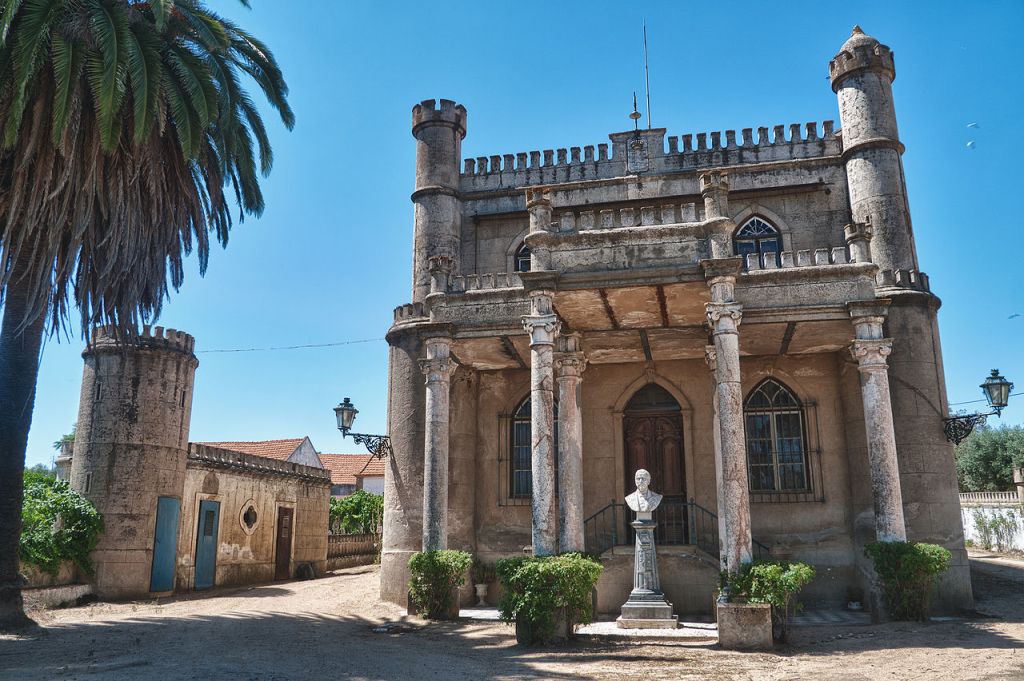
Bemposta Palace in Lisbon

The marquisate however, passed to her cousin, grandson of her aunt, Maria Sofia de Lorena, who had married … a Lencastre! Pedro de Lencastre, 5th Conde de Vila Nova de Portimão, was a descendant of the cadet branch, the commanders of the Order of Avis (as above). Their daughter, Isabel de Lencastre married Manuel Rafael de Távora, and generated the House of Lancastre e Távora, in the person of their son Pedro, who became 5th Marquês de Abrantes.

amrs of Lencastre e Tavora, marquises of Abrantes

A short while later, in 1807, Napoleon Bonaparte sent his general, Jean-Andoche Junot, to Portugal to punish it for not adhering to his Continental Blockade of Great Britain (thanks, Treaty of Windsor, 1386!). Junot landed his army on the coast and first established his headquarters at Abrantes before taking the city of Lisbon in early 1808. He was rewarded with one of the French Empire’s ‘victory titles’ as Duc d’Abrantès, but was chased out of Portugal by the end of the year. So much for victory. Nevertheless, his heirs bore the ducal title in France until the extinction of the male line in 1982.

the French press celebrating Junot’s victories in Portugal

Today therefore we have a Duke of Abrantes in Spain—the 15th, José Manuel de Zuleta y Alejandro, who works as head of the secretariat of the Queen of Spain—and a Marquis of Abrantes in Portugal—the 11th, José de Lancastre e Távora, son of a well-known author of books on genealogy and heraldry. In 1939, the pretender to the Portuguese throne, the Duke of Bragança, offered to revive the title of Duke of Aveiro, to a cousin of the Marquis of Abrantes, but he declined. The Spanish dukedom of Aveyro was revived in 1917 by King Alfonso XIII for Luis María de Carvajal y Melgarejo, Marqués de Puerto Seguro (a Spanish rendering of the Lencastre family’s ancient title of Porto-Seguro), one of his gentlemen of the chamber and a commander of the Spanish cavalry. He died in 1937, and was succeeded by his son and grandson as dukes of Aveyro, bearers of the name Lancaster in Madrid.

the Duke of Aveyro (1917)

–with special thanks for assistance from my generous Portuguese academic specialists, Dr Hélder Carvalhal and Dr Cristóvão Mata!!

(Images from Wikimedia Commons)

Dukes of Saxe-Meiningen

Where would you go if you wanted an incredible musical or theatrical experience in the later 19th century? One of Europe’s great music capitals—Vienna, Paris? The theatres in London? The capital cities of several small German principalities had either an orchestra or a theatre that punched well above its relative weight, like Weimar or Detmold, but also Meiningen, which excelled at both. The Court Orchestra and Court Theatre of the small duchy of Saxe-Meiningen were leading arts organisations, led by one of the 19th-century’s most cultured prince, Duke Georg II, known to contemporaries as the ‘Theatre Duke’. His Meiningen Ensemble influenced the history of theatre through its professionalism and dedication to authenticity; while the Meiningen Orchestra attracted the best composers in the German music world to premier their new works, notably the artistic giant Johannes Brahms.

Duke George II of Saxe-Meiningen. He even looks a bit like Brahms

As German principalities go, Saxe-Meiningen is pretty small, and mostly unknown to non-specialists in this historical period or region. But, as is often the case, the name does ring a bell with those interested in British royal history, as one of its daughters, Princess Adelaide, became a queen-consort of the United Kingdom, as wife of William IV (reigned 1830-37). This is her family’s story.

Queen Adelaide, by William Beechey

I have written in a previous blog post about the origins of the Duchy of Saxony and the House of Wettin (https://dukesandprinces.org/2020/07/02/dukes-of-saxe-coburg-and-saxe-gotha-families-of-two-british-consorts/ ). This branch splits off from those detailed there (Saxe-Gotha and Saxe-Coburg), after the section on Duke Ernst the Pious. When he died in 1675, his estates were divided amongst his numerous sons (by an agreement of 1680). The southernmost parts, including the town of Meiningen, went to one of the younger sons, Bernhard.

the town of Meiningen in the 17th century

The region around Meiningen, today the southwestern corner of the state of Thuringia, once formed the core of the powerful medieval county of Henneberg. Centred on the valley of the upper Werra river, this county lay at the crossroads between the ancient regions of Franconia and Saxony. But for a long time the Henneberg possessions didn’t include the town of Meiningen itself. The important trading town, founded at a key ford in the river in the 10th century, was for many centuries an exclave possession of the bishops of Würzburg, further to the south in Franconia. It was finally purchased by the counts of Henneberg in 1542, but only forty years later that dynasty became extinct, and most of its properties passed to the Wettins of Saxony. This heritage was commemorated in the coat of arms for the new duchy created for Bernhard in the 1680s, by the incorporation of the old Henneberg arms (literally, a chicken on a hill!). Their ancient castle, on a hill outside the town of Meiningen, was already by this point abandoned, and it remains a romantic ruin today.

the Henneberg today
an old border stone of the Duchy, with the coat of arms for Thuringia, Henneberg, Römhild, Meissen and Saxony overall

Instead of renovating Henneberg Castle, Duke Bernhard I (1649-1706) swiftly built a new ducal residence for himself and his family in Meiningen, the Elisabethenburg, named for his second wife, Elisabeth Eleonora of Brunswick-Wolfenbüttel. The site had initially been occupied by a fortress built in the 11th century by the bishops of Würzburg, which was replaced in 1511 with a building in Renaissance style. This new building would be a grand Baroque edifice, more in line with the palace built by Bernhard’s father, Duke Ernst, in Gotha. It was given three wings which formed an E. A new ducal church of the Holy Trinity would serve as the family mausoleum. Today the Elisabethenburg palace is a museum, but also houses civic ceremonial spaces for the town and the Thuringian State Archives, as well as a music school and concert hall.

Elisabethenburg Palace

This concert hall was put to use right away, as Duke Bernhard established his own court orchestra—today it is considered one of the oldest still performing in Europe. In 1711, Bernhard’s son employed as court music director Johann Ludwig Bach, a cousin of the soon-to-be-more-famous Johann Sebastian. Over three centuries later, another Bach is at the helm (Philippe Bach), though he is Swiss and (I think) unrelated.

Duke Bernhard I

Like his father, Bernhard did not believe in strict primogeniture. But rather than subdivide the state further, he decreed in his will that his sons would have to rule together (which, as you might guess, rarely works very well). Duke Ernst Ludwig I, the eldest, soon pressured his two younger brothers to let him rule on his own, but his reign was relatively short, and when he died in 1724, his brothers were able to re-assert their authority as uncle-regents for his young sons. First reigned the child Ernst Ludwig II (1709-1729), and then Karl Friedrich (1712-1743), who didn’t leave much of a mark. Uncle Friedrich Wilhelm survived his nephew and reigned as senior duke from 1743 to 1746, finally leaving the youngest brother, Anton Ulrich to rule on his own.

Duke Anton Ulrich

Duke Anton Ulrich (1687-1763), not expecting to become the head of the family, had travelled abroad and married in secret in the Netherlands in 1711, a woman of unequal rank, Philippine Caesar (one of his sister’s ladies-in-waiting). After she died in 1744—and following the death of his nephew—the Emperor decreed that their many children were unable to succeed to the duchy. So Anton Ulrich married again and produced even more children, this time of the correct rank. Still, he neglected Meiningen and preferred to live in Frankfurt.
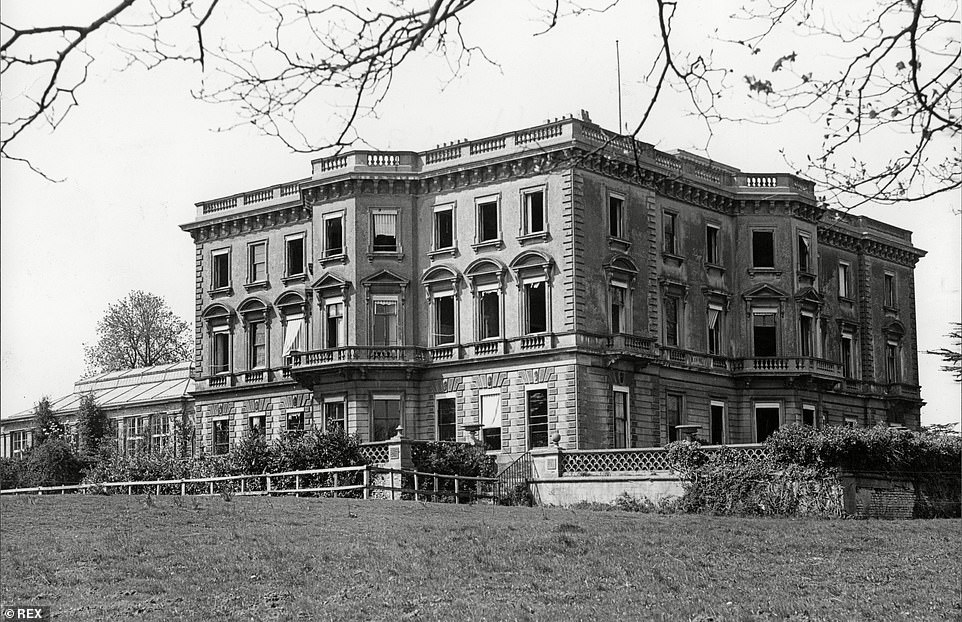
Anton Ulrich built a country house for himself, in the northern part of the duchy, in the hills separating Meiningen from the other Wettin duchies (Eisenach, Gotha, Weimar). Altenstein had (as its name suggests) long been the site of an old stone fortress, but it was destroyed by a fire in 1733, and the young duke decided to rebuild it with more comfort and stylistic whimsy. His son, Georg I would re-design the building and its setting around 1800, in a more English country gardens style. This was then expanded and again re-designed in 1846 for a visit by the Dowager Queen Adelaide—again along the lines of English landscape design. The house itself was similarly redesigned in 1888-89 by Georg II, now as a late Tudor style country manor. Altenstein Castle remained the ducal summer residence until the fall of the German monarchies in 1918, and thereafter the main residence for the dynasty once the Elisabethenburg had been ceded to the state. In about 1940, it too was sold to the state. After the war it became a convalescent home for craftsmen, and in 1979 a monument to the history of landscape and garden design. A bad fire in 1982 gutted the interior, and it was only partly restored by the East German authorities. As part of the Thuringian State Castle and Gardens Foundation since 1995, it has been slowly and steadily restored since then.

Altenstein in a postcard from 1900

When Duke Anton Ulrich died in 1763, he was succeeded by his eldest son from the second marriage, Karl Wilhelm, with his mother, Princess Charlotte Amelia of Hesse-Philippsthal, as regent. The young duke died only a few years after his emancipation, in 1782, and was succeeded by his brother, Georg I.
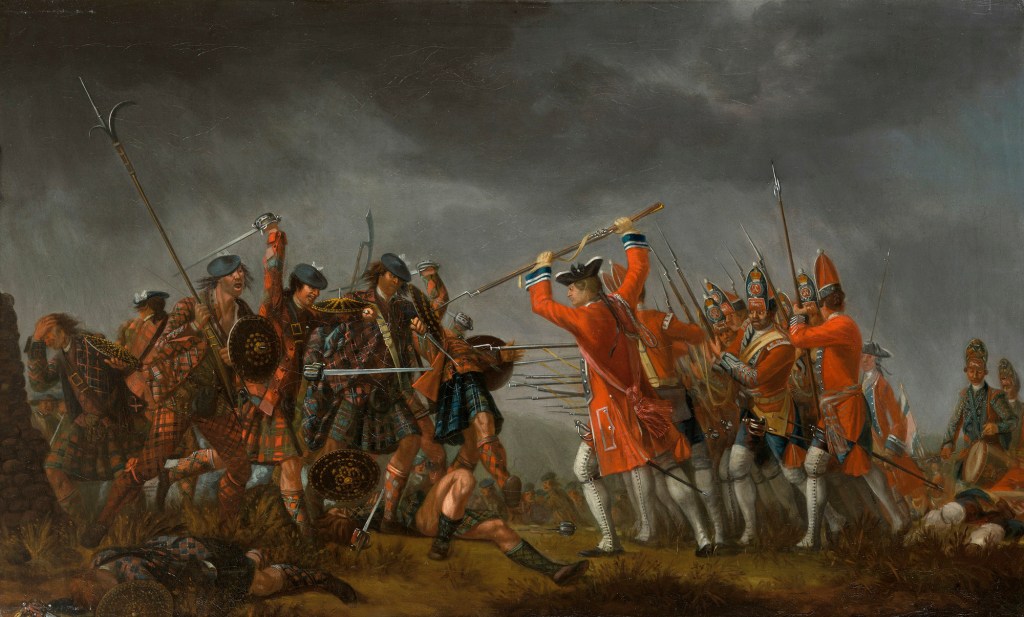
Duke Georg I

Duke Georg I (1761-1803) was considered by his contemporaries to be one of the best examples of a reforming Enlightenment prince. In his twenty-year reign he built schools and healthcare facilities for the poor, opened the ducal library to the public, established a forestry academy, and introduced a number of reformed social policies (for example abolishing the practice of ‘penance’ for unwed mothers). He even wrote philosophy essays under a pen name. Duke Georg established an English Garden just north of the centre of Meiningen shortly after his accession. Unlike many of his princely contemporaries, he did not become involved in the revolutionary wars of the 1790s, and his state was left unmolested by Napoleon’s armies. When he died in 1803 he left three very young children, again under the watchful eye of their mother, Princess Luise Eleonore of Hohenlohe-Langenburg. The eldest of these was Princess Adelheid, the future queen-consort, then Princess Ida (who became a princess of Saxe-Weimar), and finally Bernhard II.

The children had been raised in one of the most liberal states in Germany, which affected their later lives. Adelaide (to use her English name) was chosen to marry the younger brother of the Prince Regent, William, Duke of Clarence, in 1818 when the race was on to produce a Hanoverian heir—in fact it was a double wedding between the dukes of Clarence and Kent and their Saxon brides, Adelaide of Saxe-Meiningen and Victoria of Saxe-Coburg-Saalfeld. Clarence was 27 years older than his bride, and already had ten children (the FitzClarence family) by his mistress Dorothea Jordan. His naval career already long over by 1818, he and Adelaide settled in Hanover for a time (where it was significantly cheaper to run a royal household), then resided in Clarence House in London and Bushy House near Hampton Court once she started giving birth to potential heirs to the throne. Unfortunately all of these were either miscarriages, stillbirths or soon died, and once the Duke of Clarence succeeded as King William IV in 1830, it was assumed the royal couple would have no more children. Queen Adelaide was popular with the British public, who appreciated her piety, modesty and great charity. The new city of Adelaide in Australia was named for her in 1836. She survived her husband by over a decade, enjoyed good relations with her niece the new queen, Victoria, and died at Bentley Priory in Middlesex in 1849.

Adelaide as Queen of the United Kingdom

Adelaide’s brother Duke Bernhard II reached his majority in 1821. His estates were augmented a few years later when the various pieces of the Wettin duchies were re-distributed by family pact in 1825: he received the duchy of Saxe-Hildburghausen and the Saalfeld parts of the duchy of Saxe-Coburg. The new state was about 2,500 square kilometres (roughly forming a thin crescent shape), with about 150,000 people in the 1830s. It remained mostly rural, though the town of Meiningen developed as a regional banking hub.

Saxe-Meiningen after 1825 (with Meiningen as a red dot) alongside the other Saxon duchies of Thuringia in grey

Amongst the new properties that accrued with these new domains were the town palaces of Hildburghausen and Saalfeld. The ducal residence in Hildburghausen was built in 1686 by its first duke, but was mostly abandoned as a residence by the new ruling house after 1825 and used instead as a garrison for troops; it was completely destroyed in World War II. The residence in Saalfeld was a much more impressive palace (also built at the end of the 17th century), but had long before been given to the town as its administrative buildings by previous dukes, as early as the 1730s, since Coburg served as their residence. A much more significant addition to Saxe-Meiningen was the mighty fortress of Heldburg. Veste Heldburg sits atop a volcanic plug and dominates a small region called the Heldburger Land, which gave its name to the town and duchy of Hildburghausen. Its rulers had transformed a medieval castle into a Renaissance schloss in the 16th century. At first ignored by its new owners from Meiningen, in the 1870s Heldburg was restored and renovated by Duke Georg II and his wife, who played up its more romantic side. After the fall of the German monarchies in 1918, Heldburg remained the property of the former ruling dynasty, and became the family home of some of its younger members in the 1920s and 30s, as well as a new family burial site. It was confiscated by the East German government after the Second World War, and used for a time as a garrison for Soviet troops, situated as it was so close to the border with West Germany. It then became a children’s home until a bad fire in 1982 gutted much of the interior. In 1995, it became part of the Foundation for Thuringian Castles and Gardens, and since 2016 has housed a new museum dedicated to the history of German castles.

Veste Heldburg

Bernhard II did not just inherit older residences, he also built several new ones. In 1823 he built a palace in Meiningen for his mother, the now retired regent, Duchess Luise Eleonore. This gracious neo-classical building was known as the ‘widow’s palace’, and served as an anchor for the new district being developed just north of the old town, at the entrance to the Englischer Garten. It was later enlarged and remodelled and rebranded as the ‘prince’s palace’ once Bernhard moved here himself with his wife after abdicating his throne in 1866. It was later the residence of the hereditary prince, and is now known as the Großes Palais, to distinguish it from the nearby Kleines Palais, built about the same time, as a summer residence for the Duke. This small house, also known at times as the ‘princess’s palace’, was also used to host prominent guests visiting Meiningen, like Brahms. Both the large and small palaces were retained as private property by the family after 1918, but were confiscated in 1945. Today the grand palace houses some civic and medical offices, while the small palace is a bank.

Großes Palais
Kleines Palais

Finally, Bernhard II should be remembered as the builder of Landsberg Castle, on a small hill just north of the city, overlooking the Werra valley. Bernhard had travelled to England to visit his sister the Queen in the early 1830s, and in 1836 hired architects (both local and English) to make for himself a typically English neo-gothic romantic country house. Its style resembled a crenelated medieval castle (and indeed incorporated the ruins of a tower from a previous genuine medieval castle on the site), and its interiors included a rustic great hall with large-scale murals depicting Wettin and Saxon history. Landsberg was sold by the dynasty in the 1920s, and it passed through several hands before being opened by the GDR as a luxury hotel in the 1970s. Briefly repurchased by a member of the former ruling dynasty in the ‘90s (still to be run as a hotel), then acquired for a time by the Meiningen Architectural Monuments Foundation, it is now in an uncertain position, between being re-opened again as a luxury hotel or permanently opened as a heritage site by the city of Meiningen or the state of Thuringia.

Landsberg Castle

Duke Bernhard II thus kept himself busy with building projects, and was fairly moderate politically in this time of nationalist tumult in Germany between the 1840s and ‘60s. But he valued the freedom of smaller states like his own against the rising dominance of Prussia, and backed the wrong horse when Austria challenged this dominance in 1866, being forced to abdicate in his son’s favour following Austria’s defeat.

Duke Bernhard II

The new duke, Georg II (1826-1914) was a prince much more in tune with the new romantic, nationalistic age, and supported Prussia in 1866. He had also been previously attached by marriage to the Prussian royal family, through his first wife, Charlotte of Prussia, niece of King Wilhelm I—though she had died in 1855. Georg was rewarded for his loyalty in the war of 1866 not just with his father’s throne, but the rank of lieutenant-general in the Prussian army, with which he served in the Franco-Prussian War of 1870-71. At this time, he was married to a niece of Queen Victoria, Princess Feodora of Hohenlohe-Langenburg (daughter of Victoria’s half-sister). But she too died, in 1872.

Duke Georg II

In 1873, Georg II married an actress, Ellen Franz, who was created Baroness von Heldburg by the Kaiser, though he was much against the match (as was the Duke’s father and most of the local court—they resigned, refused to salute her, etc). But the people of Meiningen loved her, and the couple became renowned across Europe for their passion for theatre and the arts. Together they revived the court theatre, and created the Meiningen Ensemble, which championed a new style of realism: authentic sets and costumes, historical accuracy, and an overall ‘directorial vision’, something new in the history of theatre. The Duke was not just a distant patron: he designed much of these sets and directed scenes himself, earning his nickname of ‘Theatre Duke’.

Ellen Franz, Baroness von Heldburg

Georg, Ellen and their Ensemble travelled all over Europe in the 1870s-80s. When the original court theatre from the 1830s burned down in 1908, the Duke rebuilt it on a monumental scale, matching the neoclassical style he had been supporting in the town of Meiningen’s redevelopment since the 1870s.

The Meiningen Theatre
Bernhardstrasse’s neoclassical strand

Duke Georg II also revived the Court Orchestra, with a similar attention to rigorous professionalization. A notable benchmark was hiring in 1880 the most famous conductor in Germany of the era, Hans von Bülow, himself from an ancient noble house. Von Bülow championed in particular the work of Johannes Brahms, whose mighty 4th Symphony was premiered here in 1885, and that of up-coming new talents like Richard Strauss, who was employed as an assistant conductor for a short time. A later leader of this orchestra was the composer Max Reger, whose archive is still housed in Meiningen. The Duke’s daughter, Princess Maria Elisabeth became herself an admired musician and composer, having been given piano lessons by Brahms himself, and was later a patron of young artists in the region.

the Meiningen Court Orchestra with Hans von Bülow conducting

As a particular cruelty, Duke Georg II became deaf later in life, and he retired from public affairs. He died on the eve of World War I in June 1914. All three of his sons, Bernhard, Ernst and Friedrich had served in the Imperial armies in the years leading up to the war, but only the youngest was still in active service in 1914—Prince Friedrich was given a command in the invasion of Belgium and was killed on August 23, one of the first casualties of the war. His own second son, Prince Ernst, was killed only a few days later.

The new duke, Bernhard III, having been a general before his retirement in 1913, was disappointed at not being appointed to high command in 1914 (especially as he was both cousin and brother-in-law to the Kaiser). In 1878 he had married Princess Charlotte of Prussia, daughter of Crown Prince Friedrich and Victoria of Great Britain. Severed from his friendly English relations by the war, and disappointed by his German relations as well, the Duke withdrew from society and politics even before he abdicated the throne in November 1918, and lived quietly at Schloss Altenstein until his death in 1928.

Hereditary Prince Bernhard and Princess Charlotte of Prussia
Duke Bernhard III

The duchy of Saxe-Meiningen was briefly the ‘Free State’ of Saxony-Meiningen, 1918-20, then was incorporated into the new state of Thuringia. As seen above, some of the properties of the former ruling family were maintained as private property. Bernhard III had only a daughter, so headship of the house passed to his brother Ernst, who was also living in Altenstein. He had married morganatically, the daughter of a painter and a poet, so none of his children (known as the barons and baronesses von Saalfeld) were eligible to succeed as head of the house when he died in 1941.

Duke Ernst

Ernst’s nephew (Prince Friedrich’s son), Georg (III), lived at Veste Heldburg, with his wife and two children (another son, Anton, had been killed in the first year of the war). Georg had studied law and served as a district judge for a time in the 1920s. In the 1930s he became a member of the Nazi Party, so when the Soviet Army invaded in 1945, the castle was seized and his family fled, though he himself was captured, and died in a Prisoner of War camp in northern Russia a year later.

Duke Georg III as a young man

Duke Georg’s son Friedrich renounced the succession in 1946 and became a monk (their mother had raised the children as Catholics). His sister, Princess Regina, married one of the most famous royal exiles of the era, Archduke Otto von Habsburg, at a ceremony in Nancy (Lorraine, France) in 1951. Regina and Otto had met when she was working in a care home for Hungarian refugees after the war. They had seven children and over twenty grandchildren by the time she died in 2010.

Princess Regina and Archduke Otto von Habsburg

Meanwhile, the succession as head of the family passed to Regina’s uncle Bernhard (IV), who lived in a castle in Austria, Pitzelstätten, near Klagenfurt in Carinthia. Bernhard and his wife Margot made headlines as far away as America in 1933, when they were arrested by the Austrian government for plotting with Nazi authorities in Germany. He was held in prison for several weeks, then they escaped to Italy.

Duke Bernhard IV
Pitzelstätten Castle

After the war, Bernhard divorced his first wife, which had been an ‘unequal’ marriage, and re-married someone deemed of more appropriate rank. When he died in 1984, the headship of the family thus skipped his elder son from the first marriage, Friedrich Ernst (who was, interestingly, briefly engaged in the early 1960s to a dear friend of my family from Cologne), and passed instead to the younger son, Konrad (b. 1952) who is the current head of the Meiningen family. Konrad is unmarried and has no children, so it is thought he will formally adopt his half-brother’s son (who has impeccable princely lineage anyway, as his mother is a Saxe-Coburg), Prince Friedrich Constantin (b. 1980).

Konrad of Saxe-Meiningen

In the line-up of currently extant branches of the ancient princely house of Wettin, the House of Meiningen is second in rank, behind Weimar and before Coburg (which includes the royal families of Belgium and Great Britain). The age of the Ruritanian principalities is long over, but Saxe-Meiningen has left behind a cherished legacy of support for the performing arts and monuments to 19th-century architectural and landscape design of which it can be proud.

(images from Wikimedia Commons)

Princes of Powys Fadog and Maelor

Until very recently I had never heard of Maelor, despite it being just over an hour’s drive from my home in Manchester. I’ve now become slightly obsessed with its curious history, as an exclave of Welshness jutting into the English countryside. For a small geographical space, it is complex, with two roughly equal parts: ‘Saxon’ Maelor and ‘Welsh’ Maelor, divided by the river Dee. Yet despite being on the English side of the Dee, the traditional border between England and North Wales, Saxon (or Saesneg) Maelor has only quite briefly been formally part of England. Maelor was not a principality itself, just a key component of the principality of Powys Fadog, the northern half of the ancient kingdom of Powys.

High above the Dee Valley, near Llangollen, with the silhouette of the ancient capital of Powys Fadog, Dinas Brân

I wasn’t sure whether to include the Welsh princes in my blog site, since they are often considered to be royalty, not dukes and princes (which is always a blurred division anyway). But although earlier rulers of medieval Wales used the term king (brenin or ri), after the division of Powys in 1160 into smaller subdivisions, its rulers preferred to use the word tywysog (and in Latin princeps), and their principality a tywysogaeth, in line with the other Welsh territorial lords, perhaps to distance themselves from the challenges and defeats of the previous generation. And since there are no dukedoms based in Wales (except the anomaly of the Herberts—see my previous post on that family), I wanted to be able to explore that country on my site too, especially as a place I love to visit on days out.

The various Welsh principalities have histories that stretch back into the Iron Age, long before the Romans arrived on Britannia’s shores. A Welsh united kingdom was attempted several times after the Romans left in the 5th century, but was always plagued with disunity and internal dissension (like most regions of Europe in this era, to be fair). Powys emerged as an independent kingdom or principality in the 6th century. It is thought the name came from pagus, the Latin word for ‘countryside’—this countryside had been organised by the Romans into a province for those living in the rich lands of the foothills east of the Cambrian Mountains, the Cornovii. They built a new capital called Viroconium Cornoviorum, an important Roman centre located southeast of the town of Shrewsbury in Shropshire (today known as Wroxeter). Viroconium took its name from the nearby older fortified hill settlement of the Wrekin—still today one of the most arresting sights of this part of the world—a rock jutting up right in the middle of a plain. In Welsh Viroconium became known as Caerwrygion (or Caer Guricon). They also established a capital at Pengwern, which is thought to be modern Shrewsbury, but no one is certain.

The Wrekin

Just to the north, Maelor emerges to play a part in this early history, with one of the chief religious centres in the region being built at Bangor-on-Dee in about 560. Bangor was the scene of one of the more brutal massacres of early medieval history, when a pagan Northumbrian king, Æthelfrith, attacked the king of Powys, Selyf ap Cynan or Selyf ‘Sarffgadau’ (‘battle serpent’), in about 615, at what is called the Battle of Chester, though it took place several miles to the south, in Bangor. The King was killed, as were hundreds of monks (or even more than a thousand, if we believe Bede)—and in particular, the Northumbrian king is said to have ordered the attack on the praying monks before starting the battle against the Welsh soldiers. We don’t know exactly where the monastery at Bangor was, but its memory was evoked in poetry and song many centuries later: Walter Scott wrote ‘The Monks of Bangor’s March’, which was then set to music by none other than Ludwig van Beethoven in about 1810. As strange coincidences go, I recorded this piece with a men’s choir in Washington DC back in the ‘90s, though I’m sure I had no idea that it didn’t refer to the more famous Bangor on the northwest coast of Wales, and probably assumed it had something to do with the well-known battles of Edward I in north Wales (and I don’t even think it registered that it was a tune by Beethoven). This is the last verse:

Bangor! o’er the murder wail!

Long thy ruins told the tale,

Shattered towers and broken arch

Long recalled the woful march:

On thy shrine no tapers burn,

Never shall thy priests return;

The pilgrim sighs and sings for thee,

O miserere, Domine!

[Believe it or not, this ancient recording of mine is on YouTube! https://www.youtube.com/watch?v=NcwfZmtxHHU ]

the banks of the Dee at Bangor

Back in the 7th century, as Saxon settlements began to encroach further and further into the northwest of Britain, the Welsh principality of Powys shifted its centre to the more hilly (and defensible) lands to the west and incorporated the lands of the Ordovices, notably making their ancient hill fortress in the deep valley of the Dee as it cuts through the mountains at Llagollen, Dinas Brân, as one of their capitals (see below). Another fortified capital was Mathrafal, near the town of Welshpool (the later capital of southern Powys). Near Mathrafal, in Meifod, a church was built to honour one of the members of the dynasty who became a saint, Tysilio (d. 640). This became the dynastic mausoleum.

St. Tysilio Church

The dynasty was known as the Gwerthrynion, who claimed descent from the semi-legendary Vortigern, king of the Britons, and from a daughter of Roman Emperor Magnus Maximus (proclaimed in 383 while in Britain). A mid-9th-century stone pillar, the Pillar of Eliseg, near Llangollen, displays a carved royal line of descent from this union (using the Welsh spelling ‘Guarthigern’, from which they drew their dynastic name) to Prince Eliseg.

the Pillar of Eliseg

‘Eliseg’ is a corruption of Elisedd ap Gwylog (d. c755), considered the re-founder of the medieval kingdom of Powys. He retook the lands from the Saxons and re-established Welsh rule in the area. But very little is known about him. Lands around Caerwrygion and Pengwern were incorporated into the Kingdom of Mercia and gradually formed the English county of Shropshire. This is the era of Offa’s Dyke, built in the late 8th century to divide Mercia from Powys.

The last of this original house, King Cyngen, died in 855. His sister has married the King of Gwynedd, the powerful kingdom to the west, and for a time the two kingdoms were ruled together by their son, Rhodri the Great. Over the next two centuries, Powys and Gwynedd were ruled together then separately, again and again, by various members of the House of Gwynedd. Almost all of Wales was joined together under the leadership of Gruffydd ap Llywelyn, but broke apart again on his death in 1063, just when unity was needed following the Norman Conquest. Instead, Powys went separately to Gruffydd’s maternal half-brother, Bleddyn ap Cynfyn (supposedly of the house of Dinefwr, a cadet branch of the House of Gwynedd who ruled in South Wales), who founded a new dynasty for Powys that took its name from the castle at Mathrafal.

the remains of the castle mound at Mathrafal

Norman lords swiftly took over parts of this border territory, and built mighty castles, notably Montgomery (named after its builder’s homeland in Normandy). By 1090, they had taken over much of the region. But in 1096, Bleddyn’s sons unified and drove them back. Over the next half-century, the joint rule of these sons and grandsons struggled to find its place between an often aggressive Gwynedd, the Norman marcher lords, and the Crown of England. By about 1100, the lords of Powys were vassals of the earl of Shrewsbury. A few years later, by 1116, the principality was centralised once more under the control of Prince Maredudd. Other branches of the dynasty faded into the local gentry—notably the lords of Nannau (in Merioneth to the west of Powys), and continuing as Welsh families today with surnames Nanney and Vaughan.

Prince Maredudd’s son Madog re-asserted some of the dynasty’s power in the region through an alliance with King Henry II against Gwynedd. By the 1140s he’d added the Norman baronies of Oswestry and Whittington (in Shropshire) to his territory. But when he died in 1160, the old practice of dividing the realm between sons once more prevailed, and Powys was divided into five pieces, though eventually these were consolidated into two: Owain received the lands to the south of the Rhaeadr river, while Gruffydd Maelor received the lands to the north. The southern principality eventually took the name of Powys Wenwynwyn; while the northern principality was Powys Fadog.

The Principality of Powys Fadog included initially the lands of Maelor and the lordship of Iâl (Yale), to the west, in the foothills of the Clwyd mountains. The first prince later added Nanheudwy, the deep dales of the river Dee as it passes through the mountains, and Cynllaith, the river valley a bit further to the south. The name Maelor in fact comes from mael (another word for ‘prince’) and llawr (‘land of’). It had been separated from Wales since the construction of Offa’s Dyke, but was reclaimed in the earlier part of this century.

Prince Gruffydd Maelor I died in 1191, and his sons Madog and Owain took over as joint rulers (though the younger son died soon after). It may be that the name of the Principality of Powys Fadog comes from the name of the elder son (Welsh gender rules changing the M to an F). His mother was Princess Angharad of Gwynedd so he maintained good relations with the more powerful Welsh kingdom to the northwest. By 1200, however, Prince Madog was in the pay of King John. At about this time, he founded the Abbey of Valle Crucis, outside Llangollen and thus not far from his fortress capital of Dinas Brân. Dinas Brân—known commonly in English as ‘Crow Castle’, probably as a mistranslation of ‘the fortress of Bran’ a local chieftain (or even simply ‘the fortress on the hill’, bryn)—had been a hill fortress of the Ordovices since long before the arrival of the Romans, and re-fortified with a wooden palisade by earlier kings of Powys. A stone castle was built in the 1260s by Madog’s heirs.

Dinas Brân painted in the 19th century by Richard Wilson
Dinas Brân today

To the west, further up the valley, was the lordship of Glyndyfrdwy in the region Edeirnion. It is spelled many ways, including Glyn Dyfrdwy, which makes its meaning clearer, the glen of the river Dee (afon Dyfrdwy). There was a castle here, built by the Normans in the 12th century to command the upper Dee Valley, but it was in Welsh hands by the 13th century. Today it is just a mound, the castle having been pulled down following Owain Glyndŵr’s rebellion (see below).

The Glen of the Dee, Glyndyfrdwy

Valle Crucis was a Cistercian foundation, like many in the deep valleys of Wales (most famously, Tintern). It took its name from Croes Elisedd, Eliseg’s Cross noted above, and became the family mausoleum for this branch of the Mathrafal Dynasty. At its height, it housed up to 60 monks and servants, and became known as a favoured residence of Welsh poets. The Abbey was dissolved in the 1530s, and today it is a ruin.

Valle Crucis

Prince Madog ap Gruffydd switched sides in 1215, abandoning King John to support his cousin Llywelyn ap Iorwerth of Gwynedd. He died in 1236 and was succeeded by his five sons: Gruffydd Maelor II, Gruffydd Iâl, Maredudd, Hawel and Madog Fychan. It seems the latter was the most active in this period, leading Welsh raids on English possessions in the 1240s-50s. In contrast, the eldest, Gruffydd Maelor II, married one of them: Emma de Audley, daughter of an English baron who served as sheriff of neighbouring Shropshire.

In the next generation, the sons of Gruffydd Maelor II (d. 1269) fought, then divided the principality: Madog II ruled Maelor; Gruffydd Fychan ruled Iâl and Glyndyfrdwy; while Llywelyn and Owain ruled Cynllaith and Nanheudwy. Madog II allied with the Prince of Gwynedd and became his vassal by the Treaty of Montgomery (1267) which aimed to re-unite the Welsh principalities under one leader, and to establish peace with King Henry III at the same time. This peace was broken in 1277 and Madog was killed in an English invasion.

the arms of Powys Fadog. Other versions include the black lion on red and white stripes (see below)

His brother Prince Gruffydd Fychan (fychan means ‘of the same name’, like ‘junior’, rather than saying ‘Gruffydd ap Gruffydd’—it is the origin of the surname Vaughan) soon made peace with the English, and by the Treaty of Aberconwy was released from any fealty to Gwynedd. Yet he fought alongside Gwynedd’s prince, Llywelyn (later called ‘Llywelyn the Last’) again in 1282. With Prince Llywelyn’s defeat and death in December of that year, his ally the Prince of Powys Fadog was defeated too and his lands taken over by the English Crown. They were then re-granted to him as fiefs, though some parts were given to English marcher lords, like Roger Mortimer who founded a new castle and barony on the river Ceiriog (taking an Anglicised spelling, Chirk). The castle at Dinas Brân was dismantled, and was replaced in its role of defending the Middle Dee valley by a new English castle at Holt, northeast of Wrexham, by John de Warenne, earl of Surrey.

Chirk Castle

In the new order after 1282, Maelor was divided—the names we encountered at the start of this post now appear, with Maelor Saesneg, east of the Dee, added to English Crownlands as an exclave of the newly developed Flintshire (part of the new Principality of Wales); and Maelor Gymraeg (‘Welsh Maelor’), west of the river, becoming part of the marcher lordship of Bromfield and Yale, granted to the Earl of Surrey. Both parts remained Welsh in language and culture—the eastern parts (centred on Bangor) were called ‘English’ mostly because they became part of the diocese of Chester, while the western part (centred on the town of Wrexham, or Wrecsam in Welsh) was part of the diocese of St. Asaph. The barony of Bromfield passed to the Fitzalans of Arundel in 1347, who became extinct in 1415 and their lands divided between female heirs. In the reorganisation of the administration of Wales by Henry VIII in 1536, Welsh Maelor was added to the county of Denbighshire. English Maelor was formally attached to Cheshire in 1397 (though it remained personal property of the Crown) until 1536 when it was again attached to Flintshire. In 1974, both Maelors were joined together to form the district of ‘Wrexham Maelor’ within the new County of Clywd. But in 1996, the area was re-shuffled again, and today there is an independent ‘County Borough’ of Wrexham which includes the two Maelors plus some lands to the southwest, the Ceiriog Valley and the Berwyn Hills—in other words, much of the old Powys Fadog.

the two Powys principalities. ‘English Maelor’ is shown here as the detached piece of Flintshire, with ‘Welsh Maelor’ in purple as part of Denbighshire.

The southern principality, Powys Wenwynwyn, also surrendered to Edward I in 1283, and was re-granted as a barony—the ruling family took on a new surname, ‘de la Pole’ (from Welshpool, the capital). The barony passed by marriage to the Charleton family in 1309, and then in 1421 to the Greys, who were created Baron Grey of Powis in 1481. In 1535, feudal rights were abolished, and the lands of the former principality were incorporated into Montgomeryshire. In 1587 the barony was sold to the Herberts (cousins) and it followed the path of that family (see Herberts of Powis).

After 1282, both former ruling dynasties of Powys were considered uchelwyr, ordinary nobles descended from previously royal dynasties. The former Prince Guffydd Fychan’s son, Madog Crypl (aka Madog III) was a child when he succeeded his father in 1289, so his lands were administered by King Edward’s men. He eventually reclaimed the lordship of Glyndyfrdwy and half of Cynllaith (called ‘Cynllaith Owain’), with a castle at Sycharth, an old motte and bailey built by the Normans in the late 11th century.

modern signage at Castle Sycharth

Madog Crypl died in 1304 or 1306 and was succeeded by his son Gruffydd of Rhuddallt (a manor near Glyndyfrdwy), who was the ward, then son-in-law, of Baron Le Strange of Knockyn. He added some lands to the east in Shropshire, notably the castle of Ellesmere, in 1332, then died in 1343. His son, Gruffydd Fychan II married a sister of Marged ferch Tomos, the wife of Tudur ap Goronwy, whose grandson Owen Tudor would found a very famous new royal dynasty.

Before this great glory for Wales, however, lay one last burst of Welsh independence, led by a prince of the House of Powys. Gruffydd Fychan II’s sons Owain and Tudur, born at Sycharth Castle, were each given a family lordship in the region of Edeirnion: Owain at Glyndyfrdwy and Tudur at Gwyddelwern (further up the valley, north of the town of Corwen). English and French sources give them the surname ‘de Glendore’ or ‘Glendower’, but modern Welsh spells it Glyndŵr.

Owain’s Mound in Glyndyfrdwy

In 1400, Owain, who had served in English armies for twenty years (notably in the Scottish borders), began a rebellion against English rule in Wales, with his brother as a commander, and support given by Edmund Mortimer and Henry Percy (they drew up a plan to split England and Wales into three pieces when victorious). Joining them in this fight were their maternal cousins, the sons of Tudur ap Goronwy (who hailed from Gwynedd, on the isle of Anglesey). France and Scotland supported the rebellion as well, though not very well. Owain was crowned Prince of Wales in 1404, and convened an all-Welsh parliament at Machynlleth (near the coast, where the ancient kingdoms of Gwynedd, Powys and Ceredigion come together). His brother Tudur was killed in May 1405 at the battle of Pwll Melyn, near Usk in Monmouthshire (South Wales), and two years later, in 1407, the tide turned against the Welsh and their allies. Wales was mostly re-occupied and by 1409 a last stand was made at Harlech Castle. Owain Glyndŵr escaped and lead guerrilla warfare for another three years or so, though his exact date of death is unknown.

A modern pub in Glyndyfrdwy

The last members of the House of Powys Fadog were the sons of Owain Glyndŵr. The elder, Gruffydd, was captured in 1405 at Pwll Melyn, and was eventually taken to the Tower of London, where he died in about 1412. The younger, Maredudd, accepted an English pardon, and (it seems, but is uncertain) served Henry V in France in 1422, then vanished from history. His sister Alys inherited the lands in Glyndyfrdwy and Cynllaith Owain, and the claims to the title of Hereditary Tywysog of Powys Fadog (if they were ever used—maybe in secret?), and transmitted them to her children by Sir John Scudamore, sheriff of Herefordshire. Some of their modern descendants in South Wales, the Skidmores, claim to know where Owain Glyndŵr’s burial is, though it remains a closely guarded family secret! It is hoped that he will rise again, with Arthur, and reclaim the island of Britannia once more for its native people. Which side of the Saesneg / Gymraeg border would you want to be on?

a modern monument in Corwen

(a big thank you to my colleague Dr Kathryn Hurlock for giving this the once over to make sure I didn’t commit any atrocious gaffs in my attempts at understanding the Welsh language!)

Giedroyć Princes

At the start of a recent episode of Who Do You Think You Are?, British comedian and presenter Sue Perkins meets with her long-time sparring partner Mel Giedroyc, and shares hopes that she would discover in the programme that one of her ancestors originated from Lithuania, as it would be an amazing thing for them to share, knowing that Mel’s own ancestors also came from there. Nothing further is said about Mel’s Giedroyc ancestry, and the show moves on to focus on Perkins’ interesting journey.

Not only does Mel Giedroyc’s family come from Lithuania, and indeed from a town named for them, Giedraičiai, but her family were princes, with dynastic roots stretching back into the late 13th century. And like their kin, the Radziwill princes discussed in a recent post here, their history is intertwined with the stories of not just Lithuania, but Poland and Russia too. They split into so many different branches that by the 20th century there were Polish branches, Russian branches and those in France, England and America. This post will, as usual, focus on the origins and development of the family and on the residences they lived in, but, as a nod to Mel Giedroyc—my favourite comedian, whose morning show helped welcome me to Britain so many years ago—will highlight in particular the strong role played by several women of the family.

Giedroyć / Giedraitis coat of arms

Like many grand aristocratic families, a certain amount of mystery shrouds the origins of the Giedroyć family—this is the Polish spelling, with a mark on the c to make it a ‘ts’. The traditional story is that there was a Prince Giedrius, brother of a Grand Duke of Lithuania from the dynasty that ruled this area before the reign of the Gediminids (the 14th to 16th century). Giedrius built a castle at Giedraičiai, about 45 km north of Vilnius, on estates acquired from the Livonian Order of knights in about 1340, and gave the surname Giedraitis to his descendants. There is no castle there now, but there is a fine old tower on the Church of St Bartholomew, built in 1410 and rebuilt four hundred years later by one of the family bishops, Józef Giedroyć (Juozapas Giedraitis in Lithuanian).

the tower of the church at Giedraičiai, Lithuania
the village of Giedraičiai

Prince Giedrius’ son, Ginwill, was a candidate for the throne of the Grand Duchy of Lithuania in the next generation, but after that the family drifted further away from the direct seat of power, and by the end of the 15th century, had split firmly into two lines, that of Prince Alexander and that of Prince Bartholomew. Earlier in the century, they had begun to use the symbol of the centaur (or ‘hippocentaur’) for their coat of arms, as one of the noble families adopted into the Polish system of heraldry following the Union of Hrodło (1413), drawing together the Grand Duchy of Lithuania and the Kingdom of Poland. At other times they also used the Poraj coat of arms, the five-pointed rose. I’m not exactly sure why they used both.

a later version of the princely arms

The only other major figure to emerge from the 15th century is the family saint (or nearly): Blessed Michael (Mykolas in Lithuanian), a hermit renowned for prophecy and miracles, who died in 1485. He was born unable to walk unaided, became an Augustinian canon in a convent in Bystryca (which is now just over the border in Belarus), then moved to the capital of the Polish Kingdom, Krakow, where he was allowed to live in a simple hut attached to the Church of St Mark where he served as a sacristan. He lived as a recluse, eating little and self-flagellating, but people came to seek him out for his gift of prophecy. After his death, his cult spread across Poland and Lithuania and there were unsuccessful attempts to make him a saint, but he was beatified (a step towards canonisation) only in 2018.

Meanwhile the family were expanding, and acquired an estate a bit further to the north, Videniškiai, supposedly named for Prince Vidas, a grandson of Giedrius. This became the family seat in the 16th century, and where they built a monastery of the Canons Regular of Penance of the Blessed Martyrs (the religious order to which their ‘house saint’ Michael, had belonged). Its chapel became the family burial place after the 1620s. The church, dedicated to St Lawrence, remains, though the monastery was closed by the Russians in 1832.

the church of St Lawrence in Videniškiai

Just a short distance outside the village of Videniškiai was the castle Baltadvaris. It was built in the mid-16th century by Prince Matas or his son Prince Marcin, from the line of Prince Bartholomew (see below), with a particular role to guard the strategic road that passed through this district on the way between Vilnius to Riga. Baltadvaris means ‘white manor’, but was built of red brick, so presumably was painted. Very little remains today but earthworks and an archaeological site that is covered by a wooden structure. It had lost its strategic value in the 17th century, was sold off by the family, and fell into ruins.

the protected remnants of Baltadvaris Castle
aerial view of the site, showing raised earthen works and the winding Siesartis River

Of the senior line, that of Prince Alexander, there is less of a story to tell. Some members did become Calvinist like many grand nobles of the Polish-Lithuanian Commonwealth in this era, but most did not. Generation after generation were landowners and governors of local towns and fortifications on behalf of the Crown. The right to a princely title was confirmed by the 1569 Act of Union between the crowns of Poland and Lithuania, but for the next two centuries, they don’t emerge as major actors on the stage of Polish-Lithuanian history.

When the great time of trial for the Polish-Lithuanian Commonwealth came about, the period of the three partitions between 1772 and 1795, several members of this branch were in prominent positions to either combat it or support it. Like the English or American civil wars, many aristocratic families were split in this period, either willing to die in the defence of Polish-Lithuanian independence, or considering that absorption within the powerful Russian Empire was the best chance to preserve stability and order. Prince Krzysztof Giedroyć, owner of the estates at Giedraičiai, and his four brothers faced this question from their positions within the government or military. His brother Jan Stefan, Bishop of Samogitia from 1778, was active in the Sejm (or parliament), first advocating independence, then an alliance with Russia.

Jan Stefan, Bishop of Samogitia

Their cousin, Prince Romuald Tadeusz, was also a deputy at the Sejm, but took a more active stance against Russia, serving in the Polish-Lithuanian army in the 1790s, and becoming a general of Lithuanian troops that joined the French Grande Armée that pushed into Russia in 1812. His brother, Piotr Kacper, a priest, also tried to preserve the independence of their homeland, serving as a Secretary of State in the Grand Duchy of Lithuania in its last years, 1790-95. Once most of Lithuania was absorbed into the Russian Empire, however, Prince Romuald was reconciled (it appears) with the new government, and retired as a Lieutenant-General in the army of the new client state, a reformed ‘Kingdom of Poland’. His son, Józef Stefan, however, was not: he too had served in the Grande Armée, and continued to serve in Napoleon’s armies, promoted to Brigadier-General on the fields of Waterloo in 1815. He remained in France after the war, was naturalised in 1835, and died there in 1855.

Prince Romuald

It is in Prince Romuald’s daughters that we find the first women of great interest in this story. Both were known as writers and supporters of the Polish cause for liberty. The elder, Kunegunda, had served briefly as a lady-in-waiting to the Empress Elisabeth (the wife of Alexander I) in Russia, then transferred to Empress Josephine in France. She spent the rest of her long life in Paris, publishing books, but also pamphlets in support of, for example, the November Uprising of 1830. Her sister, Princess Lucia (or Łucja), moved to France a bit later, in 1836, and also became known for her novels, but returned to Poland in the 1840s, and became known as a travel writer. Both were part of the great fascination seen in Western Europe, and France in particular, for Polish music, art and fashion.

In Lithuania, the family of Prince Romuald had lived at a prominent estate, Bobcin (or Bobtyna), in a village now known as Žemaitkiemis, near Lithuania’s second capital, Kaunas. Originally a 16th-century manor house, it was acquired and aggrandised by the Giedraitis / Giedroyć family in the late eighteenth century, then sold once they were mostly living in exile in the 1830s.

Bobcin or Babtai today

But not all members of this branch were in exile: the youngest son of Prince Romuald, Alexander, became a chamberlain at the Imperial court in Russia. His son, and other cousins living in the Russian Empire, had their princely rank and titles formally confirmed by the Tsar in 1866. This main line became extinct in 1899.

One cousin, Prince Szymon Tadeusz, from a junior line, continued the family tradition of serving as Bishop of Samogitia (north-western Lithuania), from 1838 to 1844. His branch of the family ended up emigrating to Belgium after the Russian Revolution of 1917 and took the form of the name ‘Guédroïtz’. Prince Alexis was a prominent professor of Russian literature in Brussels and published translations of most of the great Russian classic plays, from Pushkin to Chekhov to Dostoevsky. His daughter Ania Guédroïtz (b. 1949) is a Belgian theatre actress.

Szymon, another Bishop of Samogitia
Professor Alexis Guédroïtz

The next line of this branch were also mostly in Russian service, but not entirely. Two cousins, Witold and Mikołaj, took part in a Polish anti-Russian conspiracy in 1863, and thus were excluded from the general confirmation of princely titles in 1866; the latter, who had been governor of the Vilnius region, was sent to prison. A century later, several members of this branch were deported to prisons in the Soviet Union in the 1940s and from there emigrated to the UK or Canada where many of them currently reside.

A final member of this senior branch (that of Prince Alexander) worth noting before moving on to the junior branch, is Jerzy Giedroyć (1906-2000) who had been a journalist and political activist in Poland before the Second World War, then emigrated to Paris where he founded a literary salon and a journal, Kultura, for Polish émigrés. His political ideas were to encourage exiled Poles, and the emerging European Union more generally, to accept the post-war boundaries of Poland and to foster reconciliation amongst all the states of Eastern Europe with an ultimate goal of coaxing an independent Belarus and Ukraine out of the Soviet Union. These ideas suddenly feel quite topical again. There is a Jerzy Giedroyć Square in Warsaw, located near the Łazienki Palace.

an issue of Kultura from 1984

The second major branch of the family, that of Prince Bartholomew (Baltramiejus in Lithuanian) was at first more prominent than the senior branch. Bartholomew’s son, Matas (or Mathias) was sent as an envoy to Muscovy to make peace with Tsar Ivan the Terrible in 1551, then took up important posts as Governor of Vilnius and Marshal of the Court of the Grand Duchy of Lithuania. When he died in 1562, his sons were all well placed: the eldest, Kaspar was a signatory of the Act of Union between Poland and Lithuania in 1569, and a Chamberlain of the court; Merhelis (of Melchior) was Bishop of Samogitia from 1576; and Marcin was Voivode (or governor) of the sensitive frontier province of Mstislav (now eastern Belarus) and a commander in the ongoing wars against Muscovy. Of these brothers, Merhelis left the most enduring historical legacy, as a champion of Lithuanian language and culture, sponsoring some of the first books printed in that language (religious and historical), and in supporting the reforms of the Catholic Church following the Council of Trent—building new seminaries, schools, etc.

Prince Marcin
Merhelis, Bishop of Samogitia

The line continued through descendants of Prince Kaspar. This branch, like the senior branch, then split into many, many sub-lineages. The main line, who resided at the manor of Aviliai in northern Lithuania (Owile in Polish), but became Polonised over the centuries and were more based in Warsaw. In the early 20th century, the head of this branch, Prince Franciszek Ignacy, became a celebrated historian of medicine, professor at the University of Warsaw from 1920, and was instrumental in setting up the new public health service in a newly independent Republic of Poland after 1918.

Aviliai today
Dr Franciszek

In a parallel branch at about the same time, Princess Vera Gedroits made a name for herself as well in medicine, but in Imperial Russia. The daughter of Prince Ignacy who had moved to Russia following the failed Polish uprising of 1863 (and had his princely title confirmed by the Tsar in 1878), Vera (or Wiera) wrote later that she had been inspired to study medicine by her brother Sergei’s early death as a child (and in fact used her brother’s name sometimes as her pen name). She led a truly fascinating life: it is fairly well established that she was a lesbian and arranged a marriage of convenience with a family friend to enable her to study abroad, which she did, in Lausanne. Back in Russia, she gained experience as a surgeon in the Russo-Japanese War of 1904-05, and received high honours, then was invited to work as a surgeon in the hospital at the Imperial residence at Tsarskoe Selo in 1909. When the First World War broke out, Princess Vera helped the Empress Alexandra establish her role as a nurse (and it is said, tried to speak reason to her to mitigate the damage being done by her blind faith in the faith-healer/conjurer Rasputin). After the war she became professor of medicine at the Kiev Medical Institute, where she was known as a pioneer in the area of abdominal surgery, and (so notes her online biography), lived fairly openly as part of a married couple with Countess Maria Nirod, a former maid of honour of the Empress and one of the nurses she had trained back at the Imperial court. She died in 1932 in Kiev (Kyiv).

Dr Vera Gedroits and Empress Alexandra

Many other members of this Russian branch served in the Imperial armies and then emigrated during the Revolution. One, Prince Nikolai, moved to China and became an advisor to Chiang Kai-shek, head of the Nationalist Government. Another settled in Gdansk in Poland and another in Leeds in the UK. Still another moved to New Jersey in the early 20th century, and it is I believe (but can’t seem to confirm) this branch that produced the American actor from 1990s TV shows, Jason Gedrick, born in 1965 in Chicago.

Returning to the Aviliai (Owile) branch, the line of Prince Jerzy (b. 1742) stayed in Poland and Lithuania in the nineteenth century. One of his descendants was Prince Tadeusz, born in Aviliai (then in the Russian Empire), and later owner of the Łobzów estate and manor house (now Labzova in western Belarus), which he inherited in the 1920s from aristocratic Polish relatives. After training with the Imperial army, after the First World War he helped establish border relations for the new Polish Republic and its neighbours in Ukraine and Lithuania. In the 1930s, Tadeusz worked in various administrative posts in the region of Łobzów which was by then eastern Poland, and in 1938 became a Senator of the Republic. Following the Soviet invasion of eastern Poland in 1939, he was arrested, imprisoned and tortured, and eventually executed in June 1941. His wife Anna and their three children were held in a Gulag in Western Siberia for two years until they escaped to Persia in 1942, and then made their way to the United Kingdom in 1947.

Prince Tadeusz

The youngest of these three children was Michal Jan Giedroyć, or Michael, who was 18 at the time of this dramatic escape in 1947. He went on to study in a British university then became an aircraft engineer and designer. Later in life he re-ignited his interest in family history and the history of medieval Lithuania, and after the re-emergence of Lithuania as an independent state in the 1990s, Michael worked to help reconstruct some of its historical monuments, including some of the Giedraitis churches and manors, notably the monastery at Videniškiai and the archaeological remains of Baltadvaris Castle. He and his English wife had four children, including one son, Michael, and three daughters: Kasia, a children’s book author and wife of former UK ambassador to the UN Philip Parham; Coky, a director of loads of British television shows (and now married to a baronet, so technically Lady Bowyer-Smyth); and Mel, the comedian and presenter with whom this post began. For a woman who is often presented as quintessentially English, she has a lot of fascinating non-English family history behind her.

Mel Giedroyc and her father MIchael

(images mostly Wikimedia Commons)

Dukes of Luynes, Chaulnes and Chevreuse

One of the grand families of the court of Versailles in the 17th century, and possessors of some of finest châteaux in France still today, the dukes of Luynes are not in fact by origin French. The surname Albert was originally Alberti, from Florence.

the chateau of Luynes

At least this is the traditionally accepted story—some historians and genealogists have their doubts (see below). The Alberti were a family of Florentine bankers, who, from the 13th century, controlled a flourishing trade company with branches all across Europe and the Mediterranean world, from London to Damascus. They originated from a town in the heights of the upper Arno Valley, Catenaia, from which they took their coat of arms, two crossed chains (catena = chains). The Alberti clan allied with the Medici as rivals of the Albizzi, and rose with them to great power in the Republic of Florence in the 15th century.

One form of the Albert de Luynes arms, using the ancient Alberti chains, the red Albert lion, and the escutcheon of the principality of Neuchatel (about which see below)

One of the most famous members of this family was Leon Battista Alberti (d. 1472), the poet and philosopher, and one of the major architects of the Florentine Renaissance. Like many powerful Italian families, the Alberti had a tower into which they could retreat when things got dangerous, but also a palace, the Palazzo Alberti, renamed the Palazzo Malenchini in the 19th century. Although they faded from prominence over the centuries, the Florentine Alberti family continued to live in that city until they died out in the mid 19th century.

The Alberti Tower in Florence

And dangers there were in the early Florentine republic. In one period of unrest, 1397, the Alberti were temporarily exiled from Florence. It is thought that at this time, one of them, Tomasso, travelled to the Papal court in Avignon and acquired a position there. In 1415, he was appointed a viguier, or magistrate, in Pont-Saint-Esprit, one of the key crossing points of the Rhône River, north of Avignon. A few years later, in 1420, he was appointed by the King of France as viguier-royal of the town of Bagnols, across the Rhône in Languedoc. He acquired the lordship of Boussargues, a castle near Sabran, across the river from Orange, in 1434, and in 1447, was named Royal Bailiff of the surrounding provinces of the Vivarais and the Valentinois. He kept these two important districts on either side of the Rhône loyal to the French Crown in this time of turmoil (the end of the 100 Years War) until he died in 1455.

There is an alternative story about Thomas Albert (as he was known in French), that was published in the major royal genealogical texts of the 17th century: that he was in fact descended from the brother of one of the Avignon popes, Innocent VI, born Etienne Aubert, from a family of nobles in the Limousin (west-central France), pope in 1352-62. There is also the idea that Tomasso Alberti did come from Florence, but returned, and that the Thomas Albert in the previous paragraph is in fact a relation from another noble family in Nice (then still known as Nizza in Italian)—the Alberti della Briga. Indeed, the later arms of the Albert family in France, the red lion on gold, was the same as the family in Nice.

Whatever the truth, the sons of Thomas Albert quickly married into the French nobility of the Rhône Valley, and acquired the barony of Montclus, in Languedoc near Sabran, but also several castles and estates in Provence. They also moved out of papal service and obtained posts as servants of the royal household (legal officers and equerries), so split their time between the king’s court and the far southeast. In 1535, Léon Albert married the heiress of the lordship of Luynes, in Provence (Loina in the local spelling), the name of a local stream that flows into the town of Aix, the capital of Provence.

Their son, Honoré Albert, Seigneur de Luynes, became one of the favourites of the Duke of Alençon, the younger brother of King Henry III, in the 1570s, and was appointed his chamberlain. This was a period when many nobles from provincial families suddenly gained footing at court and rose to great heights through princely favour. Honoré was named governor of their old family stomping grounds at Pont-Saint-Esprit, but also of the important royal fortress downriver at Beaucaire. In 1575 he was appointed Master of Artillery of Languedoc and Provence, and was crucial in keeping the area loyal to the Crown during the Wars of Religion. Loyal to the monarchy rather than either faction in these wars, he soon recognised Henry IV as the new king after the assassination of Henry III in 1589, and thus set his sons up well as close allies to the new Bourbon dynasty and the future king, Louis XIII.

The generation that followed was the golden generation for the Albert de Luynes family. All three sons became dukes by the 1620s—Luynes, Chaulnes and Luxembourg—and the daughters married well too: one became Lady-in-Waiting to the Queen, another the Duchess of Bouillon, while the third was married to the Master of the Household of the King’s younger brother, Gaston d’Orléans.

The older two brothers have more significant stories, and left many descendants, so it is simpler to start with the youngest, Léon. The third son was given the seigneurie of Brantes, a tiny hamlet south of Orange in Papal territory of northern Provence (the area known as the Comtat Venaissin). As his brothers rose in royal favour in the reign of Louis XIII, Léon was given the post of governor of the Bastille in Paris. In 1620, he married an important heiress, Marguerite-Charlotte de Luxembourg, 3rd Duchess of Piney. This dukedom was known either as Piney or Luxembourg (and by genealogists today as Luxembourg-Piney, to make it clear that it does not refer to the actual Duchy of Luxembourg in the Low Countries).

Marguerite-Charlotte de Luxembourg, Duchesse de Piney, with her second husband (Clermont-Tonnerre)

Piney, a medieval castle in southwest Champagne, was the centre of a barony that had been held by the powerful Brienne family from the 10th century, and passed by marriage to a cadet branch of the House of Luxembourg in 1397. This line, Luxembourg-Brienne, rose to great power at court in the 16th century, and their estate at Piney (it’s castle having long crumbled into dust) was elevated to a dukedom, at first promised by the King in 1576, but officially in 1581. The second duke, Henri de Luxembourg, died in 1616 and his dukedom passed to his daughter, Marguerite-Charlotte. She was also Princess of Tingry, a small lordship in Artois that had been elevated into a principality (though without any connotations of sovereignty) for the Luxembourgs in 1587.

Léon Albert, 3rd Duke of Luxembourg-Piney, Prince of Tingry, died in 1630, and his wife ceded her duchy and principality to their son, Henri-Léon (born that same year). Legally the 4th Duke of Piney, he was reputed to be mentally disabled and lived under his mother’s care until in 1661, when he renounced his dukedom in favour of his half-sister and took religious orders (he died in 1697). The half-sister, Madeleine-Charlotte de Clermont-Tonnerre, the product of Marguerite-Charlotte de Luxembourg’s second marriage, was thus the 5th Duchess of Luxembourg-Piney, and immediately shared this title with her husband, François-Henri de Montmorency-Bouteville, a favoured commander of the armies of Louis XIV and later Marshal of France. The dukedom of Luxembourg-Piney thus passes out of the story of the Albert de Luynes family.

The second brother, Honoré d’Albert (they started using a ‘de’ to sound more aristocratic), came to court bearing the name of another of the family’s Provençal lordships, Cadenet, and was given appointments in the army. Through the extreme favour of his older brother (which we will come to), he was appointed Lieutenant-General of Picardy and a Marshal of France in 1619. Like his younger brother, Léon, he married a major heiress, in 1620, this time from the province over which he was establishing his presence as a powerful lord: Picardy, the important frontier province to the north of Paris. Claire-Charlotte d’Ailly de Picquigny, Countess of Chaulnes, was the heiress of one of the oldest families in the region.

1st Duke of Chaulnes

The barony of Picquigny was a major estate and one of the oldest baronies in France, circa 1000, though with roots and evidence of fortification back as far as the 6th century. The impressive castle was no longer lived in by the late 17th century, and was dismantled in the 18th century—today preserved as ruins.

the ruins of Picquigny

The Picquigny family had merged with the local Ailly family in the 1370s. These were also powerful nobles, as the secular lords responsible for the ecclesiastical landholdings of the bishops of Amiens—this position, known elsewhere as an avoué (or ‘advocate’) was known in a few places in France as a ‘vidame’, and the vidamé of Amiens was linked with the Ailly de Picquigny family for centuries. In 1604, Claire-Charlotte inherited from her brother-in-law (Louis II d’Oignies), the nearby county of Chaulnes. The important town and lordship of Chaulnes, east of Amiens in the Somme valley, was a major crossroads of north and south, east and west (and may take its name from calceia or chaussée, a road). The original line died out when its lord was killed at Agincourt in 1415, and the estates and castle passed through several families before ending up with the Oignies by the 1460s. The château was destroyed in 1471 and not rebuilt until 1555, on a much grander scale, and was elevated to the status of a county for Louis I d’Oignies in 1563.

the chateau of Chaulnes at the start of the 17th century

When her own family became extinct in the male line in 1619, Claire-Charlotte d’Ailly de Picquigny thus inherited the barony of Picquigny, the vidamé of Amiens and the county of Chaulnes. She married Honoré d’Albert, who from this point took the surname Albert d’Ailly, and was created Duke of Chaulnes in 1621. The château of Chaulnes was enlarged in the 17th century; after 1792 the title of duke passed to the main line of Luynes, but not the castle and the lands—sold to pay off the family’s great debts. It was mostly destroyed in World War I.

Albert d’Ailly

Honoré, 1st Duke of Chaulnes continued to serve the crown, particularly as an army commander defending his province of Picardy. He kept the Spanish invasion at bay in the 1630s, and retired from service in the 1640s (d. 1649). Honoré and Claire-Charlotte had three sons, Henri, Charles and Armand. Henri, the 2nd Duke of Chaulnes (briefly, 1649 to 1653) was a soldier in the 1640s, and son-in-law of the Marshal de Villeroy. He lived in the Hôtel de Chaulnes, on the very fashionable new Place Royale (today’s Place des Vosges), which had been purchased by his father in 1644 (it was later sold in 1698).

Hotel de Chaulnes, Paris

The second son, Charles d’Albert d’Ailly, was the 3rd Duke of Chaulnes from 1653. He was an important member of the court of Louis XIV, first serving as Ambassador to Rome (three times in the 1660s-80s), then as Governor of Brittany, 1670-95, then Governor of Guyenne, from 1695. His time in Brittany is often examined by historians as a classic example of how Louis XIV’s absolutism functioned in the provinces. Chaulnes died in 1698. He never married, and as early as 1667, a family pact arranged that his estates and titles (and the Ailly surname) would pass to a younger son of his cousin the Duke of Luynes, so it is finally to the senior line that we should now turn to.

Charles, 3rd Duke of Chaulnes

The eldest of the three d’Albert brothers who did so well at the court of Louis XIII, Charles, had been placed by his father as a page in the royal stables in 1592, when he was about 12 or 13. By 1606, he was promoted into a position within the royal falconry, and by 1611 was a favourite guide and companion to the new boy-king, Louis XIII, due to their shared love for birds and hunting. By 1616, he was named head of the King’s falconry, and was soon recognised as the King’s favourite. At this time, the King was still under the thumb of his mother, Marie de Medici, and her Italian favourites. In Spring 1617, Luynes was part of the plot (perhaps its mastermind?) that brought down the Queen Mother’s chief favourite, Concini, and led to the end of the regency and the King’s independence. Luynes was rewarded with much of the wealth of Concini and his wife (houses, furnishings) as well as the marquisate of Ancre (or Encre), based on the town of that name in Picardy, which soon changed its name to Albert (which it still bears today). The efforts to distance himself from the Queen Mother and her Italian favourites may in fact be the origins of some of the genealogical attempts to make his lineage ‘more French’, ie the Aubert story cited above.

Charles, 1st Duke of Luynes (presumed portrait)

As chief favourite of the King, Luynes was given many other posts at court, and the important position of governor of Picardy, where his marquisate was based. He was given a dukedom in 1619, but unlike other favourites with provincial origins, he didn’t have his humble Provençal lordship elevated to this title; instead he purchased the ancient and wealthy county of Maillé, next to the city of Tours in the Loire Valley, and had it, and its castle, renamed Luynes. From here on, the family would maintain twin power bases in Picardy and Touraine.

Chateau de Luynes

The Lords of Maillé had been one of the most powerful noble families of the province of Touraine since the 11th century. Extinct in 1501, their lands passed to the Laval family, in whose favour the lordship became a county in 1572. The 12th-century fortress built on a rock overlooking the Loire was transformed into a Late Gothic residence in the 15th century, with round towers and larger windows, and was sold to Charles d’Albert in 1619, and became his family seat. He destroyed the central and donjon and constructed in its place a new pavilion to make the château a more comfortable and fashionable residence, and the family maintain the property still today.

chateau de Luynes in the 17th century

The 1st Duke of Luynes was now expected to act not just as the King’s favourite for hunting and leisure time, but to have a hand in government. He proved to be fairly ill-equipped for the job, though he did leave behind a fairly good legacy as the ‘dove’ on the King’s Privy Council, usually counselling peace with France’s neighbours and with the Protestant faction within the Kingdom. He pushed the King to reconcile with his mother, and arranged the marriage of the King’s sister to the Duke of Savoy in 1619 (and pushed for an English match for his other sister too, though that did not come about until later). But in the Spring of 1621, the ‘hawks’ on the Council won out and the King was determined to march against rebellious Protestants in the southwest. Luynes, despite having almost no military experience, was appointed Constable of France, the supreme head of the military. His failure to successfully take the city of Montauban in August was sharply criticised, and while still on campaign, he caught a fever and died in December.

The 1st Duke of Luynes’ short time at the top served as an important case study for future minister-favourites. While he himself did not enjoy a long and fruitful reign at the top, the favours he secured for his brothers and sisters set up the family as a whole extremely well, as did his marriage. Marie de Rohan, who came from one of the grandest court families of all, was one of the most interesting, infuriating and dangerous women of the period (her story will be told in a Rohan blog post), and her enterprising skill led to a significant addition of property later on for the Albert de Luynes family, notably the Duchy of Chevreuse.

After the 1st Duke of Luynes died in 1621, Marie de Rohan re-married a much older man, Claude de Lorraine, whose rank was second to none in France, making Marie a princess of the House of Lorraine and thus an unassailable political force in France and indeed in Europe. Claude was the younger son of the Duke of Guise, and had been given the Duchy of Chevreuse as his part of the patrimony when he came of age. Chevreuse was a lordship in a wooded valley southwest of Paris, with its massive fortress of La Madeleine built in the 12th century, then reinforced by French kings in the Hundred Years War. The lordship was sold to King François I’s mistress, Anne de Pisseleu, for whom it was erected as a duchy in 1546. Charles, Cardinal de Lorraine, one of the most powerful members of the French court in the mid-16th century then purchased it for use as his own country house in 1551. When he died it passed to his Guise nephews, and eventually to Claude, who held the dukedom and its castle until his death in 1657. It then passed to his widow, Marie de Rohan, due to a complex financial arrangement between the spouses. In 1663, she gave it to her son from her first marriage, the 2nd Duke of Luynes, with the idea that it would be used to establish a secondary line. In another complex financial arrangement, in 1667 it was exchanged with Louis XIV for the county of Montfort-l’Amaury (see next). The King gave the estate of Chevreuse to the Dames of St-Cyr (where the school was later established by Madame de Maintenon), but two centuries later, in 1853, the Duke of Luynes repurchased the ruins of the Château de la Madeleine. In the 1970s, his efforts to sell the estate led to much (but not all) of it being purchased by the regional council and opened as a natural park.

Chateau of La Madeleine, Chevreuse

The 2nd Duke of Luynes, Louis-Charles, was only a year old when his father died, but when he came of age, he was given his father’s old job of Grand Falconer, in 1643. Less sporty than his father, and less of a political intriguer than his mother, he nonetheless espoused some more dangerous views in the religious and intellectual climate of the mid-17th century: he became quite close to the nuns of Port Royal and the Jansenist (ie, reformist) circles that congregated there. He participated in some of their intellectual endeavours, notably in the translation of the New Testament into French, and a translation of the works of Descartes (from Latin). Luynes built a château nearby at Vaumurier in 1651 (destroyed in 1680, with very little remaining), which sometimes served as a place of refuge for the nuns and the Jansenists when the much more orthodox Louis XIV turned up the heat in their persecution, and he himself retired from court to live a life of quiet piety before he died in 1690. In 1663, Luynes became proprietor of the nearby Duchy of Chevreuse, from his mother, which was, as we’ve seen, soon exchanged for Montfort (though the name Chevreuse was retained).

Louis-Charles, 2nd Duke of Luynes

The Castle of Montfort-l’Amaury, only a few miles to the west of Chevreuse, was the seat of one of the most powerful lordships of the Middle Ages, with a powerful line of lords from the 11th century, who rose to become counts of Evreux in 1118, and earls of Leicester in the early 13th century—this includes the famous Simon de Montfort, leader of the baronial revolt against Henry III of England. The lordship of Montfort itself was elevated to a county in 1218, then passed to the House of Brittany (Dreux) in 1249; a junior line, Brittany-Montfort, succeeded as dukes of Brittany themselves from the 1340s but had to wage a long bloody civil war to secure their title. Meanwhile, the castle at Montfort was destroyed in the Hundred Years War, and mostly forgotten. The lands passed with Brittany to the Crown in 1524, then were possessed by various members of the royal family until given to one of the great royal favourites, the Duke of Epernon, in 1587. In 1658, Marie de Rohan purchased the estate from Epernon’s heirs (it was still considered an ‘alienated’ Crown land), and in 1663, as above, gave it to her son Luynes. Full title to Montfort is then given by Louis XIV in 1667 (in exchange for the Chevreuse lands), and renamed ‘Chevreuse’. This was confirmed in 1692, when the King issued new letters patent saying that the son of the Duke of Luynes, Honoré-Charles, could be called ‘Duke of Chevreuse-Montfort’. The ruins of the castle (a single tower known as the ‘Anne of Brittany Tower’) today belong to the local commune.

The Anne of Brittany Tower today

The 2nd Duke of Luynes had also acquired a townhouse in Paris, the Hôtel de Luynes, on the rue Saint-Dominique on the western edge of the fashionable Saint-Germain neighbourhood. His mother, Marie de Rohan, Dowager Duchess of Chevreuse, had built the house in 1660 (and it was originally called the Hôtel de Chevreuse), and it passed to Luynes on her death in 1679. It was destroyed in the 19th century, when many of this area’s grand boulevards were being constructed, though much of the house’s interiors were preserved, notably a grand staircase in the Musée Carnavalet, and a bedchamber in the Louvre.

Already by 1688, the eldest son of the 2nd Duke had been ceded his father’s peerage enabling him to take a seat in Parlement. While the older man lived, the younger was known as the Duke of Chevreuse, and this established the tradition that persists to this day. This son, Charles-Honoré, would be the most political of all the Albert de Luynes family, and the builder of one of its most spectacular residences at Dampierre. But before we look at him, we should look at his half-siblings. These half siblings were born of the 2nd Duke’s second marriage to his aunt, Princess Anne de Rohan. Of the many daughters from this union, one stands out: Jeanne-Baptiste, the Comtesse de Verrue. She was the wife of the Savoyard diplomat, the Count of Verrua, and long-term mistress of Victor Amadeus II, Duke of Savoy, a powerful member of his court in Turin in the 1690s. Afterwards, she returned to Paris and was an influential member of salon circles for many decades.

The Countess de Verrue

Of the sons of this second marriage, Louis-Joseph served as a soldier in the French armies in the 1690s, then moved into the service of the then French ally, the Elector of Bavaria. He served as envoy of Bavaria to France and to Spain at the period of the end of the War of Spanish Succession, then in 1715 was named to two high posts in the Wittelsbach court: Chamberlain and Grand Equerry of the Elector of Bavaria; and Grand Bailiff of Liège for the Elector-Archbishop of Cologne (the brother of the Elector, who was also Prince-Bishop of Liège). It was hoped that Bavaria might be given the Southern Netherlands as part of the treaties ending the war, so these ‘Belgian’ connections made sense: indeed, that same year Louis-Joseph (known as the ‘Comte d’Albert’) married a major Belgian heiress, Madeleine-Marie de Berghes, daughter of the first Prince of Grimberghe and heiress of her brother the 2nd Prince (who would die in 1721).

Louis-Joseph d’Albert, Prince of Grimberghe

Grimbergen (or Grimberghe) is a town just north of the city of Brussels, and had been a lordship, then county, held by the House of Glimes (also known as Berghes) for generations. This family was one of the most prominent in the Southern Netherlands, in fact descended from one of the many illegitimate sons of the dukes of Burgundy in the 15th century. PhilippeFrançois de Berghes was created 1st Prince of Grimberghe in 1686 by the King of Spain. His daughter’s inheritance also included the Château of Feluy, romantically situated on a lake in northern Hainault.

Grimberghe
Feluy

With Bavarian ambitions in the Southern Netherlands dashed after 1715, the Comte d’Albert followed the Elector back to the court of Munich, and was rewarded with lands in Bavaria, the Counties of Wertingen and Hochenreichen (northwest of Augsburg). But his career was crowned in 1742 when his master, now the Elector Charles Albert, was elected Holy Roman Emperor (as Charles VII), and elevated his loyal servant to the rank of 3rd Prince of Grimberghe and Prince of the Empire. His wife died two years later, and the Prince in 1758, with no immediate heirs; their only daughter, Thérèse-Pélagie, had married her cousin the Duke of Chevreuse in 1735 (always a good strategy to keep wealth and titles within the family), but died only a year later, childless. The vast estates in the Austrian Netherlands and Bavaria passed to other families.

So, returning to the 3rd Duke of Luynes, Charles-Honoré, you might say his political links were forged early, since his mother was a close relative of the Chancellor of France, Pierre Séguier, and when he himself married, in 1667, it was to a daughter of Jean-Baptiste Colbert, the most powerful man in the ministry of Louis XIV. The famous ‘Sun King’ is traditionally known as the man who kept the old nobility far from government, trapped in their ‘gilded cage’ of Versailles. But Luynes (or Chevreuse as he was known for most of his career) is a good example of how some of the old nobility did continue to influence the King and his government, through more informal channels, as part of the triumvirate that included the Duke of Beauvilliers and Archbishop Fénelon. They were reformers, and hoped especially to influence the education and character of the King’s grandson, the Duke of Burgundy. Charles-Honoré took over his father’s duchy of Luynes in 1688, received the transfer of the new duchy of Chevreuse-Montfort in 1692 (immediately transferred to his son), and succeeded his cousin as Duke of Chaulnes in 1698 (as well as his cousin’s office of Governor of Guyenne).

Charles-Honoré, 3rd Duke of Luynes

But the 3rd Duke’s longest-lasting contribution was the construction of Dampierre. Returning once more to the Chevreuse valley southwest of Paris, the château de Dampierre is one of the nicest in the Ile de France. Dampierre too had been a lordship since the 12th century, with a castle built in the 13th, rebuilt in the 15th, and purchased by the Cardinal de Lorraine in 1551 to add to his Duchy of Chevreuse. Along with the rest of the Duchy, it passed from the Cardinal to Claude de Lorraine, and then from Marie to Rohan to the 2nd Duke of Luynes and to his son, Charles-Honoré. The new Duke of Chevreuse built the château anew in the late 1670s, with the master architect Jules Hardouin-Mansart and an extensive park by André Le Nôtre. The château of Dampierre remained the residence of the dukes of Luynes for the next three hundred years. It has served as a substitute ‘Versailles’ in films such as Ridicule in 1996, and (in parts) Marie-Antoinette in 2006. But revenue from the film productions was not sufficient to keep the tax man at bay, and in 2013, the Duke of Luynes had a huge sale of books (about 10,000) at Sothebys. Then in 2018, he sold the château entirely to the Mulliez family, owners of Auchan chain of supermarkets, who have since undertaken major renovations and created a museum dedicated to the history of carriages.

Dampierre in the 17th century
Dampierre today

The 3rd Duke of Luynes, who was also the Duke of Chaulnes due to the mutual succession pact, had two sons, and thus divided the patrimony once more between them. The eldest, Honoré-Charles, was known mostly as the Duke of Chevreuse (or sometimes the Duke of Montfort), and rose through the ranks to become a Field Marshal before he was killed in battle in 1704, predeceasing his father. The 4th Duke of Luynes was thus the 3rd Duke’s grandson. The younger son, Louis-August, became Duke of Chaulnes in 1710, and began a new junior branch of the family (next).

The 4th Duke of Luynes, Charles-Philippe, was not really known for very much except for being an excellent court insider, a part of the inner circle of Queen Marie Leszczynska, which put him in the excellent position to record lengthy and detailed memoirs, published in 17 volumes in the 19th century. He also made an important marriage in 1710 to the heiress of one of the royal cadet lines, Bourbon-Soissons, who brought to the marriage the counties of Dunois (a good augmentation to the nearby dukedom of Luynes) and Noyers, once a major Bourbon-Condé fortress in northern Burgundy (dismantled after the Wars of Religion). Louise-Léontine de Bourbon was also the titular ‘Princess of Neuchâtel’ a sovereign territory between the Swiss cities of Geneva and Basel. By 1710, these claims were completely empty, Neuchâtel being governed by the King of Prussia, and the family would never make good their claims to its sovereign territory; nevertheless, the title remained in use for the next several generations. Their descendants would add both Bourbon-Soissons and Neuchâtel arms to the Albert de Luynes arms. Very young heirs (ie sons, not sons) were now sometimes titled by courtesy ‘Count of Dunois’ rather than ‘Count of Montfort’, which gave the family an air of historical grandeur, as ‘Dunois’ was always remembered as one of the great French heroes of the Hundred Years War.

The 4th Duke’s younger brother, Paul, as Bishop of Bayeux, was also a prominent member of the dévot faction at court, the Queen’s faction, and became close to the similarly minded Dauphin and Dauphine and thus hoped to influence the education of their children (that is, the future Louis XVI and his siblings). The Bishop was a passionate supporter not just of piety in daily life, but also of the new learning of the Enlightenment: he was given a place in the Académie française in 1743, and made significant discoveries himself in the world of astronomy. He was promoted to be Archbishop of Sens in 1753, and a Cardinal in 1756, but his royal connections died one by one just as their children (born in the 1750s) were at the prime age of development: the Dauphin in 1765, the Dauphine in 1767 and the Queen in 1768, so Sens was much less relevant in the upbringing of the next royal generation than he would have liked.

The Cardinal-Archbishop of Sens

The 5th Duke of Luynes, known as was tradition as Duke of Chevreuse until his father died, led a military career, fighting in the wars of the middle of the 18th century and rising to the rank of Lieutenant-General in 1748, then taking up a court position as Colonel-General of the Royal Dragoons, one of the key regiments of the Royal Guard, in 1754, and being awarded the important post of Governor of Paris in 1758.

There were interesting dynastic aspirational strategies being displayed in the family in the early decades of the 18th century. Not only would the 5th Duke of Luynes have claimed (fairly weakly) the sovereign principalities of Neuchâtel and Valangin in Switzerland, but this claim was also linked to the principality of Orange, in the south of France (interestingly, next to where the Albert family had its origins, three centuries before). The 5th Duke as we’ve seen, married his Grimberghe cousin with great aspirations to lands and titles in the Southern Netherlands, but after her death he almost immediately married another ‘Belgian’, the Princess Pignatelli d’Egmont. Not only did her family have claims to extensive lands in southern Italy, but through the Egmont name, were (again quite weakly) claimants to the semi-sovereign duchies of Guelders and Jülich in the area of the Middle Rhine.

the 5th Duke of Luynes

These were all quite fantastical claims, and didn’t come to anything. The 6th Duke in particular seemed to be quite down to earth, and embraced the cause of the French Revolution in its very earliest days. Louis-Joseph-Charles, who had taken over his father’s court post of Colonel-General of the Dragoons in 1783, was elected to the Estates General in 1789 as a delegate from the Second Estate of Touraine, and was one of those nobles who swiftly joined the Third Estate in forming the National Assembly in June of 1789. When things got too hot for the court aristocracy by 1792, Luynes did not emigrate like most, but quietly retreated to Dampierre to wait it out. He rallied to the cause of Bonaparte and was given posts in the new administration: Mayor of the 9th Arrondissement of Paris in 1800, and Senator of the Republic in 1803—and died peaceably in 1807. As had happened once before, the cadet branch of Chaulnes had died out in 1792, so he was technically a duke twice over. So before moving into the 19th century, we should look at the cadet line.

Chaulnes was re-created as a duchy-peerage in 1711, for the second (surviving) son of the Duke of Luynes—who also added the surname of d’Ailly like his predecessors. This 4th Duke of Chaulnes, Louis-Auguste, was a career soldier, who took up one of his family’s traditional commands as Lieutenant-General of Picardy from 1692, and rose through the ranks to become Marshal of France in 1741. He died in 1744, but before he did, he signed a mutual succession pact in 1732 with the senior line of Luynes, like the one from 1667.

the 4th Duke of Chaulnes, Marshal of France

The 4th Duke’s elder son Charles-François was called ‘Duke of Picquigny’, as merely a courtesy title (ie not a peerage) from 1719, but was ceded his father’s peerage in 1729 so that he could sit in the Parlement of Paris. But he died in 1731, and these titles and honours were given instead to his younger brother, Michel-Ferdinand, who then became the 5th Duke of Chaulnes in 1744. Like his father, he was a soldier, serving in the wars of the 1740s, then appointed as Governor of Picardy and Artois in 1752. Like his cousin the Cardinal-Archbishop of Sens, he was a passionate astronomer, and built his own observatory at Chaulnes. He invented a new type of microscope and helped found the Academy of Science in Amiens in Picardy in 1750.

The 5th Duke of Chaulnes by Nattier

As before, the heir of the 5th Duke, Louis-Joseph, while at first using the traditional title for this branch’s heir, ‘Vidame d’Amiens’, was given an ‘advance’ on the ducal title, with a brevet d’honneur in 1762, making him ‘Duke of Picquigny’. He then succeeded as the 6th Duke of Chaulnes in 1769. He was less interested in a military career, but more interested in his father’s passion for science. He became a chemist and worked on various projects, including a means to purify the brewing process and a way to identify poisonous gases in mines. He also travelled extensively, including a tour of the royal tombs in Egypt. Despite the great fortunes he inherited from his parents, he was soon heavily in debt and sold nearly all this branch of the family’s properties.

The 6th Duke of Chaulnes married his cousin, daughter of the 5th Duke of Luynes, but they had no children. In 1792, the dukedom of Chaulnes (and associated names and titles) thus went back to the main line. In 1869, it was given to a younger grandson of the 8th Duke of Luynes (Paul-Marie, who already bore the title ‘Duke of Picquigny’), who established a new line. This branch was extinct in 1980, and Chaulnes passed to Jacques, second son of the 11th Duke of Luynes (b. 1946), who himself has a son who uses the courtesy title of Duke of Picquigny (Charles, b. 1978).

The 6th Duke of Luynes survived the Revolution mostly intact and left his estates and titles to his son, Charles-Marie-Paul, the 7th Duke of Luynes, who mostly lived out of the spotlight and died in 1839. His son, the 8th Duke, was a much more celebrated figure of mid-century Parisian society. Honoré-Théodoric had liberal political interests, and served in the National Assembly of the Second Republic from 1843, but withdrew from politics once the Second Empire was proclaimed. Instead, he turned to his great passion, archaeology. He had helped found an academic journal for archaeology in 1835. Now in the 1850s, he renovated the Château of Dampierre with classical elements and antique artworks, and in 1858 built the Villa Alberti above the Mediterranean at Hyères (next to Toulon), where he opened a museum of Greek and Egyptian antiquities (today this is known as the Villa Tholozan, after a later owner). In 1862, he made a huge bequest of his collections (mostly coins) to the Louvre; and he died in 1867 in Rome.

the 8th Duke of Luynes
Villa Alberti in about 1900

The 8th Duke’s son, Honoré-Louis, Duke of Chevreuse, pre-deceased him (1854), so the Luynes title passed to his grandson Charles-Honoré, while Chaulnes was ‘re-created’ once again as we’ve seen for the second grandson, Paul-Marie. The 9th Duke only survived his grandfather by three years (killed in battle in the Franco-Prussian War), so the 10th Duke, another Honoré, was duke from the age of two until he died in 1924. The 10th Duke’s eldest son, a pilot, was killed in World War I, so the title passed to the second son, Philippe, 11th Duke of Luynes.

Philippe d’Albert, 11th Duke of Luynes, was one of the most aristocratic of aristocrats in 20th-century France, closely related to the dukes of Noailles, Uzès, Brissac and Doudeauville, and the princes of Polignac. His marriage to a great Argentinian heiress in 1934 was a celebrated media event (as was the marriage in the 1960s of their daughter Inès to Prince Napoléon Murat).

the 11th Duke’s marriage in Les Modes magazine

Philippe’s son and heir, Jean, was known as the Duke of Chevreuse, and after 1980, as we’ve seen, the two lines came together once more and the second son, Jacques, was named Duke of Chaulnes. After 1993, the elder son became the 12th Duke of Luynes, and he died in 2008, making the current Duke another Philippe. As noted above, Philippe, 13th Duke, sold Dampierre, but the other family jewel, the Château of Luynes, remains.

Luynes interior courtyard

For an enjoyable and informative book about the 1st Duke of Luynes, check out Sharon Kettering’s Power and Reputation at the Court of Louis XIII. The Career of Charles d’Albert, Duc de Luynes (1578-1621) (Manchester University Press, 2014): https://manchesteruniversitypress.co.uk/9780719089985/

(images Wikimedia Commons)

Princes of Transylvania, part II

(see here for Part I)

The seventeenth century was a century of great conflict in Transylvania, but also so its longest periods of stable autonomy and the emergence of its most famous national heros. Prince Gábor Bethlen’s 15-year reign, 1613 to 1629, and the 18 years of the reign of György I Rákóczy, 1630-1648, are seen as islands of respite in a mostly turbulent history.

Gábor Bethlen

There are two Bethlen noble houses in Hungarian/Transylvanian history. Both (probably) derive their name from the town of Bethlen (today Beclean) in northern Transylvania. Sources differ as to whether they were branches of the same family or not (they bear different coats of arms which is usually a strong indicator they are distinct). The family known as Bethlen de Bethlen was probably descended from the Apafi (see below), and while they were consistently one of the most prominent noble families in the region—all the way up to becoming Chancellor of Transylvania in the 1670s—they were not princely, so are not ‘on topic’ here. They outlived the princely Bethlen dynasty, continued to dominate local administration in the Austro-Hungarian monarchy of the 19th century, and even remained prominent in the 20th century: Count István Bethlen de Bethlen was Prime Minister of Hungary, 1921-31.

The other branch had their ancestral seat at Iktár, in a region of the old Kingdom of Hungary known as the Banat, which, following the conquest by the Ottomans in the 1520s, became a province directly ruled by the Sultan, the Eyalet of Temeşvar (the Temesvári vilajet, in Hungarian). The family moved their seat therefore in 1576 to Marosillye, to a fortified castle a short distance across the frontier in Transylvania. This castle was demolished in 1670 (leaving just a bastion), and the castle there today was one rebuilt by new owners in the 18th century, the Bornemisza family.

Farkas Bethlen de Iktár was given lands in Transylvania by Stephen Báthory, and named Captain-General of the Principality, but left his two sons as orphans in 1591. The elder, Gábor, was raised under the aegis of István Bocskai, then supported the rule of Mózes Székely as one of his leading commanders. When the latter was defeated, Bethlen fled to the Ottoman Empire and became leader of the Transylvanian refugees. He returned to join Bocskai’s Uprising and was rewarded with lands in Hunyad County and the job of Lieutenant there (1605). He fell out with Gábor Báthory so went into exile once again into Ottoman lands. When Báthory was then replaced by the annoyed Sultan in 1613, Bethlen was the logical choice. He was soon endorsed by the Transylvanian Diet, then by the Emperor Matthias in Vienna in 1615.

Prince Gábor Bethlen (or Bethlen Gábor—remember it is traditional in Hungarian to reverse the names) was seen as an ‘enlightened’ ruler, and developed the area’s mines and industry. He built a new grand palace in Gyulafehérvár, founded a Protestant college here and sponsored Protestant students to go abroad and study in England and the Netherlands. Disliking increasing Habsburg persecution of Protestants in Royal Hungary, he invaded in August 1619, captured the chief cities of Kassa and Pozsony (the royal capital), and advanced into Austria but by November was pushed back out by Habsburg forces. After a temporary peace, in August 1620, he was elected King of Hungary by an anti-Habsburg assembly, though this was never recognised by all parties, and by December 1621, he renounced the election and signed another peace accord—in exchange he was given more counties on the eastern margins of Royal Hungary to govern, and the Emperor agreed to tolerate religious freedom in Bethlen’s domains. He was also given one of those small Silesian duchies that were always being handed out to solidify alliances (Opole), but did not hold on to it very long.

the 17th-century prince’s palace in Gyulafehérvár (Alba Julia), now very much overshadowed by the much larger fortifications built by the Habsburgs in the 18th century (photo Ciprian Lazar)

As the Thirty Years War, which broke out in 1618, started to heat up for the new Habsburg Emperor (Ferdinand II), Bethlen pressed for more advantages, including a Habsburg bride for himself (always a good thing for raising the status of your dynasty). When he was turned down, he negotiated instead for a Calvinist Hohenzollern bride from Brandenburg, Princess Catherine. She was the daughter of the Elector of Brandenburg, but also, crucially, the sister-in-law of King Gustavus Adolphus of Sweden, the Protestant military champion. The couple married in 1626, but had no children before Gábor died in November 1629.

Catherine of Brandenburg

Catherine of Brandenburg was named Princess of Transylvania in her own right in November 1629, and even minted her own coins, but she was replaced by her husband’s younger brother István in September 1630. She converted to Catholicism in 1639 to marry the Duke of Saxe-Lauenburg and died in 1649.

Catherine’s coins

Prince István Bethlen resigned only a few months later in favour of György Rákóczi, the son of Prince Zsigmond. Rákóczi had been the leader of the Protestant faction of nobles in Hungary in the reign of Gábor Bethlen, but also enjoyed the favour of the Habsburg regime in Vienna. He married a wealthy heiress, Zsuzsanna Lórántffy, and settled in her estate of Sárospatak.

Prince István Bethlen

The magnificent castle of Sárospatak, in the far northeast corner of Hungary (bordering on Slovakia) is today one of the crown jewels of the Hungarian National Museum network of museums. It is considered amongst the best-preserved Renaissance architecture in Hungary. The central fortified tower, the ‘red tower’, was built by King Andrew II in the 13th century, and is thought to be the birthplace of one of Hungary’s national saints, Saint Elizabeth. The Perényi family added a Renaissance palace in the 1530s and 40s, a period when this area became known as a place for Protestant education and thinking—the first Protestant college in Hungary was founded here in 1530, and the famous Czech theologian Comenius (Komenský) was given safe have to write and teach here in the 1650s, by which time it was one of the main Rákóczy strongholds. After the tumults of the end of the century, much damaaged, the castle was handed over by the Habsburgs to various Austrian families, and today, restored, it serves as the Rákóczi Museum—it even features on the back of the 500 forint note.

Sárospatak Castle (photo Civertan)

György Rákóczi led troops in Gábor Bethlen’s war against the Habsburgs in the early 1620s, then (eventually) succeeded him as Prince of Transylvania from November 1630. The reign of György I is mostly uneventful, though he survived an attempt by the Ottomans to replace him in 1636 and unrest from neighbouring Wallachian and Moldavian princes later in the decade; but a mostly peaceful reign gave him time to continue to develop Bethlen’s princely court at Gyulafehérvár, and elevate his residences at Sárospatak and Munkács as truly princely residences in the 1630s and 40s, receiving ambassadors with lavish attention to augment his reputation in the diplomatic world.

a sketch of Prince György Rákóczi by Rembrandt

The monumental fortress of Munkács was for centuries one of the most famous in Hungary, yet ironically isn’t in Hungary at all today. Called Mukachevo in Ukrainian, it is one of the major tourist attractions of the Zakarpattia (Trans-Carpathia) region of the far southwest of Ukraine. It was also called Plankenburg in German or Palanok in Ruthenian (early Ukrainian). Perched high on a volcanic hill, it was built as early as the founding of the Hungarian kingdom by Saint Stephen in the 11th century to guard the Vereche Pass, over which the Magyar tribes had come from the steppes north of the Black Sea. Indeed, it proved a useful guardian against further tribes who crossed the same pass: the Pechenegs, the Mongols, the Tatars. By the mid-13th century it was the largest, best defended fortress in the Kingdom of Hungary. Munkács was held by various noble families in the 14th and 15th centuries, then directly by the Crown in the 16th, until Maximilian II gave it in 1573 to Gábor Mágócsi, whose sons were raised (and fleeced, it looks like) by their stepfather, Zsigmond Rákóczi. It again passed through different aristocratic hands until it was returned by Prince Gábor Bethlen to the Rákóczi in 1629.

Munkács Castle–todays’ Mukachevo in Ukraine

Munkács remained the seat of the Rákóczi princes for much of the rest of the seventeenth century, and was famously defended by the widow of Prince Ferenc I, Ilona Zrínyi, in sieges lasting for several years in 1685 to 1687. Until she finally surrendered it in January 1688, Munkács was the only castle the Habsburgs were unable to take by force. It was retaken by Ferenc II Rákóczi in 1703, then retaken again by Imperial forces in 1711. But across the 18th century, it lost its strategic value (especially once Galicia became part of the Habsburg domains following the partition of Poland), and it became a state prison. Many significant prisoners were held here until it was decommissioned by Emperor Franz Josef in 1896 in commemoration of the Millennium of the founding of the Hungarian Kingdom. In the 20th century it was used as a barracks for the Czech, Hungarian, then Soviet armies, then restored and re-opened as a museum (as Mukachevo) by the Ukrainian government in the 1990s.

As the Thirty Years War was already starting to wind down, Prince György I Rákóczi decided to intervene, and attacked the forces of Emperor Ferdinand III in 1644. But the Sultan was not in a mood to wage war, and ordered his vassal to withdraw in 1645. The resulting peace treaty confirmed the earlier treaties (rule over some of the eastern counties of north-eastern Hungary and religious freedom for Protestants), and the Prince died soon after in 1648.

His son, Prince György II, had been elected as successor already in 1642, and in 1643 married Zsófia Báthory (from above), the last of her family. Her mother had forced her to convert from Catholicism in a bid to keep relevant in Transylvanian magnate politics, and she was a most unwilling bride. In 1657, the Prince joined Sweden in its war against Poland-Lithuania, with the aid of the rulers of Wallachia and Moldavia, and Cossack troops disgruntled with Polish rule in the eastern steppes of what is now Ukraine. György decided to claim the Polish throne itself, perhaps drawing on the reputation of his wife’s Báthory name. Like his father, he did not consult with his overlord, the Sultan Mehmed IV, and was thus not supported when things went wrong. After initial successes in Poland, his forces were were thrown into disarray in the late summer, and as he fled back to Transylvania, his abandoned army was almost entirely captured by the Crimean Tatars, allies of Poland. György II was deposed formally by the Sultan in November, but defiantly reinstated by the Transylvanian Diet in January 1658. He was driven out then returned again in March 1659. The Turks invaded the principality in Spring 1660, and Rákóczi died from wounds he received in the fierce battle at Szászfenes (today’s Florești) in May.

Prince György II Rákóczi

György’s son, Ferenc (Francis), had been pre-elected like his father in 1652 (aged only 7), but was passed over for the throne following the debacle of 1657. His mother, Zsófia Báthory, hastily converted herself back to Catholicism, and her young son too, earning Habsburg favour, and even obtained from the Imperial court the title of count for the Rákóczi family (in 1664). As noted above, Hungarian nobles rarely sported any title at all, so this was a relatively rare privilege. We will return to Ferenc below.

A 19th-century historical illustration of two of Transylvania’s heroic women: Ilona Zrínyi and Zsófia Báthory

In the confusion of 1657-58, a number of very short-lived princely reigns followed in quick succession: Rhédey, Barcsay, Kemény. The first was Ferenc Rhédey, who ruled from November 1657 to January 1658. The Rhédey were ancient nobles, a cadet branch of the powerful Clan Aba (one of the first families of Hungary, see below), who adopted the name Rhédey in the late 13th century, taken from their properties of Kisréde and Nagyréde in Heves County, northeast of Buda. With the Turkish occupation of central Hungary in the 1540s, they moved east into Transylvania and were given lands in Maros County, and gradually built up lands there, and the title of baron, 1606. They acquired the castle of Erdőszentgyörgy there in 1627 (today’s Sângeorgiu de Pădure); as Rhédey Castle it was rebuilt in the 18th century, then renovated in a classical style in the early 19th century, and was the birthplace of Countess Claudine Rhédey who became the grandmother of Princess Mary of Teck, queen-consort of King George V of Great Britain. It is this connection that has brought Prince Charles to Transylvania in support of renovating its built heritage and conserving its wildlife. Rhédey Castle served as the local primary school in the 20th century, and is now a museum. There is also a Rhédey Palace in the city of Cluj (formerly Kolozsvár), originally built by the Székely family in the 17th century, inherited in the 18th century by the Rhédeys, and rebuilt in the 1770s to house one of the very first Hungarian theatre companies.

Rhédey Castle (photo Wikizoli)

Ferenc Rhédey, Prince of Transylvania, was closely connected to Prince Gábor Bethlen, his mother having remarried the Prince’s brother István Bethlen, and Ferenc himself marrying his step-sister Druzsiána Bethlen. Like his father, he served as lieutenant of Máramaros County, and became a trusted counsellor to Prince György II Rákóczi. He had the wisdom not to try to hold on to power in January 1658, when the latter reclaimed his throne, and was rewarded with the title of count in 1659. His branch of the family went extinct with his death in 1667, but his cousins were re-created counts again in 1744. The family was extinct by the end of the 19th century.

Prince Ferenc Rhédey

In September 1658, the Sultan appointed another of Prince György’s chief commanders and advisors, Ákos Barcsay. Despite his stronger position as Rákóczy’s chief of council and one of the governors of Transylvania appointed while the Prince was away in Poland in 1657, he had initially been passed over for Rhédey as he was of lower rank. But only just. The Barcsay family traced their lineage back to the early 14th century, and were originally based in Transylvania too (unlike the Bethlens or the Rákóczis), at Nagybarca (Bârcea Mare) in Hunyad County. Like most magnates they became Calvinist in the Reformation.

Prince Ákos Barcsay

Ákos Barcsay had been a diplomat and counsellor of Prince György I, Lieutenant of Hunyad County from 1648, then, as noted, chief of council for Prince György II. His brother was one of the leaders of the Transylvanian army. In October 1658, the Diet agreed to the Sultan’s choice, and the new Prince Barcsay agreed to pay 40,000 thalers a year in tribute, and to capture the deposed Prince György. But in March 1659, at a time he was away from the capital, consulting with regional Turkish administrators, Rákóczi returned and resumed his government of the Principality. Barcsay was installed by the Turks once again by force in May 1660 (and from this point they occupied directly those counties of the Hungarian kingdom known as the ‘Partium’). One of his main generals was killed in battle by another of Rákóczi’s former commanders, János Kemény, in November 1660, and Prince Ákos himself was defeated in December and abdicated. He was murdered by Kemény’s men in July 1661. The Barcsay family continued for a while, named barons from 1742, but this branch soon died out.

Meanwhile, János Kemény was now Prince of Transylvania, this time as a vassal of the Habsburgs, not the Ottomans. His family were also ancient nobles, Transylvanian, from the 13th century, based around estates at Magyargyerőmonostori (Mănăstireni), near Kolozsvár. In the 1640s, János acquired a castle further north at Aranyosmeggyes (Medieşu Aurit) in the far northwest of the Principality in Szatmár County, through his marriage to an heiress of the noble Lónyai family. The 13th-century castle had been held for centuries by the Báthorys, then rebuilt in the Renaissance style in the 1620s, before it passed to Anna Lónyay. It was mostly destroyed in the rebellions of the later 17th century, rebuilt in the 19th century, then blown up in World War II and left as a ruin.

Aranyosmeggyes Castle (photo h_laca)

Like Rhédey and Barcsay, Kemény had been a chief advisor to Prince György II, and went with him to Poland as one of his commanders in 1657. He was held captive by the Tatars in Bağçasaray, the capital of the Crimean Khanate, until his wife paid a huge ransom in August 1659. He wrote a memoir of his experiences, which is considered one of the best of that genre of the 17th century. So he had been completely out of the way during the confusion of 1658-59. He realised that György II would never regain the support of the Sultan, that Barcsay was unlikely to hold on to his throne, and that Transylvania would not recover any semblance of freedom without help from Vienna. So with authorisation from the Emperor, he organised a Diet to proclaim himself Prince of Transylvania in January 1661, and went further to declare the end of dependence on the Ottomans in April. But the Sultan felt differently, and sent an army back to Transylvania and defeated the ‘false prince’ in June. János Kemény tried again in September, but was killed in battle in January 1662. He left descendants who became barons in 1698, and counts in 1804.

Prince János Kemény

Reasserting Ottoman authority, Küçük Ali Pasha chose another of Rákóczi’s former commanders, Mihály (Michael) Apafi, to be Prince of Transylvania in September 1661. Apparently he had asked three other nobles who had refused. Apafi accepted, was approved by the Diet, and immediately made a secret peace deal with the Habsburgs, who therefore abandoned Kemény. By 1664, in a new peace treaty between the Habsburgs and the Ottomans, Emperor Leopold recognised Mihály Apafi as prince, and he settled in for a nice thirty-year rule.

Prince Mihály I Apafi

At this point—for fun—we can delve a bit more into the very ancient history of the Magyar peoples, and look (finally) at the Aba Clan, progenitors of the Apafi. The ‘Gens Aba’ are considered to be amongst the founding fathers of the nation. According to the 13th-century Gesta Hunnorum et Hungarorum, they descended from Attila the Hun and a daughter of Emperor Honorius, though Honorius (d. 423) had no children, and there aren’t nearly enough generations to their supposed son Csaba in the 9th century. More historically the founder may have been a tribal leader of Khazars, a Turkic tribe that joined the Magyar federation in the 9th century on the Pontic Steppes before they emigrated into the Danube Basin. They were given lands by Prince Árpád, the founder of the royal dynasty, in about 900, in the forests of the Matra Mountains, now Heves County (northeast of Buda), centred on Gyöngyös. They built a castle called Pata, or Gyöngyöspata. Prince Shaba (or Csaba) married in about 1009 a daughter of the Magyar chieftain, Géza, and had a son called Sámuel. The family converted to Christianity, perhaps from paganism, but maybe from Judaism (Samuel’s name is a clue)—there were in fact Khazar leaders who had adopted Judaism in the 8th century. It is an intriguing idea. In any case, the newly Christianised Aba family built the Abbey of Abasár on their lands, around which formed the new Eger diocese. The name Aba could refer to the word for ‘father’, to represent their patriarchal piety.

Sámuel Aba became ‘count palatine’ (head of the court) for his first cousin, King Stephen I. When that king, founder of the Hungarian monarchy, died childless in 1038, he was first succeeded by his nephew Peter the Venetian, then by Sámuel in 1041. It is likely he who built Abaújvár (‘Aba’s New Castle’, a fortified hilltop, today just an archaeological site), which came to form the core of a new county in the northeast of the Kingdom, Abaúj. Peter the Venetian returned however, reclaimed the throne in 1044, and executed his cousin.

a rather helpless looking King Sámuel Aba (from a much later chronicle)

Famous Aba descendants include Miklós Aba, Ban of Dalmatia and Croatia, 1272-73, and Makján Aba, Palatine of Hungary, 1286-87. But the most famous was Amadé Aba, also Palatine, on and off several times between 1288 and 1310. After the death of the last king from the Árpád dynasty (András III) in 1301, Amadé led his own more or less independent foreign policy, supporting candidates for the royal throne from dynasties of Bohemia, Poland, Naples (Anjou) and Austria. He ultimately supported the election of Charles of Anjou in 1308, and was appointed Lieutenant of Szepes County—he became virtual ruler of a large domain in this area, centred on Gönc and Boldogkő castles (in Abaúj County), and the town of Kassa (today’s Košice)—stretching towards the Carpathians into what’s now Ukraine (Munkács—see above).

Boldogkő Castle (photo Peter Svitek)

Prince Amadé Aba granted lands to his followers, and noble titles, and ran his own judicial court. But in 1310, he was stripped of his titles by the king he had helped create, and in 1311 was murdered by the citizens of Kassa. His sons tried to continue his powerful dominion but were defeated by King Charles’s army at Rozgony (Rozhanovce, near Košice) in June 1312. After the Battle of Rozgony, the Aba supremacy was crushed. Abaujvár and the core lands around Gyöngyös passed into other noble families. But nearly twenty noble houses trace descent back to the Clan Aba, including the Rhédey and the Bethlen de Bethlen (not the Bethlen de Iktár). And of course the Apafi (or Abafy or Apaffy).

The Apafi surname appeared in the early 14th century, and they made their base at Apa-Nagyfalva (Nușeni in Romanian) in north-central Transylvania (Beszterce-Naszód County). This castle was destroyed several times in the 17th century, then passed to the Bánffy family by the end of the century. As far as I can tell, there are no remains.

While the noble family name remained Apafi de Apanagyfalva, their dynastic headquarters, from the 15th century, was Ebesfalva, in Szeben County (Sibiu), central Transylvania. It was also known just as Apafi Castle. (falva by the way means ‘someone’s village’). In the 1550s, the castle was rebuilt by Gergely Apafi, whose son and grandson rose to the rank of lieutenant of neighbouring Küküllő County. The latter’s son was Mihály Apafi, who became Prince of Transylvania. After the extinction of the family in 1713, the town was bought by Armenian settlers in 1720s, and renamed Erzsébetváros (or Elisabethstadt). The castle later served as a courthouse, a district court, a prison and a town hall; it is now a museum of Armenian culture (renamed Dumbrăveni in Romanian in the 20th century).

Ebesfalva or Apafi Castle (photo Andrei Kokelburg)

Another residence was the villa at Almakerék (Mălâncrav, southwest of Sighisoara), built in late 16th century, which passed to the Bethlen family in the 18th century—this is one of those renovated with the aid of Prince Charles in 2000. The Lutheran church in this town was also the dynastic burial place for the Apafi family.

Apafi manor at Almakerék (photo El bes)

Mihály Apafi served with Prince György Rákóczy in the disastrous campaign in Poland in 1657, and like János Kemény, was held by the Tatars in Crimea until his wife paid his ransom in 1661. As we’ve seen above, he was appointed Prince of Transylvania by the Turks in September 1661, approved by the Transylvanian Diet, then recognised by the Habsburg emperor in 1664 (Treaty of Vasvár). This treaty, while good for Apafi, annoyed a lot of the Hungarian nobles who sensed the Ottoman Empire was finally on the defensive and potentially challengable. Seeing the Habsburg Emperor do nothing, they rebelled against him in 1666-67. They invited young Ferenc Rákóczy, the son of Prince György, to be their leader. The rebellion was disorganised and quickly put down, with most of its leaders brutally executed. But Ferenc’s mother, Zsófia Báthory, intervened and paid a huge fee (300,000 forints). She was a tremendous force; but so too was her daughter-in-law, Ilona Zrínyi, the immensely rich daughter of the Ban of Croatia, Count Peter Zrínyi (or Zrinski in Croatian) who had initially spearheaded the rebellion, and would be executed in 1671. Prince Ferenc I tried then to stay neutral in the coming years, and died, aged only 31, in 1676.

Prince Ferenc I Rákóczy

Apafi had stayed mostly out of all of this. As prince he resided mostly at Fogaras Castle (Făgăraș, the capital of the old Fogaras County, now in Brașov County), a traditional seat of Transylvanian princes, built in the 1310s, rebuilt in the 1520s, and transformed by Prince Mihály Apafi into a princely residence (as Gyulafehérvár had been mostly destroyed by the Turks in 1658). In the 20th century it was used as a prison, and is today a museum—one of the great castle-museums of Romania.

Fogaras Castle (photo Andrei Dan Suciu)

Prince Mihály remained loyal to the Sultan during the Ottoman invasion of western Hungary and the siege of Vienna in 1683, and indeed led some Transylvanian troops in support (but carefully avoided actually engaging in battle), but after the spectacular (and rather surprising) defeat of the Ottomans, Apafi saw his autonomy threatened by Habsburg armies advancing across the Hungarian plain. Buda was liberated from the Turks in 1686, and troops of Duke Charles of Lorraine entered Transylvania. Apafi made a deal in 1687 recognising Habsburg suzerainty, and to pay a very large sum of money; in return, the Emperor recognised his son’s right to the succession, which was approved soon after by the Sultan as well.

Prince Mihály I Apafi

Mihály I died in 1690, and was indeed succeeded by his son, Mihály II. He had been ‘associated’ with his father’s reign as prince since 1681. By the mid-1680s, however, the Turks had shifted their interests towards the leader of a new anti-Habsburg rebellion, Imre Thököly (more on him next). Emperor Leopold recognised Mihály II Apafi as Prince of Transylvania in 1691, though under a regency council (he was only 15). His councillors continued to negotiate for a semi-independent state, now under the protection of the Protestant Great Powers: England, the United Dutch Provinces and Brandenburg-Prussia. But in 1692, the young Prince was lured to Vienna and pressed to concede control of the principality. By 1696 it was under the rule of a military governor and he formally abdicated. Apafi was created a Reichsfürst, given a generous pension and lived out his days in Vienna where he died in 1713.

Prince Mihály II Apafi

By this point, the attentions of Hungarian and Transylvanian nationalists had firmly shifted to Imre Thököly and his step-son, who happened to be Ferenc II Rákóczy.

The Thököly family are quite different from all the other families surveyed thus far, in that they were not very ancient, and were (at first) not very noble. They were also not from Transylvania, and the individual we need to focus on here, Imre, was only nominally prince of Transylvania for one year. His history mostly belongs to the history of Hungary and to the Ottoman-Habsburg wars more generally, so I’ll focus on his dynastic history here. From a family of horse and cattle merchants from Upper Hungary, Sebestyén Thököly began to accumulate great wealth in the mid-16th century, so much that he was able loan some to the Habsburg monarchs to fund their wars. They reciprocated generously with ennoblement in 1572, then the title of baron in 1598. In between, he acquired an estate at Késmárk (today Kežmarok), in Szepes County, in 1583. This was a Lutheran town, and Thököly a member of the new faith. Most residents were in fact German (and the name of the town was German for ‘cheese market’), and would remain the majority until about 1910.

Késmárk Castle

The newly minted Baron Sebestyén Thököly de Késmárk left his fortune to his son, István, who then married a great heiress, Katalin Thurzó, and acquired through this union notably the major fortress of Árva, perched dramatically above a river bend in the mountainous frontier between Hungary and Poland. This castle (now Orava) was built in the mid-16th century on the site of a much older wooden fortification, and was added to by various magnate families, notably the Thurzós. Today it is frequently used as a set for filming, including the 2020 retelling of the Dracula story for BBC and Netflix (so Count Dracula does get into this story!).

Árva Castle (photo Civertan)

Baron István’s son, also called István, became Lieutenant of Árva County, and as a steadfastly loyal supporter of the Habsburg monarchy, was elevated further to the rank of Count in 1654. He married a grand-daughter of Prince István Bethlen, with estates in Transylvania, and close relations with the Rhédey family. But the nervous Habsburg administration grew suspicious about Count István’s loyalties during an anti-Habsburg aristocratic plot in 1670, and when he and his family retreated to Árva Castle, they laid siege, during which he died. His young son Imre was smuggled out to safety to his mother’s estates in Transylvania.

Prince Imre Thököly

Count Imre (usually translated as ‘Emeric’ in English) thus became the charismatic leader of Hungarian resistance to Habsburg rule for the next three decades, one of the most formidable. As an exile at the court of Prince Mihály I Apafi, he came into contact with a number of disgruntled Protestant nobles and clergy, who as soldiers took on the name kuruc, which some have thought to have come from cruciatus (‘crusader’) but is more likely from the Turkish word kurudsch, ‘rebel’. In 1677, Apafi made some secret deals with the king of France, Louis XIV, who agreed to subsidise a kuruc rebellion, especially if led by young Imre Thököly. He raised troops in Transylvania and initiated a grand revolt in 1678, and initially did extremely well, taking over much of the Kingdom of Hungary and proclaiming himself ‘Prince of Upper Hungary’ in 1681. Playing on his kinship relations with the Bethlen and Rhédey clans, he also married the widow of Prince Ferenc I Rákóczy for good measure— llona Zríniyi would certainly play her part as the ‘Kuruc Queen’. Sultan Mehmed IV went further and recognised Thököly as ‘king’ of Upper Hungary, a title confirmed by some local diets.

llona Zríniyi

A triumphant Prince Imre aided the Ottomans in the siege of Vienna, but when that went badly for them, bore the brunt of the blame. In frustration, he tried to make a deal with Emperor Leopold, offering to end his rebellion in return for acknowledgement of the rights of Protestants in Hungary and of his title as Prince of Upper Hungary. Leopold refused. War re-commenced, and Thököly suffered a major defeat at Eperjes (now Prešov), 11 August 1685. When he sought the help of his Turkish protectors, they sent him in chains to Adrianople, and most of his kuruc followers abandoned him. A year later, however, he was released and sent with a small army to Transylvania to attempt to reclaim his principality. He had little success, nor in the attempt that followed in 1688, but in September 1690, he did defeat a combined Austrian and Apafi army, and was elected Prince of Transylvania by the Diet. But he was ousted soon after in 1691.

For the rest of the decade, Prince Imre Thököly served as an able cavalry commander in Ottoman armies, notably at the Battle of Zenta in 1697. But when a peace treaty was finally made (Karlowitz) in January 1699, his name was explicitly excluded from the amnesty that was offered to most Hungarian rebels. After one last attempt to reclaim his lands, he and his wife retired to the community of Hungarian exiles in Galata (the foreigner settlement across the Golden Horn from Constantinople). He received the title ‘Count of Widin’ (Vidin, Bulgaria) from the Sultan (Mustafa II), and spent the last years of his life in exile. After he died in 1705, in the city of İzmit (ancient Nicomedia), he was buried there, but in 1906 his ashes were returned to Hungarian (for the moment) soil in Késmárk.

Thököly’s statue on Heroes’ Square (Hősök tere) in Budapest (photo Karelj)

The leadership role of anti-Habsburg rebellion in Hungary was now taken up by Thököly’s step-son, Prince Ferenc II Rákóczy. After the death of his father, Ferenc I, the boy had been raised, with his sister Julianna, at the family estates of Munkács and Sárospatak, though under the strict formal guardianship of Emperor Leopold. The powerful Countess Ilona kept her children safe during the three-year siege of Munkács in 1686-88, but after her surrender, all were taken to Vienna to be educated at court and integrated into the Austrian aristocracy. In 1694, young ‘Franz’ married Princess Amalia of Hesse-Rheinfels-Wanfried, and they settled down at Sárospatak Castle from where he could act as a loyal supporter of the Habsburg regime as Lieutenant of Sáros County.

Prince Ferenc II Rákóczy

But in April 1700, letters were intercepted by Habsburg authorities that implicated Rákóczy in a developing international plot by which France was attempting to gather allies for its impending war against Austria over the rights to the Spanish Succession. He was arrested, but escaped to Poland and by June 1703 accepted an offer to lead another kuruc uprising, a war of liberation. He convinced and army of peasant soldiers and Hajduks, but this time the bulk of the Hungarian nobility did not rally to the cause. Nevertheless, Rákóczy initially made great gains and occupied much of the Kingdom. In 1704, he assumed the title Prince of Transylvania, the last native son to bear this title.

But by 1705, France was doing badly in the war and was no longer able to send financial support. Still, in September, a diet of ‘Confederated Estates’ from all over Hungary elected Rákóczy as ‘Ruling Prince’. Peace talks with Vienna stumbled over the issue of the sovereignty of Transylvania, and in June 1707, the Habsburgs were formally declared ‘deposed’ by another diet. At the battle of Trencsén (Trenčin), 3 August 1708, the Prince suffered a defeat, and most of his allies abandoned him. He held out in Munkács, waiting for French aid that never came, until he fled once more to Poland in February 1711. The Emperor’s forces made peace with Rákóczy’s remaining troops in May (the Peace of Szatmár), and assured the Prince clemency if he would swear an oath of loyalty. He refused. His lands were confiscated, especially Munkács and others in Trans-Carpathia. He stayed in Poland—supported even as a candidate for the crown there by Tsar Peter I and others—then in 1712 went west on a tour and to press his case at the international peace negotiations then in full swing at Utrecht. He visited England and France and was viewed as a great hero by the fashionable set, but was completely ignored by the diplomats at Utrecht. His welcome in France ran out following the death of his erstwhile ally Louis XIV, so in 1717 he travelled to the Ottoman Empire, with a large entourage, where he settled in the large community of exiled Hungarian nobles at Rodostó on the Sea of Marmara (the ancient Rhaedestus, which was renamed Tekirdağ later in the 18th century).

Rákóczy’s statue in front of the parliament building in Budapest

The last Prince of Transylvania lived here in comfort for many years and died in 1735. His heart was sent to France and his body to the Jesuit church in Galata, in Constantinople, alongside his mother Ilona. In 1906, their bodies were moved to the Cathedral in Kassa in a great Hungarian nationalist pageant—though of course, this city (Kosiče) is no longer in Hungary either.

Meanwhile, the Prince of Transylvania had become the Habsburg Emperor himself. From 1711 (and legally from 1699), Transylvania was incorporated more fully into the Habsburg monarchy and ruled directly by governors. None of these were from the great Transylvanian magnate families, with the exception of Count György Bánffy, who had a long run in quite challenging times: 1787 to 1822. After 1765, the status of Transylvania was raised to a ‘Grand Principality’ for Emperor Joseph II, as an autonomous realm of the Hungarian Crown. The rising numbers of Romanians in the population were ignored, and even though they were the majority, their numbers could always be balanced by the combined numbers of Hungarian and German subjects (according to some statistics, but not others—and this became controversial). In 1804, Transylvania was declared an Austrian Crownland, severing its link with Hungary, but in the 1848 revolution, it was incorporated into Hungary directly. Once this revolution failed, the situation was reversed, until the great compromise of 1867 joined Transylvania firmly to the Crown of Hungary and the separate Grand Principality was dissolved for good.

The Austrian Empire in the early 19th century, with Transylvania in yellow at right

As the Habsburg Monarchy collapsed at the end of the First World War, Transylvania was proclaimed to be united with Romania, December 1918 (the Union of Alba Julia). This was sealed by the Treaty of Trianon, June 1920, but was not accepted by Hungary, who argued that 1.6 million Hungarians were now trapped on the wrong side of the border. By 2011, they still have a significant presence in some parts of Transylvania, cited at about 18% of the total population (with the ancient Saxon / German population now measuring only about 0.5%).

After 1711, there were also two ‘pretenders’ to the throne of Transylvania, the two sons of Prince Ferenc II Rákóczy: József and György. Both boys were kept in Vienna after the exile of their father, as ‘guests’ of the Emperor, who gave them an education and new ‘incognito’ titles: the Marchese di San Marco and the Marchese della Santa Elisabetta. I doubt people were fooled. In 1734, their father in far-off Turkey, probably sensing his end, decided to grant them better titles: the Duke of Munkács for the elder and the Duke of Makovica for the younger. József soon left Vienna and travelled through Italy, France and Spain, then visited Rodostó, and was recognised as Prince of Transylvania by the Sultan in 1737 as he prepared to launch a new war against the Habsburgs. This Prince Rákóczy was sent to the Balkans but didn’t get very far and died in 1738. György, on the other hand, had already settled in Paris much earlier (from about 1726) and lived there for many years, a fashionable curiosity in society, but little else. He did travel to the Ottoman Empire in 1742 on the invitation of the Sultan, but declined his offer to take up once more the Rákóczy family claims to Transylvania, and returned to France. He died at St Denis in 1756.

a life of József Rákóczy published shortly after his death

The house at Rodostó (Tekirdağ) in which Prince Ferenc II Rákóczy lived for many years was rebuilt after the property was donated to the Hungarian state in 1982. It now stands proudly as the Rákóczy Museum, a place of pilgrimage nearly four centuries after the Prince’s death. The memory of the Principality of Transylvania lives on.

The Rákóczy Museum in Rodostó (Tekirdağ) (photo Ollios)

(images Wikimedia Commons)

–A very big thanks to Dr Gábor Kármán of the Institute of History, Budapest, for helping me spot errors in this complicated story!

Families covered in this post:

  • Hunyadi
  • Zápolya
  • Báthory
  • Gutkeled
  • Székely
  • Bocskai
  • Rákóczi
  • Bethlen
  • Rhédey
  • Barcsay
  • Kemény
  • Apafi
  • Aba
  • Thököly

Castles visited:

in Romania (Transylvania):

  • Hunyad (Hunedoara / Corvin Castle)
  • Gyulafehérvár (Alba Julia)
  • Somlyó (Şimleu, Báthory Castle)
  • Erdőszentgyörgy (Sângeorgiu / Rhédey Castle)
  • Aranyosmeggyes (Medieşu Aurit)
  • Ebesfalva (Ibașfalău, now Dumbrăveni / Apafi Castle)
  • Almakerek (Mălâncrav)
  • Fogaras (Făgăras)

in Slovakia (‘Upper Hungary’):

  • Trencsén (Trenčin)
  • Makovica (Zboró, Zborov)
  • Késmárk (Kežmarok)
  • Árva (Orava)

in Hungary

  • Nyírbátor
  • Nagyecsed (Ecsed)
  • Szerencs
  • Nagykereki (Bocskai Castle)
  • Sárospatak
  • Boldogkő

in Ukraine (Trans-Carpathia):

  • Munkács (Mukachevo or Palanok)

List of Princes of Transylvania and reigns:

1570-71: János Zsigmond Zápolya

1576-86: István Báthory

1586-98: Zsigmond Báthory

1599: András Báthory

1601-02: Zsigmond Báthory

1603: Mózes Székely

1605-06: István Bocskai

1607-08: Zsigmond Rákóczi

1608-13: Gábor Báthory

1613-29: Gábor Bethlen

1629: Catherine of Brandenburg

1630: István Bethlen

1630-48: György I Rákóczi

1648-57: György II Rákóczi

heir only: Ferenc I Rákóczi

1657: Ferenc Rhédey

1658: György II Rákóczi

1658-59: Ákos Barcsay

1659-60: György II Rákóczi

1660: Ákos Barcsay

1661: János Kemény

1661-90: Mihály I Apafi

1690-96: Mihály II Apafi

1690: Imre Thököly

1704-11: Ferenc II Rákóczi