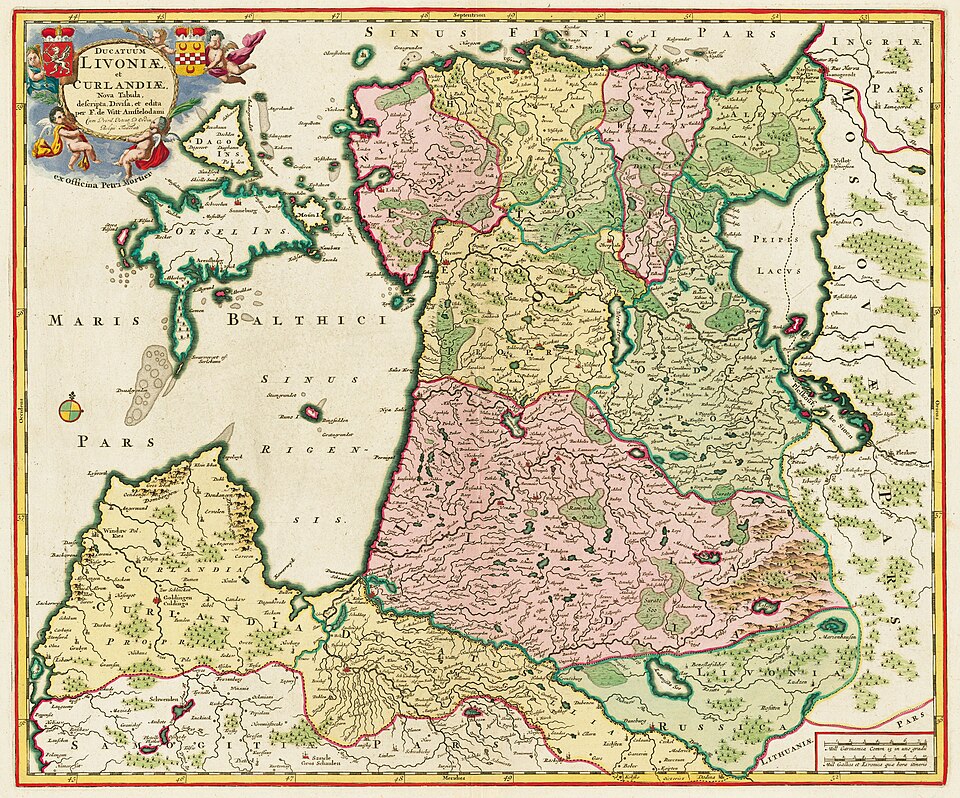
Can you think of a country in Europe that existed in the pre-modern period but vanished completely, leaving almost no trace? The Duchy of Courland is one of these. It was a semi-sovereign state from 1561 to 1795—only semi- since it was legally a fief of the grand dukes of Lithuania, then the kings of Poland, and then a puppet state of Russia. After 1795, Courland was a component of the Russian Empire, and after 1918 it joined with Livonia to become Latvia. And that is how it remains.
Two families ruled as dukes of Courland: Kettler then Büren whose name morphed into Biron. After they were deposed in 1795, the Biron story did not end: the senior line became dukes of Sagan in Silesia, while the younger branch stayed in Russia, then moved to Germany as princes Biron von Kurland.
The name Kurland (German for Courland) took its name from the local people on these Baltic shores, the Kurs (latinised as Curonians), related to their neighbours to the north (Letts and Livonians) and to the south (Semigallians and Lithuanians). The ‘land of the Kurs’ in Latvian is Kurzeme, which survives today as a name for one of the districts of Latvia, the westernmost part of the country. There were early dukes of the Curonians, fierce pagan warriors who defended their coasts against incursions by Christian crusaders; in about 1230, Duke Lamekins agreed to convert his people in return for freedoms from paying taxes to the local bishop. Details of others are very patchy. The later Duchy of Courland—the focus of this post—was usually joined with Semigallia, to the east, with its capital at Mitau, today’s Jelgava. Riga, the major city in this region (and today’s capital of Latvia) was not part of Courland, but was the seat of a prince-archbishopric subject to the Holy Roman Empire. This ecclesiastic principality was set up in the thirteenth century when German knights conquered and Christianised the area and set up the State of the Livonian Order or Terra Mariana (‘the Land of Mary’), which included the lands of the Kurs, except for certain western lands (three separate enclaves) that were set up as a separate Bishopric of Courland, with its capital at Pilten. For the next three centuries, German knights ruled the area as a religious state.
Things began to change in the 1520s as the Reformation arrived in the Baltic. The other German knightly state, the Teutonic Order, to the south, was secularised in 1525 and its last Grand Master, Albert of Brandenburg (a Hohenzollern) became Duke of Prussia, a vassal to the King of Poland. The Livonian elites wanted the same, in part to be defended against the increasing expansion of Orthodox Muscovy to the east. But not all of them—the urban elites in port cities like Riga preferred to join with the expanding trading empires in the Baltic of Sweden and Denmark-Norway. Between 1558 and 1583 various wars raged between all of these external players, and in the meantime, the last Grand Master (or Landmeister) of the Livonian Order, Gotthard Kettler, proclaimed in 1561 a secular state, the Duchy of Courland and Semigallia, with himself as duke, as a client of the Grand Duke of Lithuania (who was also the King of Poland; a few years later these two states formally merged). Fighting continued, and eventually Sweden and Poland-Lithuania defeated Muscovy in 1583. The northern border of Courland was recognised as the river Daugava (Düna in German), and, after several more complicated wars, the rest of Livonia was ceded to Sweden.
Gotthard Kettler came from Westphalia, the flat plain between the Rhineland and the bishopric of Paderborn. The Kettlers were from the ministeriales (administrative) class of minor nobles, with an early ancestor cited in 1210, based in the Sauerland, the hilly forested land in the eastern part of today’s North Rhine-Westphalia state. They acquired castles and estates as vassals of the counts of Arnsberg. By the fourteenth century they were using the name Ketteler, later Kettler, and used a kettle hook (a Kesselhaken) on their coat of arms. The senior line built a castle called Kettelburg (now completely vanished) and died out about 1500.
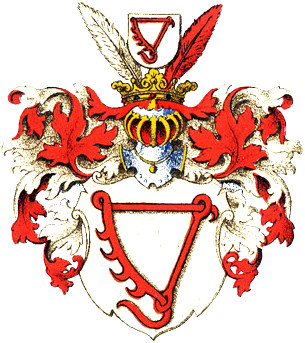
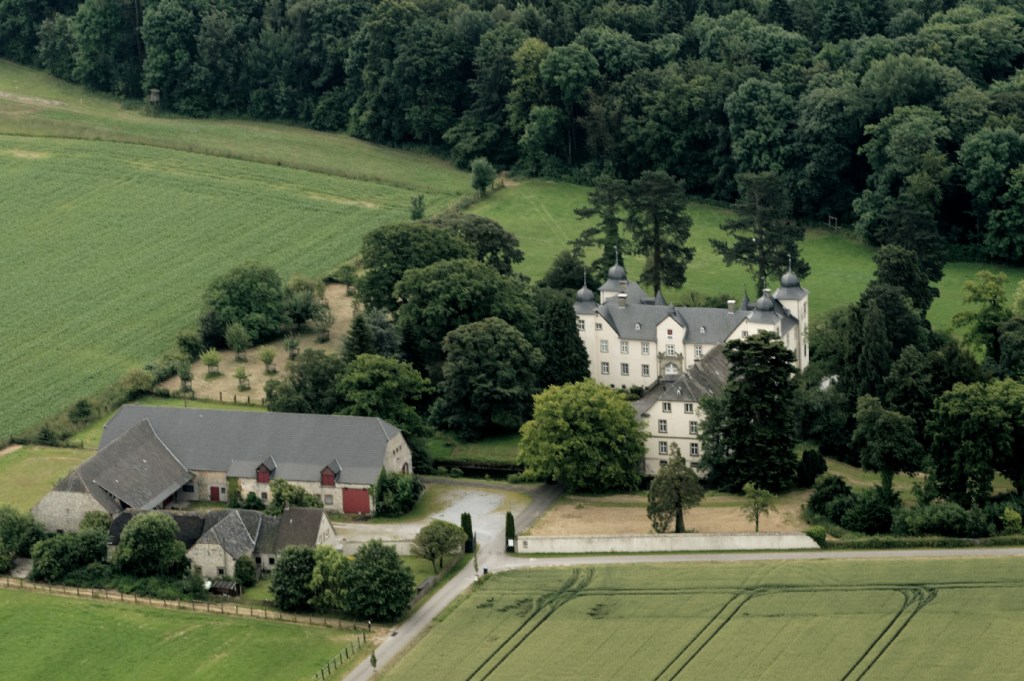
A junior branch split off in the 1380s with the acquisition of a castle called Assen, in Lippetal (the river Lippe runs through Westphalia and gives its name to many places). A Neu-Assen Castle was built in the 1560s then passed to the Counts von Galen for whom it is best known. Gotthard I Kettler acquired the estate of Mellrich a bit to the south, in 1483—this is not too far from Büren, which we will encounter below. The estate included a castle, Eggeringhausen, built in the 1380s by a knightly family, von Mellrich, which the Kettlers eventually sold in the early seventeenth century to other local noble houses.
Gotthard II Kettler of Mellrich had several sons. One of these was Wilhelm, who followed his family’s path of many generations of canons in either Münster or Paderborn cathedral, then rose further and was elected Prince-Bishop of Münster in 1553, but clashed with the Pope over concessions being given to Protestants and resigned in 1558. By this point, his younger brother Gotthard was rising through the ranks as a knight of the Livonian Order. He’d joined up in 1537, and in 1554 was awarded the Komtur (a commandery) of Dünaburg (Daugavpils) on the eastern frontiers with Muscovy/Russia. When the Grand Master of the Order resigned in 1559 due to ongoing crossfire between Poland, Russia and Sweden, Kettler stepped into his shoes, and as we’ve seen, became the first Duke of Courland and Semigallia in 1561—and he converted to Lutheranism. In 1566, no longer a celibate knight, he decided to marry and start a dynasty; his union was a great success (for someone from such a relatively low ranking noble family), in Anna, daughter of Duke Albert VII of Mecklenburg-Güstrow, whose mother was Princess Anna of Brandenburg, sister of the Elector of Brandenburg and cousin of the 1st Duke of Prussia.

During his reign as duke, Gotthard encouraged other former knights to marry and create a new nobility that would dominate this Baltic state for generations. They converted their commanderies into inheritable estates, as did the Duke himself—it is estimated he owned about one-third of the land outright. The Duke also imported governing and economic practices from the German principalities, notably enforcing the enserfment of the local non-German population. He also acquired the last bits of land for the Duchy by purchasing the lands of the medieval bishopric of Courland from Denmark in 1585.
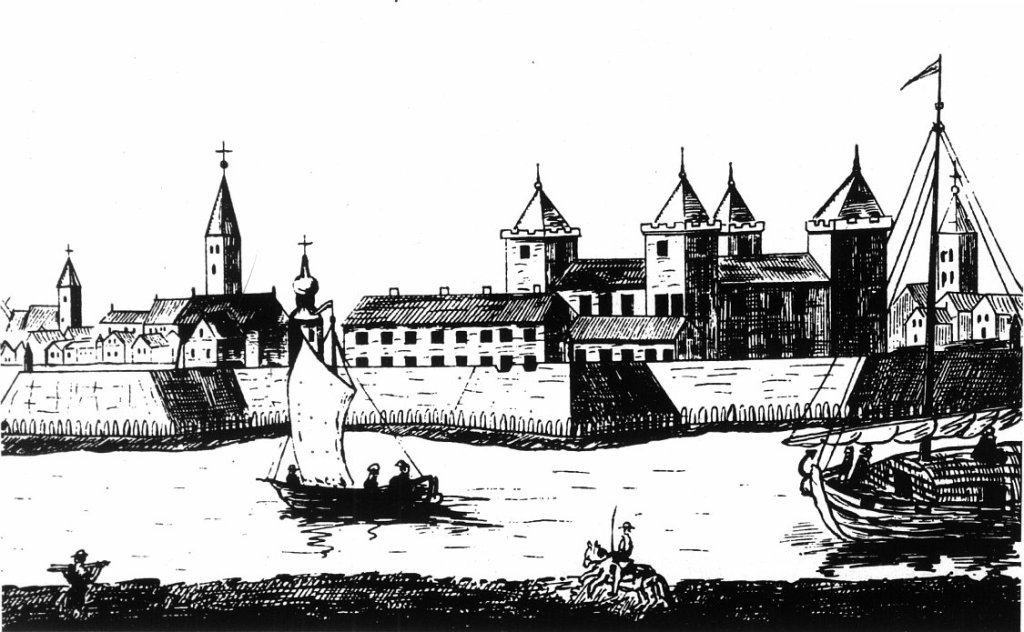
In the 1570s, Duke Gotthard rebuilt the castle at his capital in Mitau. It is unsure where this name came from, but it may be from Mitte in der Aue as it was built in the middle of a river island or floodplain, which in Old German was an Aue or Aa; this makes sense when considering that the modern Latvian name for the town is Jelgava which means ‘town on the river’. The Livonian Order built a castle to guard a crossing of the river Lielupe here in the 1260s We will return to the story of this castle below.
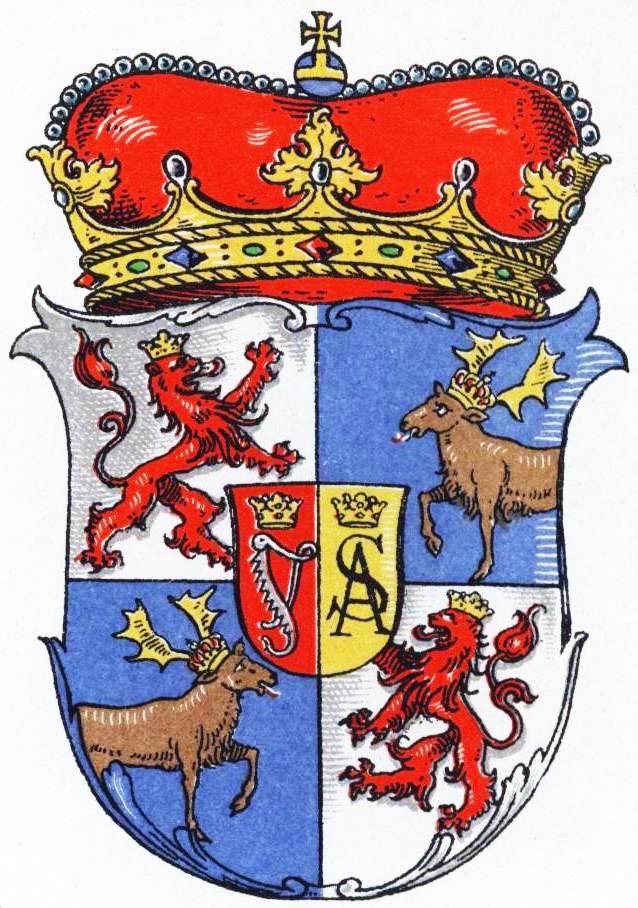
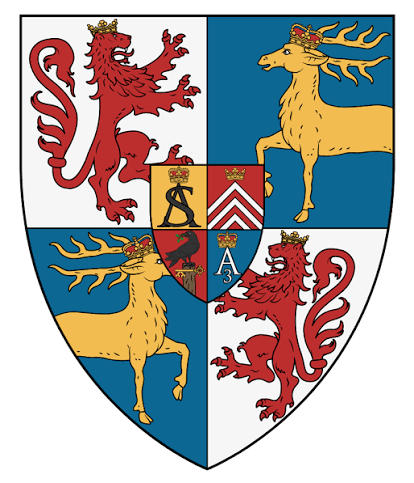
The arms of the Duchy at this point were formed from the emblems of Courland and Semigallia: a red lion on silver and a crowned stag or elk on blue. The Kettler arms were placed in the middle and sometimes combined with the arms of the ruler of Poland-Lithuania (usually the Vasa dynasty) to display feudal loyalty.
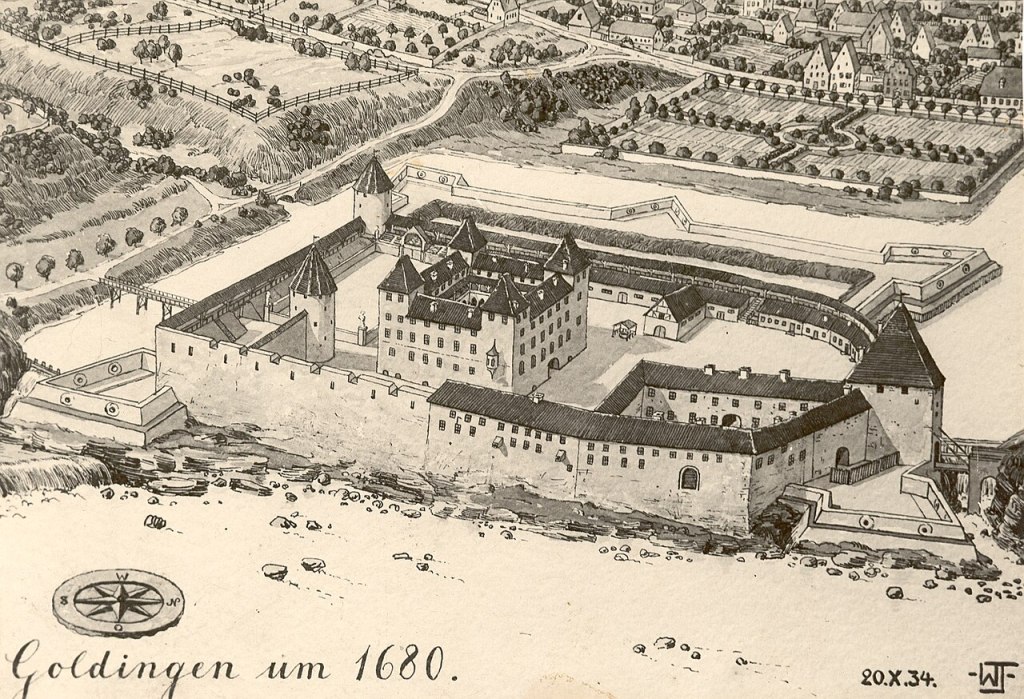
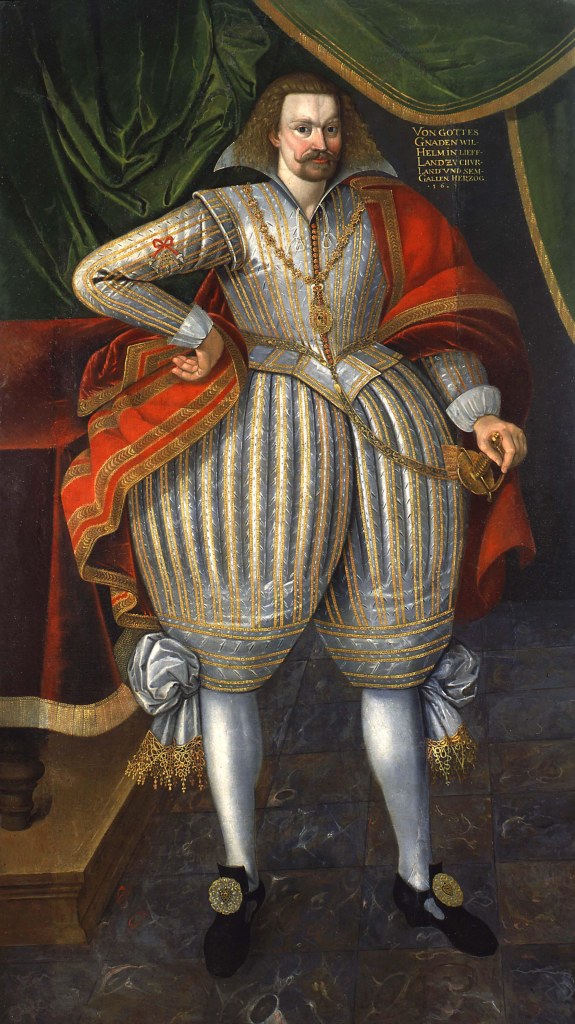
In 1587 the Duchy was divided into two pieces by Duke Gotthard’s will: Semigallia for the eldest, Friedrich, and Courland for the younger, Wilhelm—though the split would not take place until the younger reached his majority in 1596. Both brothers served with the armies of the King of Poland (their feudal overlord) against the invading Swedes. Friedrich resided in Mitau, while Wilhelm established himself at the Castle of Goldingen (today’s Kuldīga, in the western part of modern Latvia). The castle here had been built in the 1240s by the Livonian Order to defend a market town on the river Venta, an important crossroads between Prussia and the large Hanseatic port city of Riga. For much of the later middle ages, Goldingen had been the administrative centre of Courland. After this shifted to Mitau in the early seventeenth century, the castle faded in importance. Sacked by the Swedes in 1658, it was nonetheless rebuilt and upgraded in the 1680s as a summer residence—with a zoo! Looted and burned by the Swedes and Russians in the Great Northern War in the early eighteenth century, it was not restored again and began to collapse. Its remains were dismantled in 1801 and its grounds now form a city park.
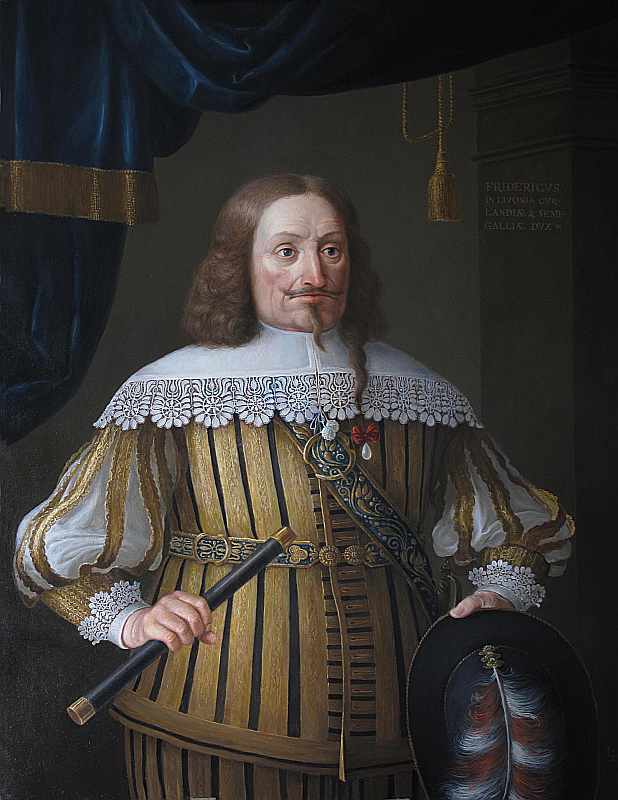
There was no need for two courts anyway after 1617, when Duke Friedrich consolidated his rule over both parts. His brother Wilhelm had ruled despotically in Mitau, and when he executed two of his powerful opponents, the local diet (the Landtag) drove him out and elected his brother as sole duke, reuniting Courland and Semigallia once more. The diet adopted a new constitution that limited the power of the duke and ensured the landholding nobles would have more control—this is the first ‘constitutional monarchy’ in Europe. Wilhelm went abroad and served in the armies of King Gustavus Adolphus of Sweden, gained a few vacant benefices in Pomerania, and died in 1640.
But Duke Friedrich did not have a son, so he adopted his nephew Jacob to be his heir, and his co-ruler from 1638. Although Jacob’s father had been unsuitable, the nobles recognised that his mother, Sophie, daughter of the Duke of Prussia, connected the dynasty to the growing power in the region (though she herself had died shortly after his birth). And indeed, as soon as Jacob was sole duke from 1642, he launched plans to make his small duchy (and himself) very very rich. He opened a shipbuilding industry, constructed a navy and developed the port of Libau (today’s Liepāja) on Courland’s western Baltic coast. One major advantage of this port was that it remained ice-free in the winter—a feature that would later be important to the Tsarist regime of the nineteenth century and the Soviet regime of the twentieth. From Libau, the Duke’s government expanded trade with the Dutch, the English and further, all the way to Portugal. He controlled the collections of customs duties personally, then, extraordinarily for such a small and remote territory, launched colonial ventures. In 1651, he set up a trading base at Fort Jacob on an island in the Gambia river in West Africa, then in 1654, he sent ships to settle the island of Tobago in the Caribbean. ‘New Courland’ received 80 families and was defended by 120 soldiers. In honour of Duke Jacob, there was soon a Fort Jacob, Jacobs Bay and Jacobsstadt.
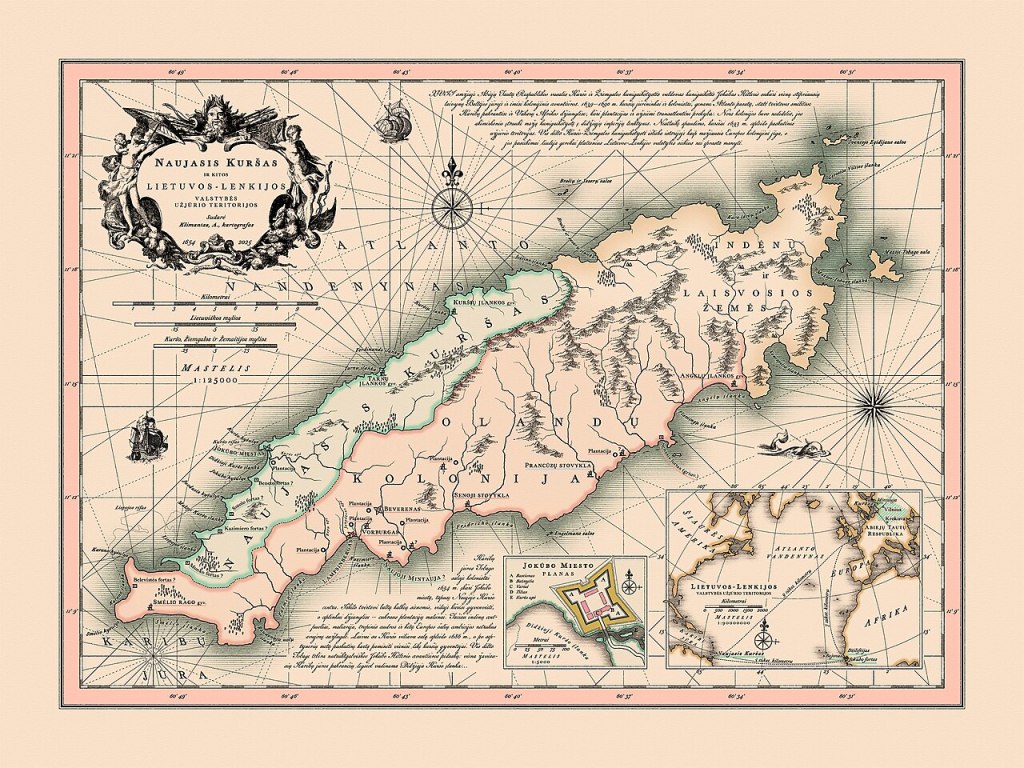
Things went badly when, as part of its war against Poland-Lithuania, Sweden attacked Courland, imprisoned its duke in Riga, 1658-60, destroyed its fleet and took its colonies. When freed by the peace treaty of 1660, Duke Jacob did rebuild the fleet and even retook Tobago (by then in Dutch hands), and he maintained these until his death in 1682. Duke Jacob had married well (as his father and grandfather had done), Princess Luise Charlotte, the daughter of the Elector of Brandenburg (who was now also the Duke of Prussia, a close neighbour, just a few miles south of Libau). So when he died his duchy was passed in a healthy state, with a good ally, to his eldest son Friedrich Casimir.

The 4th Duke of Courland and Semigallia had learned soldiering as a young man, leading a regiment of Courlanders in service of the Dutch against France in 1673. While he was in The Hague he married a cousin of the Prince of Orange, Princess Sophie Amalie of Nassau-Siegen. Once installed as duke in Mitau, he encouraged the first printing of books in Latvian, not German, and tried to continue building on his father’s successes in international trade. But Sweden’s Baltic Empire was booming and by the 1690s wanted to block Courland as a rival. In 1693, he sold Tobago to the English. Looking to reinforce his alliance with the House of Hohenzollern, in 1691, he married as his second wife Elisabeth Sophie of Brandenburg, daughter of the ‘Great Elector’ Frederick William. A new chapter for Courland started, however, when the young Tsar Peter visited Courland in 1697 and took a great interest in its accessible ports.
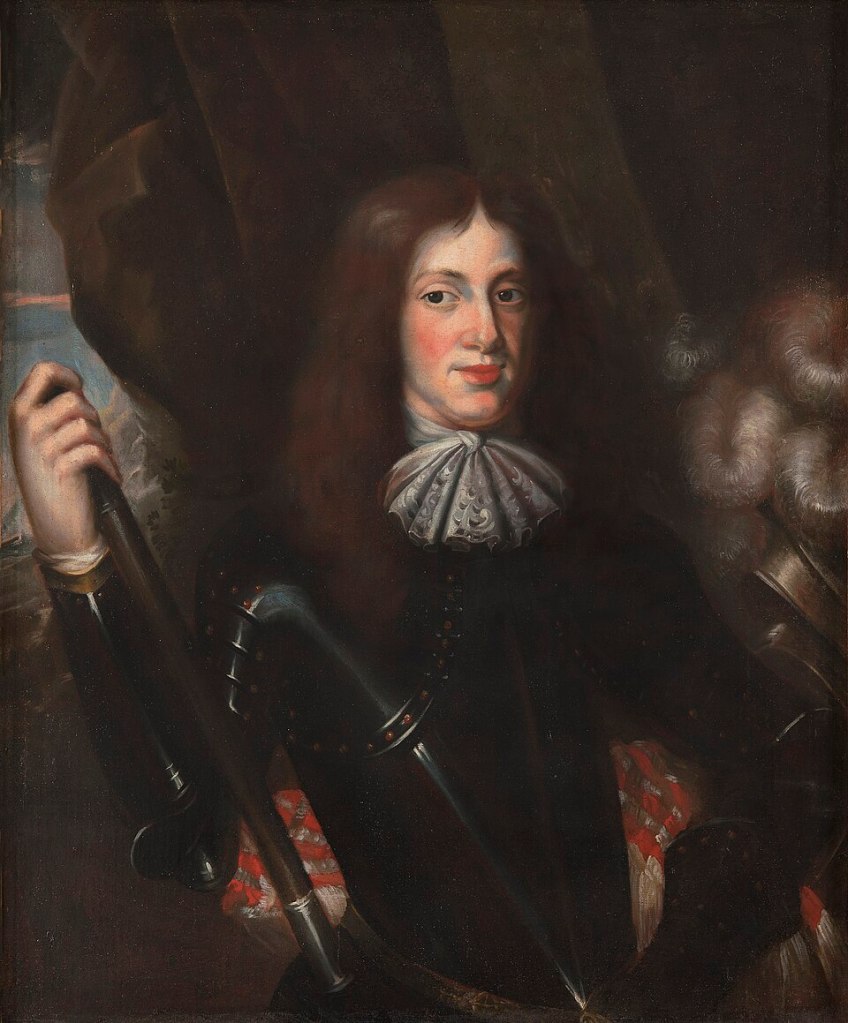
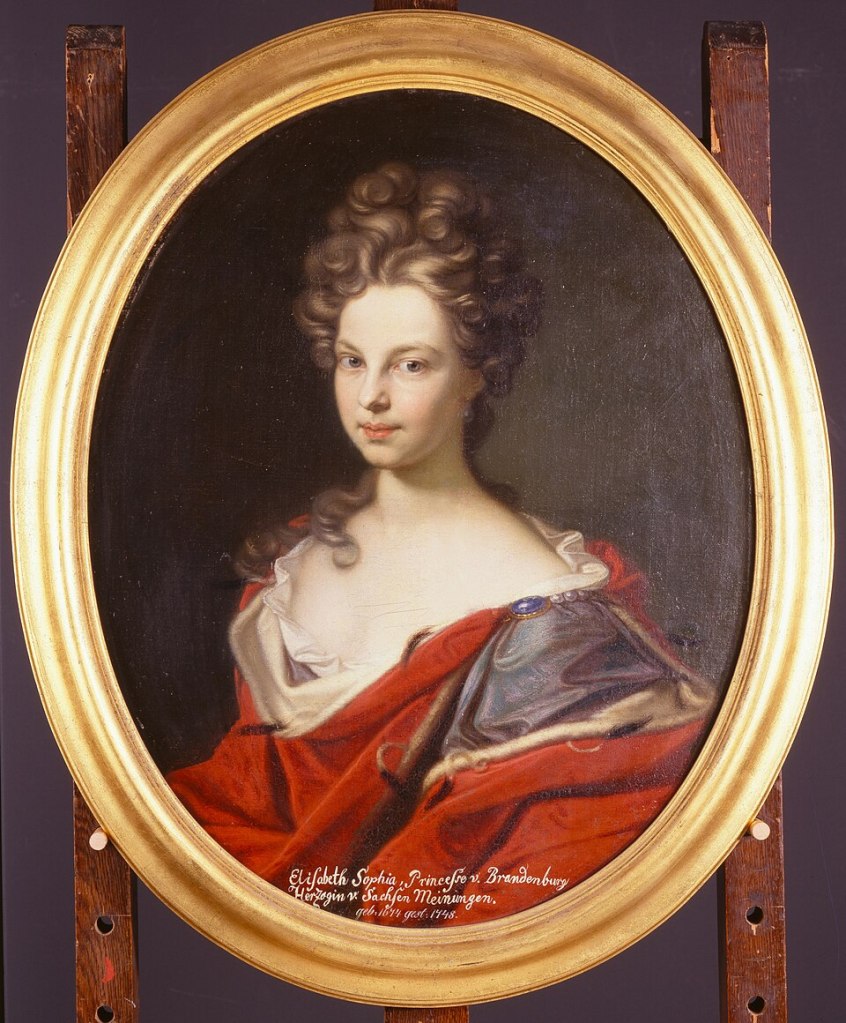
Friedrich Casimir died in 1698, leaving his throne to his five-year-old son Fredrich Wilhelm, under a regency by his mother and his uncle Ferdinand of Courland, who lived in Danzig, a free city under Polish sovereignty on the Baltic (now Gdánsk). When the Great Northern War broke out between Sweden and Russia, the Regent Elisabeth Sophie and her son were forced to flee when Sweden occupied the duchy in 1701. They went to live in Berlin with her brother’s family (now King in Prussia). Peter the Great once again took an interest, and in 1709, engaged the young Duke Friedrich Wilhelm to his niece Anna Ivanovna (or Ioannovna, daughter of Tsar Ivan V), helped him regain his duchy, and brought him to St Petersburg for his wedding in November 1710. Sadly he died on the journey back to Courland in January 1711, and so Anna was installed as Duchess of Courland and Semigallia—legally as the regent, since the throne now passed to uncle Ferdinand—but he remained in Danzig. Duchess Elisabeth Sophie was by now married to the Margrave of Brandenburg-Bayreuth, and then to the Duke of Saxe-Meiningen. Widowed a third time in 1724, she lived on in a small castle in Thuringia for another two decades.

Ferdinand was a soldier—serving in the Polish armies versus the Turks in the 1690s, then attempting to lead the defence of Courland against the Swedes in 1701. The Courland Landtag was not particularly interested in him in 1711, so preferred the benevolent rule of Duchess Anna. She maintained a court in Mitau with a meagre pension from Tsar Peter. Then in 1725, they took a different approach and tried to re-affirm their loyalty to the Polish Crown (still legally the feudal overlord, though mostly a fiction since the reign of Duke Jacob), by electing an illegitimate son of the King of Poland, Count Moritz of Saxony. He already had a reputation as a soldier in the armies of the Holy Roman Emperor. He angled for a marriage to Duchess Anna, but the Tsar sent Russian troops in 1727 to run him out. Moritz moved to France and forged a career there (as Maurice de Saxe), although he did return briefly to Russia in 1742 to press his claims to Courland which went nowhere. The next year he was named a Marshal of France, one of the great commanders of the century.
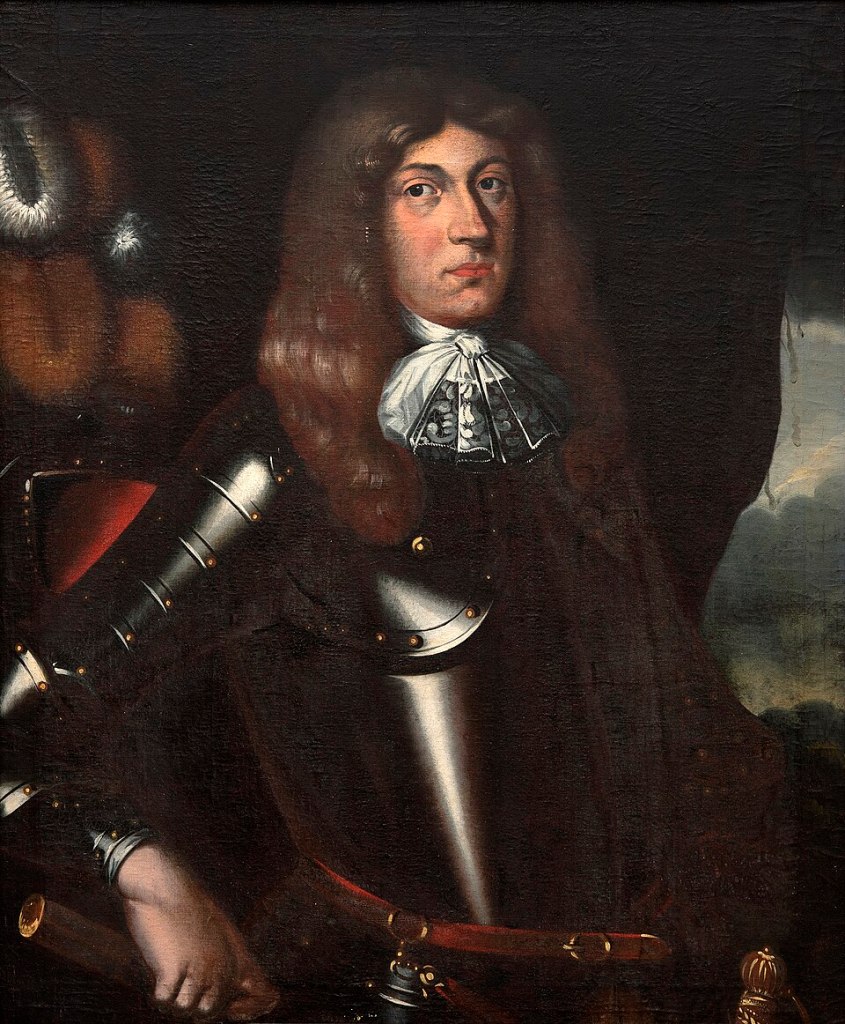
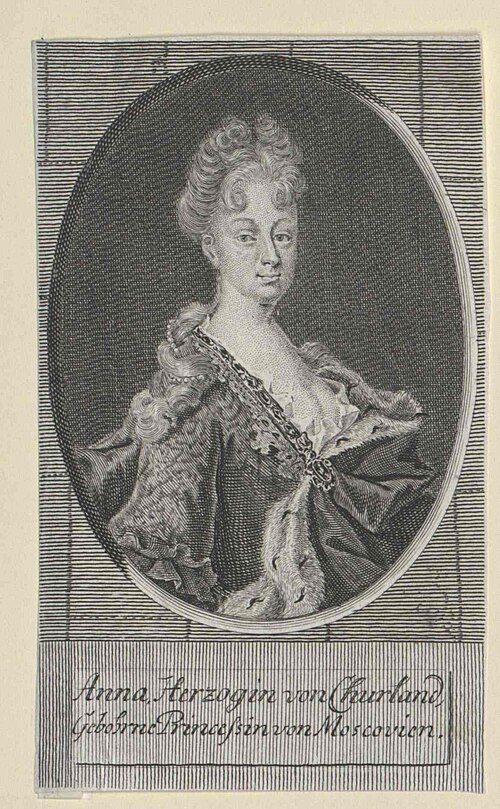
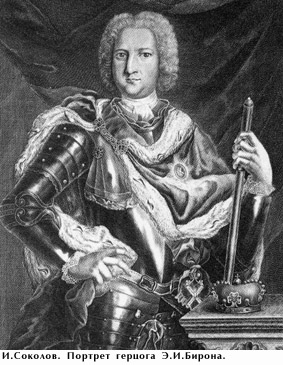
Anna Ivanovna ruled as regent of Courland and Semigalia until 1730 when, through the strange twists of the Romanov succession, she became Empress of Russia. Ferdinand of Courland asserted his right to rule from Danzig, but again the local estates were not interested (and he was by now 76, and only married now to try to get an heir). When he died in May 1737, the estates, in concert with the King of Poland and Empress Anna, chose a local Courland nobleman, Ernst Johann von Bühren, or Biron as it was spelled in Russian. Russia helped Augustus III get elected as King of Poland and Grand Duke of Lithuania, and in return he recognised Biron as Duke of Courland and Semigallia.
So who was Ernst Johann von Bühren? His story is one of the great success stories of the eighteenth century. One of great rise, great fall, and then rise again. The noble House of Bühren (or Büren) came from the same region of central Germany as the Kettlers, only a short distance from the Kettler base in Westphalia, and indeed, had first come to this region in the retinue of Gotthard, 1st Duke of Courland. The family as a whole had many branches and there were several who made their mark in German history, in government and military, most notably Moritz, Baron zu Büren, President of the Imperial Supreme Court (the Reichskammergericht) between 1629 and 1644. NB: This family is not to be confused with the princes von Bülow, from Mecklenburg; nor is it related to the dukes of Biron in France (the Gontaut family, based in southwest France); or the family of US President Martin van Buren, whose Dutch ancestors were perhaps from the town of Buren, an imperial county in the Middle Ages held by the houses of Egmont then Orange (and the Dutch king is still called the Count of Buren). These Bührens, Lutherans, settled in Semigallia, on an estate called Kalnciems, on the Lielupe river downstream from the capital Mitau. They were ennobled by the King of Poland in 1638.
Ernst Johann, born 1690, was an adventurer from a young age: expelled from the University of Königsberg, he travelled abroad looking for employment in various courts. One of his sisters became a lady-in-waiting to Anna Ivanovna when she was Duchess of Courland, then became the mistress of Peter Bestuzhev, Anna’s minister in Courland (and perhaps her lover). Bestuzhev ran Courland from 1715 to 1728 when he was run out, accused of mismanagement and supporting the candidacy of Moritz of Saxony as duke. Büren, now Biron, had been given a job at court in Mitau, as the Duchess Anna’s secretary, and now took over the running of the Duchy from his former patron. He also became Anna’s lover, though in 1723 he married one of her ladies-in-waiting, from a local noble family (von Trotha) probably to help hide the affair. But when Anna moved to Moscow to take over the government of Russia in 1730, Biron went with her. At her coronation, he was named a count and Grand Chamberlain of the Russian court. When Anna crushed the old aristocratic faction at court, Count Biron became virtual ruler of Russia at her side. His opponents were executed or exiled—it was said that the Germans had taken over the Russian court. He became very rich.
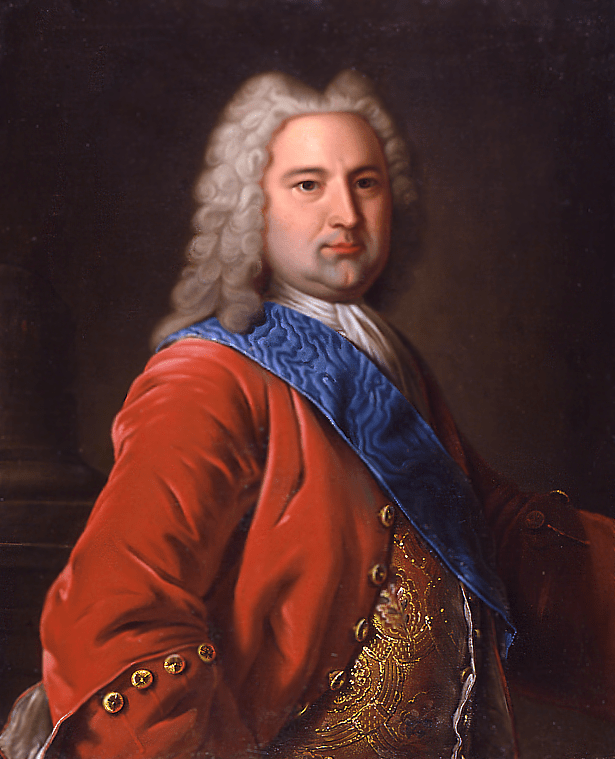
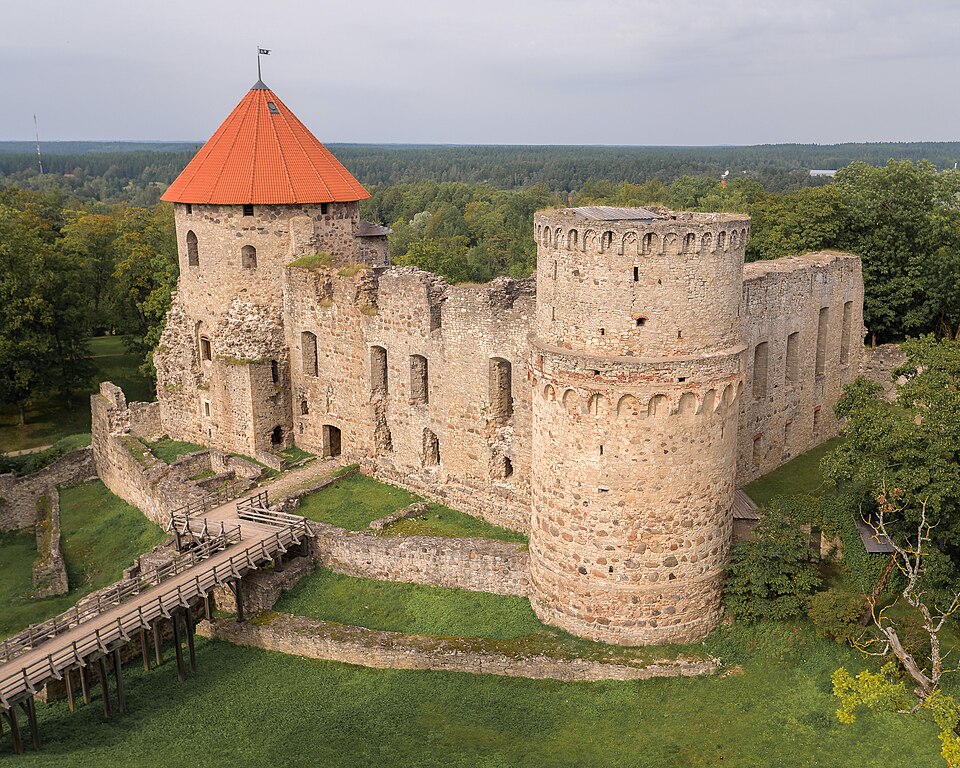
Back in Courland, Biron was given an estate, Wenden (northeast of Riga, so actually in Livonia, which became part of Russia in 1721). This estate had a fine castle, built by the Livonian Order and for many centuries the seat of its Grand Master. Today the castle ruins are among the tourist highlights of Latvia.
In 1737, as we’ve seen, Ernst Johann was elected Duke of Courland and Semigallia, to replace the last of the Kettlers. He changed the coat of arms of the duchy, replacing the Kettler escutcheon with that of Büren: a black raven holding berries in its beak, sitting on a small tree with a gold key. Other elements added included a large crowned A S monogram in one quarter and with an A 3 in another (I think these stand for Augustus of Saxony and Augustus III, the Courland feudal lords, but I am not sure); and crowned silver chevrons on red.
But the Duke stayed at the Empress’s side in Moscow or St Petersburg. His older brother Karl was named a general and Governor of Moscow; his younger brother Gustav was also named a general. When Anna died in October 1740, Biron was named Regent for her adopted heir, her infant grandnephew Ivan VI. Just three weeks later Biron was driven out by a rival faction and condemned to death, commuted to exile in Siberia, along with his brothers and all his family. His estates in Courland were confiscated. But in Spring 1741, a palace coup installed Elizabeth Petrovna as the new Empress, and Biron was allowed back from Siberia, but ordered to live in Yaroslavl, still quite far from court.
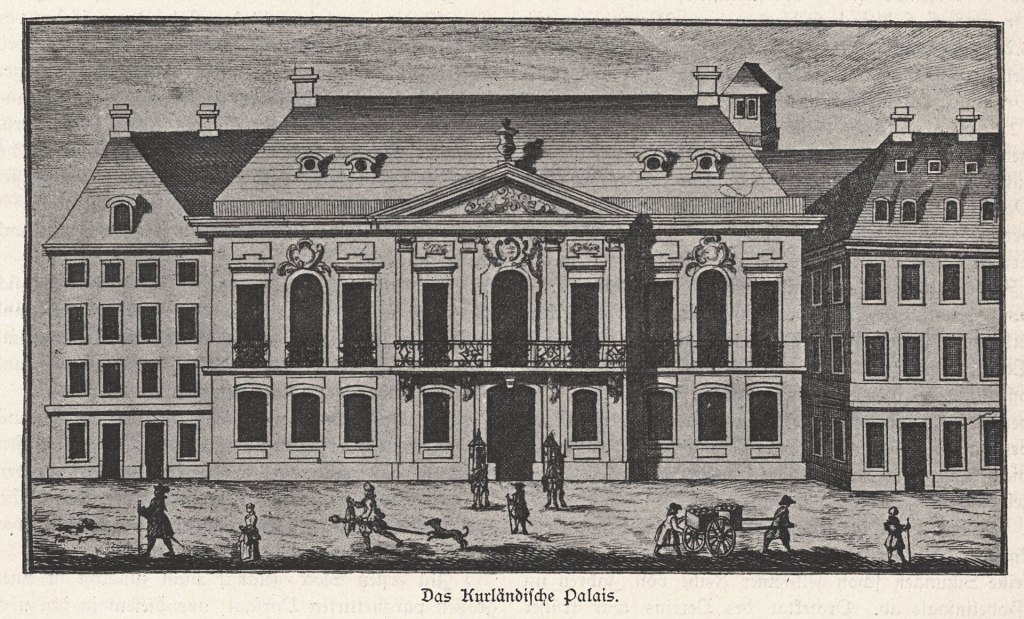
Meanwhile, in Courland, Biron was at first replaced by Ludwig Ernst of Brunswick-Wolfenbüttel, young Ivan VI’s paternal uncle; but with Ivan’s deposing, Brunswick went too. Empress Elizabeth left the matter of who would govern Courland (still legally a fief of Poland, so really none of her business) unresolved for nearly two decades, before concocting a plan in 1758 to help her cosy up to the regime in Poland-Lithuania (enemies of her enemies in Prussia), encouraging the local estates to elect the fifth son of King Augustus III, Prince Karl of Saxony, as their duke. This they did, but there was an immediate clash, since they elected him as a very limited ruler who would not attempt to curtail their freedoms, whereas his father, as feudal overlord of Courland and Semigallia, appointed his son without any restrictions. Karl was also a Catholic prince in a Lutheran state. Nevertheless, he held on, maintaining a festive court in Mitau, until Catherine II deposed him in 1762 and restored Biron. Prince Karl moved back to Dresden where he acquired a baroque palace on the edge of the old city (fairly close to the Frauenkirche), which he renamed the Kurländer Palais. When he died 1797 it was acquired by the royal family of Saxony who used it for various purposes. Mostly destroyed in 1945, it was rebuilt in 2006, and still reflects in its name Dresden’s brief encounter with far-off Courland.
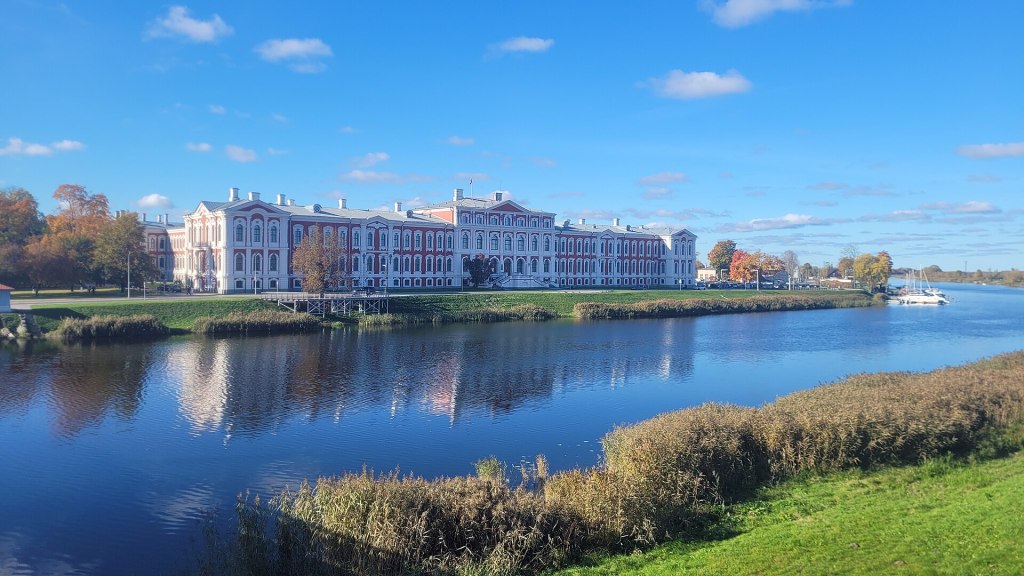
With the death of Elisabeth and the coup of Catherine II, Ernst Johann von Biron was once again restored to his throne in Courland. He set about completing the building of two of the most impressive palaces in the Baltic: Mitau and Ruhental (Rundāle).
Back in 1736, Biron had lured one of Empress Anna’s favourite architects, Bartolomeo Rastrelli, to Courland, and commissioned him to completely rebuilt the old castle at Mitau, destroyed in the Great Northern War in the previous decade. Rastrelli was the son of a Florentine but was himself born in Paris; his most famous works in St Petersburg include the Winter Palace and the Smolny convent, both commissioned by Empress Elizabeth in the 1740s. By the time Rastrelli returned to work in Mitau in the 1760s, tastes had changed somewhat, so this enormous palace (for such a small state) blended baroque with classical styles. After Courland was absorbed by the Russian Empire at the end of the century, Mitau Palace was put at the disposal of the exiled Louis XVIII of France and his small court in 1798. It was here that the most important event staged to keep alive the flame of royalism (in the face of the rise of Napoleon back in France) was held in 1799: a wedding between the King’s niece Marie-Thérèse Charlotte (‘Madame Royale’, the daughter of Louis XVI and Marie-Antoinette) and his nephew, the Duke of Angoulême. Though the French court had to leave Russia in 1801, they were allowed back in 1804, only to be sent away again in 1807 when the Russian Emperor made overtures to Bonaparte. The Palace at Mitau was the seat of the Governor of Courland until 1915. During the Russian civil war its interiors were burned, 1919, by a retreating army of Whites. From 1939 the Latvian Academy of Agriculture was established here. Badly damaged again in World War II, its exteriors were restored in the 1950s, but not the interiors, and the Academy was re-opened (now the University of Life Sciences). The only part visitable for tourists is the ducal crypt underneath one of the wings. But the exteriors alone are worth the visit.
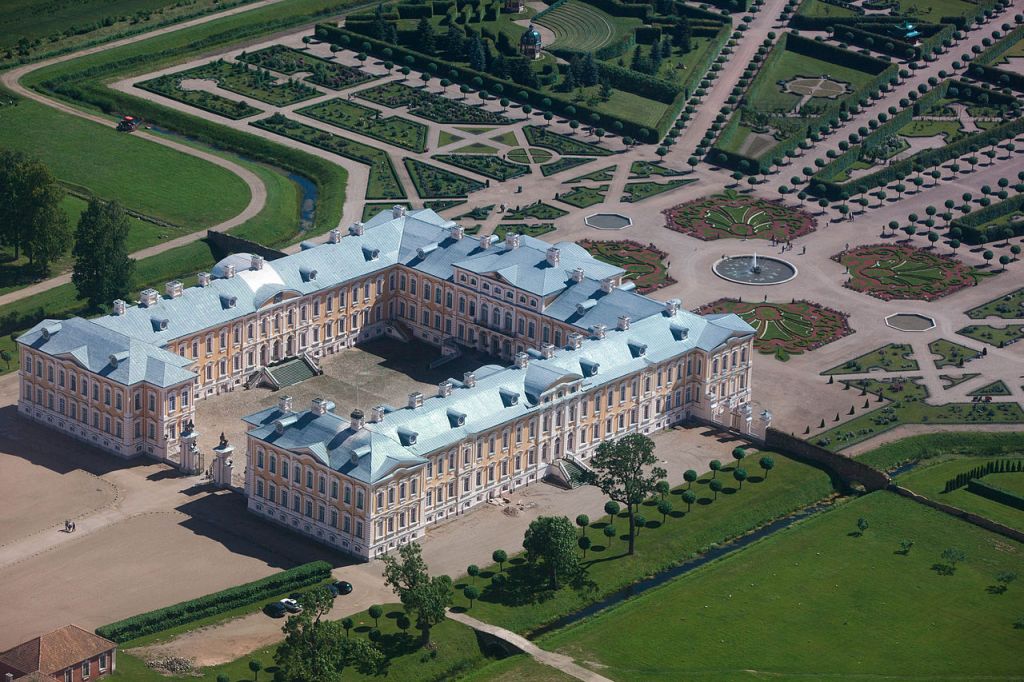
Happily, the interiors of the second Rastrelli designed palace have been fully restored and are now one of the most visited tourist spots in Latvia: Rundāle. Called Ruhental in German, it was designed to be the summer residence of the dukes, a short distance southeast of Mitau. Also built in two phases (1730s, 1760s), it became famous for its stucco decorations in the White Hall and its gardens inspired by Versailles (indeed, it is referred to as the ‘Versailles of Latvia’). After the Birons ceased to reign in Courland, the palace was given to Count Valerian Zubov, the brother of Catherine II’s last great love, Platon. The latter inherited it in 1804, then his widow who remarried Count Shuvalov. Ruhental stayed in this family for the next century, then, like Mitau, it was badly damaged by retreating White Russians. In 1920, the new Republic of Latvia used the palace to house a school and a home for military veterans. In 1933, the Ministry of Education renovated it further as a school (the dining room was used as the gymnasium). Then starting in about 1970, the state began to restore Rundāle Palace as a museum, a long slow process that only concluded in 2015, to stunning effect.
In 1769, Duke Ernst Johann ceded his duchy to his son Peter. Peter had been born in Mitau in 1724, then was raised at the Russian court until he was exiled with his father in 1740. He married first a princess from the German house of Waldeck, then a Yusupov princess (a marriage that ended in divorce). Finally in 1779, once in charge in Courland, he married for the third time Countess Dorothea von Medem, from an old Baltic German noble family, whose father had been a prominent general in Russian service. Duke Peter was 55, and she 18, but he badly needed an heir; what he got was four daughters, all beautiful and intelligent, who will be looked at individually below.
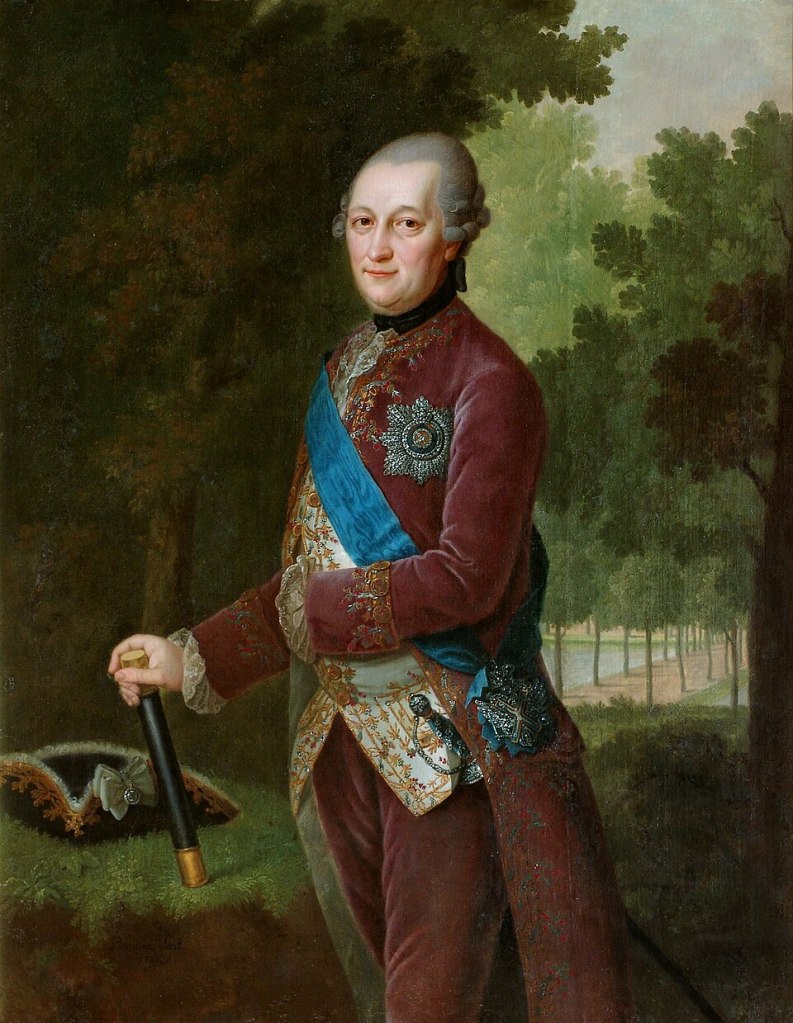
Duke Peter Biron wanted to restore Courland to its former glory. He restored and enhanced his palaces at Mitau and Ruhental, and wanted to build a university in his capital. So in Mitau he founded the Petrine Academy, and invited scholars to move there from the University of Königsberg, notably the famous philosopher Emmanuel Kant, who declined. The Academy does still survive today and is one of the attractive sights of modern Jelgava (now a history and art museum).
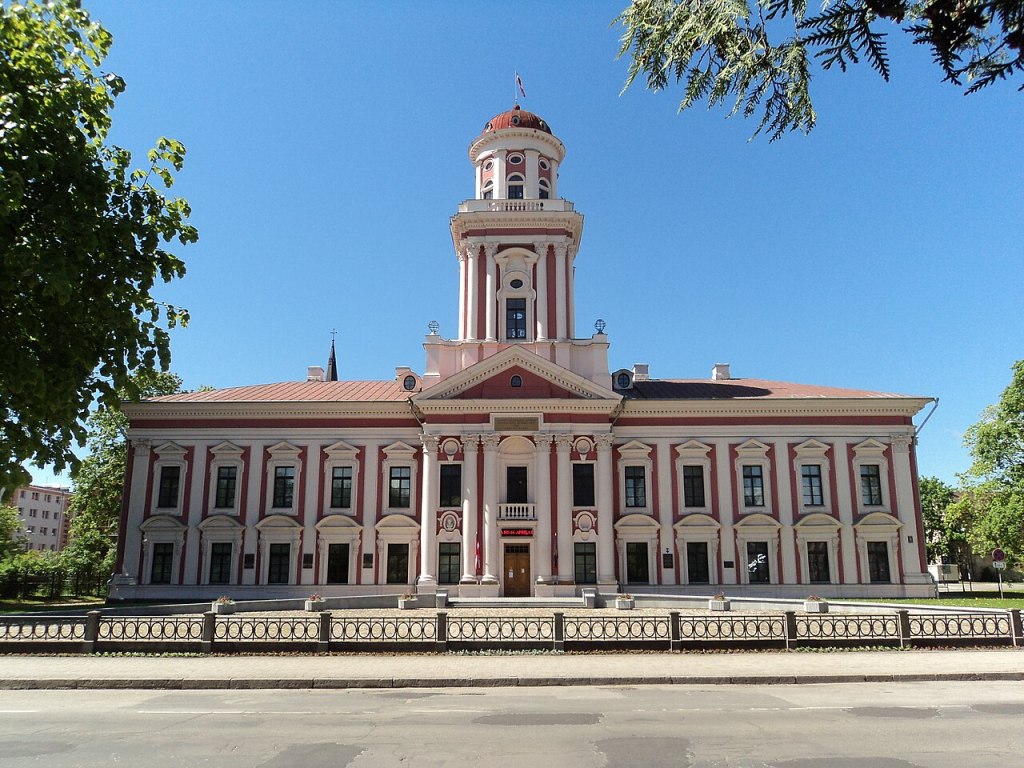
Yet Peter’s reign was not popular amongst his Courlandish subjects, and seeing that the days of the Polish-Lithuanian Commonwealth—of which the Duchy of Courland and Semigallia was at least still notionally a part—were numbered following the first and second partitions of the 1770s-80s, Duke Peter aligned himself increasingly with Prussia, and began to spend more time in Berlin. He purchased a palace with extensive parklands, Friedrichsfelde, in the Lichtenberg district (now an eastern suburb). This country manor had been purchased and renamed in 1699 by Elector Friedrich III (soon the first King of Prussia), who soon gave it to his half-brother the Margrave of Brandenburg-Schwedt. In 1762, his heirs sold it to Frederick the Great’s younger brother Prince Augustus Ferdinand, who then sold it to Biron in 1786. Biron had it redesigned along neoclassical lines. In 1816, Friedrichsfelde was acquired by the von Treskow family who held it until 1945. Today its large parklands have been turned into the Tierpark, a zoo, while the house is used for concerts.
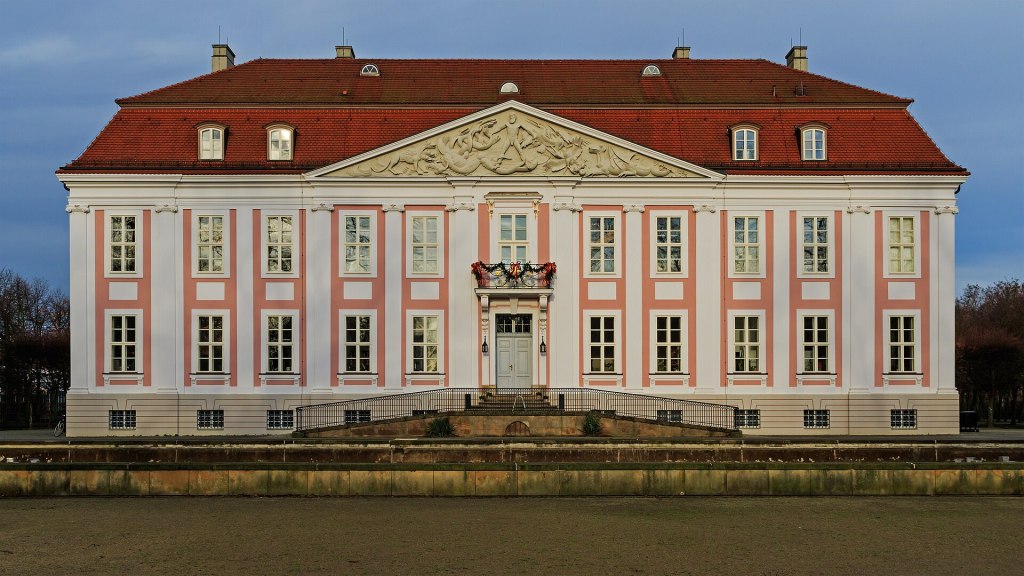
Also in 1786, the Duke purchased the Duchy of Sagan in Silesia from the Lobkowitz family. Sagan, today’s Żagań in Polish, was one of the many semi-sovereign duchies that made up of the medieval Duchy of Silesia—once part of the Polish Crown, but from the early fourteenth century part of the Bohemian Crown. One of the northernmost of these sub-duchies, Głogów, was divided between heirs in 1274, so Żagań was off and on independent until it was acquired by the dukes of Saxony in 1472, who imported Lutheranism during the Reformation, then acquired by the King of Bohemia directly (that is, Emperor Ferdinand I), in 1549. Ferdinand II gave it to his best general Wallenstein in 1627, then to the Bohemian princely house of Lobkowitz in 1646, who converted the old castle of Sagan into a baroque palace. From 1740, Silesia was part of the Kingdom of Prussia, but Sagan remained semi-sovereign within it; after 1815, however, Sagan’s sovereignty was removed, but its dukes remained members of the local diet of Silesia and also had a seat in the Prussian House of Lords. Biron’s heirs continued to hold it (as we will see below) until Silesia became part of Poland in 1945 and all feudal estates were confiscated. After a period of restoration in the 1960s-70s, the palace was refitted as a cultural centre for the town of Żagań.

In 1795, when the final partition of Poland-Lithuania did come, Duke Peter formally ceded Courland and Semigallia to the Russian Empire in return for a huge sum of two million roubles and a large annual pension. Already very wealthy, he was now one of the richest men in all of Europe—though it would be his daughters who would enjoy this great wealth more than he. The last Duke of Courland died in in 1800, in Gellenau, Silesia (now Jeleniów), a palace of his neighbour the Count von Mutius, of an overdose of mercury (prescribed by Mutius himself, despite Biron not having syphilis). He was later reburied at Sagan in the Church of Grace, one of several Lutheran churches built in Silesia in the early eighteenth century. Rebuilt by the Duke’s daughters in the 1840s to serve as a family mausoleum, its large brick tower survives today, the rest having been demolished (and the crypt ransacked) in the 1960s.

Dorothea, the former Duchess of Courland—remember, much younger than he—had raised her daughters mostly in Sagan. While her husband still ruled, she had been sent on diplomatic missions to employ her charm in the courts of Berlin and St Petersburg to ensure their family survived the coming partitions of Poland. She became alienated from her husband and took lovers, and by 1793 was already living in Berlin at Fredrichsfelde, where she gave birth to the youngest daughter, Dorothea—probably not Peter’s daughter, the assumed candidate is Count Aleksander Batowski, a Polish envoy to the Duchy of Courland.
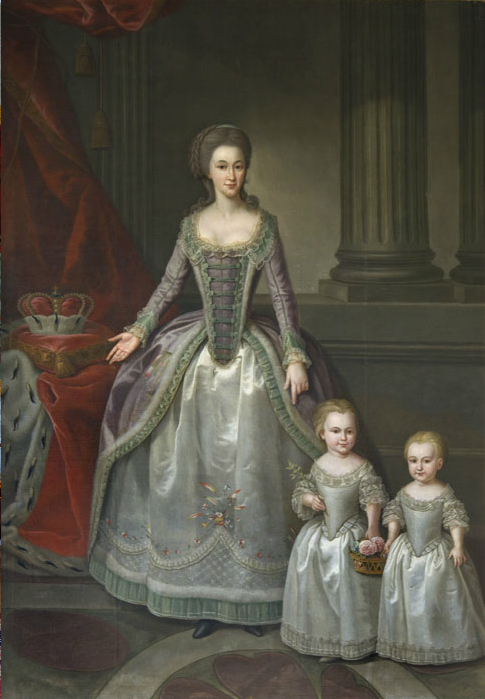
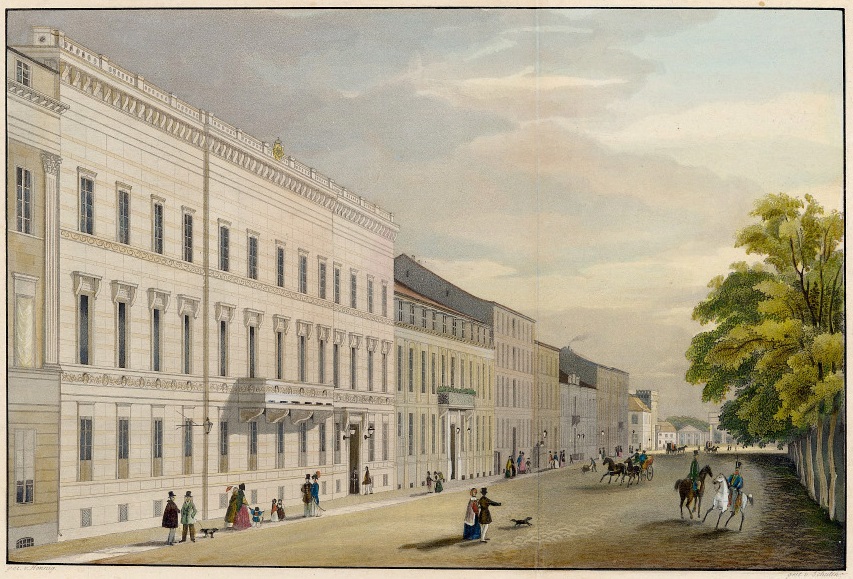
In the city itself, Dorothea resided at a large palace on Unter den Linden: the Palais Kurland. This building was originally built in the 1730s, and from the 1760s was owned by Princess Amalie of Prussia, sister of Frederick the Great, then from the 1780s by Crown Prince Frederick William. Online sources conflict about when it became property of the Birons: one source says it was purchased by Duke Peter in the 1780s, and another says by Duchess Dorothea in 1805. In any case, it passed to her youngest daughter Dorothea by the 1820s, and retained the name Courland Palace even after it was sold in 1837 to Tsar Nicholas I who rebuilt it in the 1840s to use as the Russian embassy. Destroyed during World War II it was completely rebuilt in the 1950s as the embassy of the Soviet Union, and it remains the Russian embassy today.
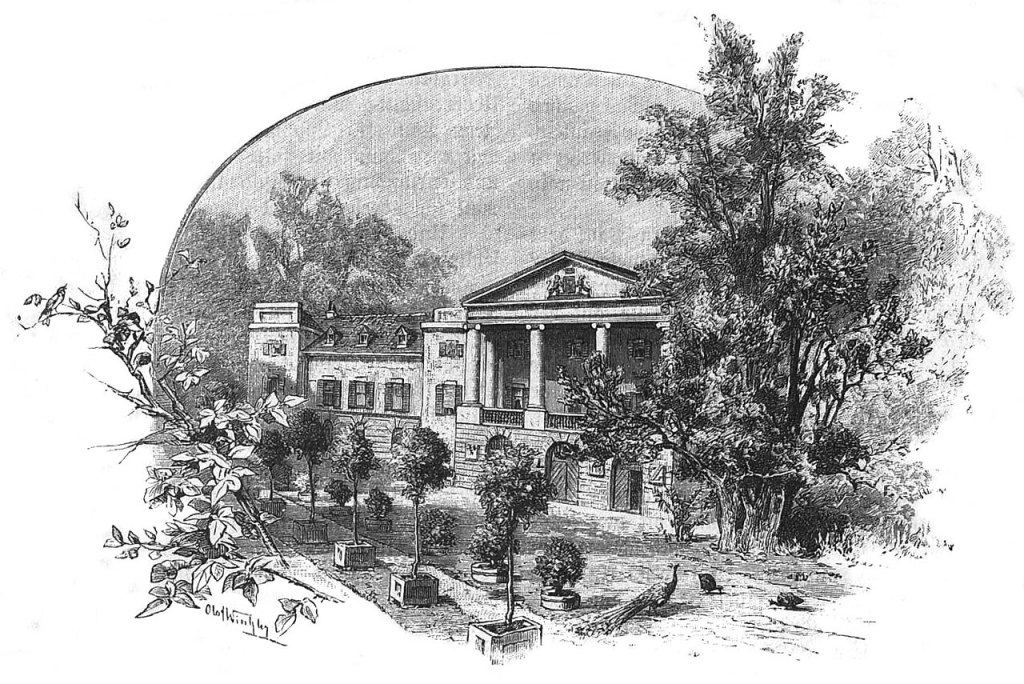
Desiring her own country residence, in 1794 Duchess Dorothea purchased the lordship of Löbichau in Thuringia (within the Duchy of Saxe-Altenburg) and built a summer palace in neoclassical style. A manor house here had been owned by various nobles since the fourteenth century. The Duchess now expanded the house and added a garden in English style. She also built a smaller Tannenfeld Palace nearby in ‘baroque revival’ style. At Löbichau she hosted a salon for poets, writers and princes, known to many as the ‘court of the muses’. Famous visitors included Tsar Alexander I and Napoleon, Talleyrand and Metternich, and artists like Goethe, Schiller and the patriot poet Theodor Körner. Such was Dorothea’s reputation for beauty and intelligence that princes proposed to her, like Prince Frederick Alfred of Sweden (youngest brother of King Gustav III) in 1801. After 1809, she moved to Paris where her daughter had become entrenched in the new courtly society of Napoleon and his first minister Talleyrand—some say it was she who began to turn Talleyrand against his master, with consequences that affected the entire continent. The last Duchess of Courland died in Löbichau in 1821 and was later reburied with the rest of the family in Sagan. The estate in Thuringia passed to her third daughter, the Duchess of Acerenza, and eventually to her niece Luise von Tümpling, who in 1908 turned Löbichau Palace into a school for girls. After the 1950s it was used as an administrative building for the local government which in 2009 demolished it and rebuilt it (still as a neoclassical structure) to use as a nursing home.
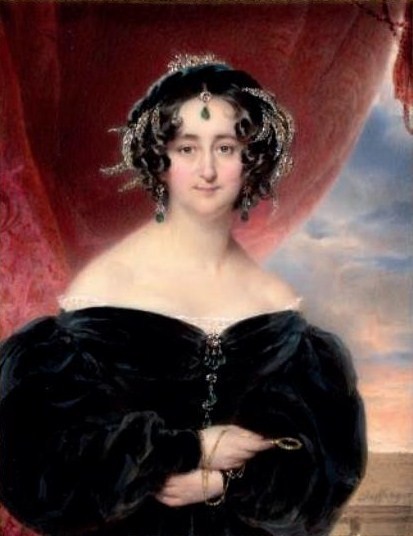
The eldest daughter of Duke Peter and Duchess Dorothea, Princess Wilhelmine of Courland (also known as Wilhelmine von Sagan), was—like her mother—known for her beauty and intelligence. But like a lot of aristocrats her generation (born in the 1780s) she was inspired by the revolutionary age and wanted to be free from society’s rules and regulations about courtship and marriage—as we will see with all the Courland sisters. As a teenager, she fell in love with her tutor, the Swedish Baron (later Count) Gustaf Armfelt—a general, courtier and statesman, much older, already married … and her mother’s former lover!—and bore him a daughter in 1801: Adelaide Gustava, whisked away to be raised by his relatives. The year before, Armfelt and her mother arranged for Wilhelmine to be married to Prince Louis de Rohan-Guémené, younger brother of the Duc de Montbazon—both already in exile and fighting in Austrian service. She was a great catch, since her father had left her the Duchy of Sagan in Silesia, plus several properties in Bohemia. And it was Bohemia in which the Rohan émigrés were beginning to settle, so it seemed like a good match.
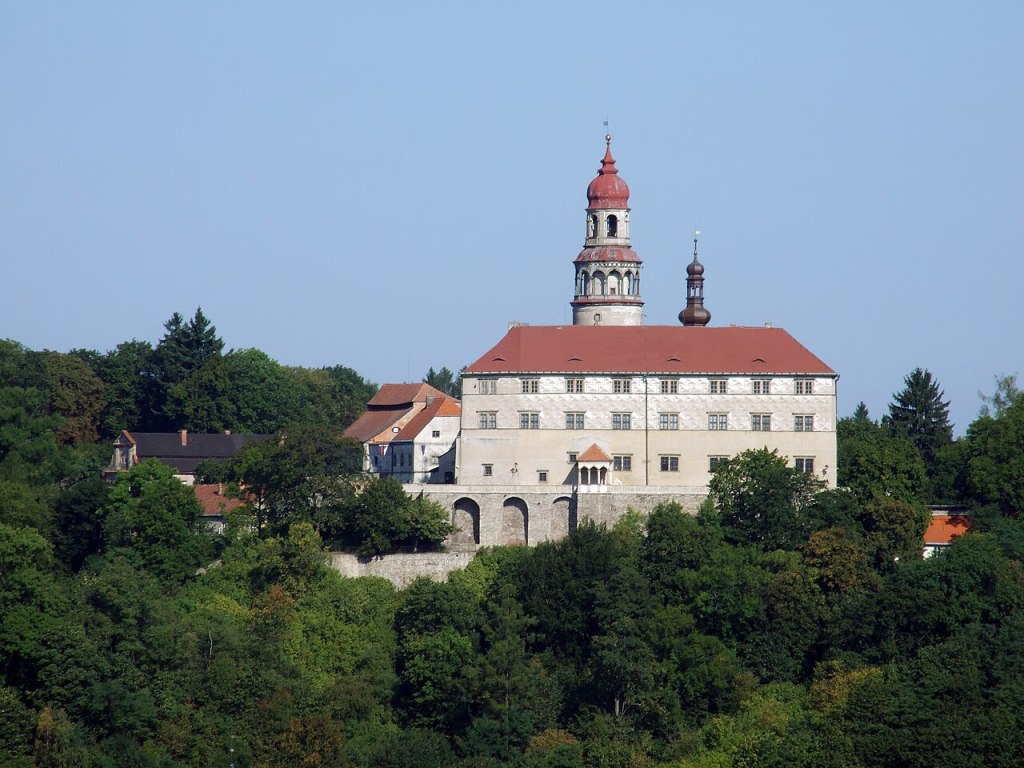
Wilhelmine is known in Czech history as Kateřina Zaháňská (her full name was Katharina Wilhelmine; the surname means ‘of Sagan’). Her major estate in the Kingdom of Bohemia was Náchod, in the far northeast. Its name translates as ‘the place of arrival’ which was appropriate for this town on the borders with Polish Silesia. There was a castle here from the thirteenth century, important enough to be held by Bohemian kings in the Middle Ages, and the powerful Poděbrady family in the fifteenth century. Sold to the noble house of Simiřický (or Smiřičtí) in 1544, the castle was refashioned as a Renaissance palace. But as Protestants, they were deprived of their estates in the aftermath of the Battle of White Mountain, 1620. Náchod was eventually given to General Ottavio Piccolomini in 1634. His family remodelled the palace once more in a more baroque style, and held it until the line was extinct in 1783. Sold to Peter von Biron in 1792, he modernised it as a residence and built a theatre here to entertain guests. After his daughter Wilhelmine’s death in 1839, it was purchased by the Prince of Schaumburg-Lippe whose descendants held it until confiscated by the state in 1945.
Just a few miles in the countryside to the west was Ratibořice which became one of Wilhelmine’s preferred residences. It was also formerly part of the Simiřický then Piccolomini estates—the latter built a summer palace here in 1708, modelled on an Italian villa. Wilhelmine rebuilt it in the 1820s along neoclassical lines, and lavishly furnished it and equipped it with a large library. Ratibořice palace also passed to the Schaumburg-Lippe family until 1945.
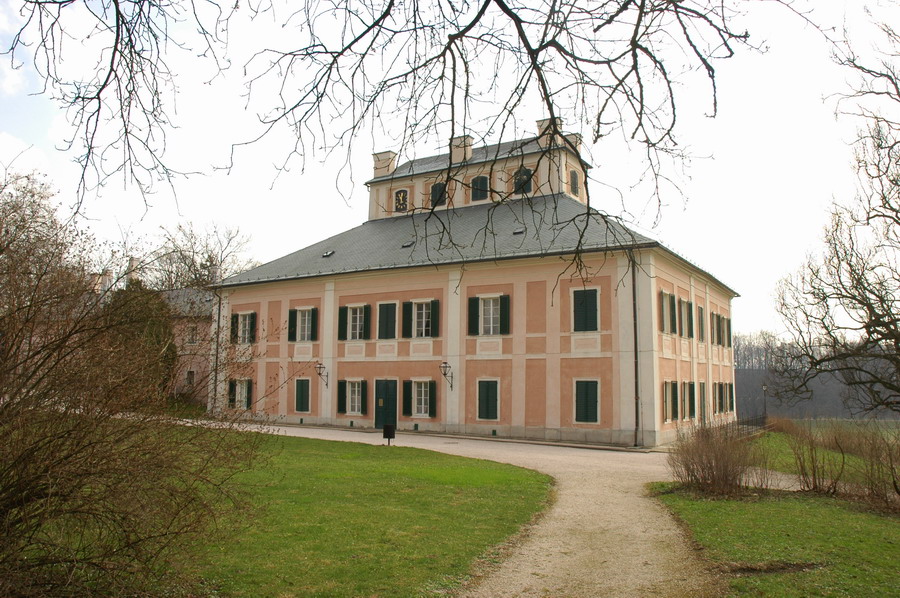
The Duchess of Sagan spent her winters in Vienna, where she set up an elite salon and had a string of lovers. Her marriage to Prince Rohan ended in divorce in 1805; and while she re-married soon, to Prince Vasily Trubetskoy, that also ended within a year. By 1813, she was in a relationship with Prince Metternich, the most powerful man in Vienna if not in Europe. Their correspondence has been published and reveals her influence in his decision to re-create an anti-French coalition, with emissaries meeting in Ratibořice, which ultimately led to Napoleon’s defeat in 1814. She then had a relationship with Prince Windisch-Graetz, one of the leading soldiers in this effort. In 1819, the Princess married a third time, to Count Karl Rudolf von der Schulenberg—this marriage also ended in divorce, in 1828, and she spent the rest of her days in Vienna where she died.
Wilhelmine’s residence in Vienna was a rented wing of the Palais Palm, the former residence of the Prince of Palm, in the aristocratic quarter near where the Burgtheater now stands. During the Congress of Vienna, the other half of the palace was rented out to her rival, Princess Katharina Bagration, and both of their salons became a hotbed of romantic intrigues and international espionage. The building was demolished in 1857, so we cannot visit it today. Another Biron palace that does still exist is their residence in Prague, built in the eighteenth century by the Černín family in the Lesser Town at the foot of the royal palace hill. Wilhelmine sold it to her sister Pauline in 1806, who in 1816 sold it to the older brother of Prince Louis de Rohan—it remained known as the Rohanský Palace until confiscated by the state in 1945.
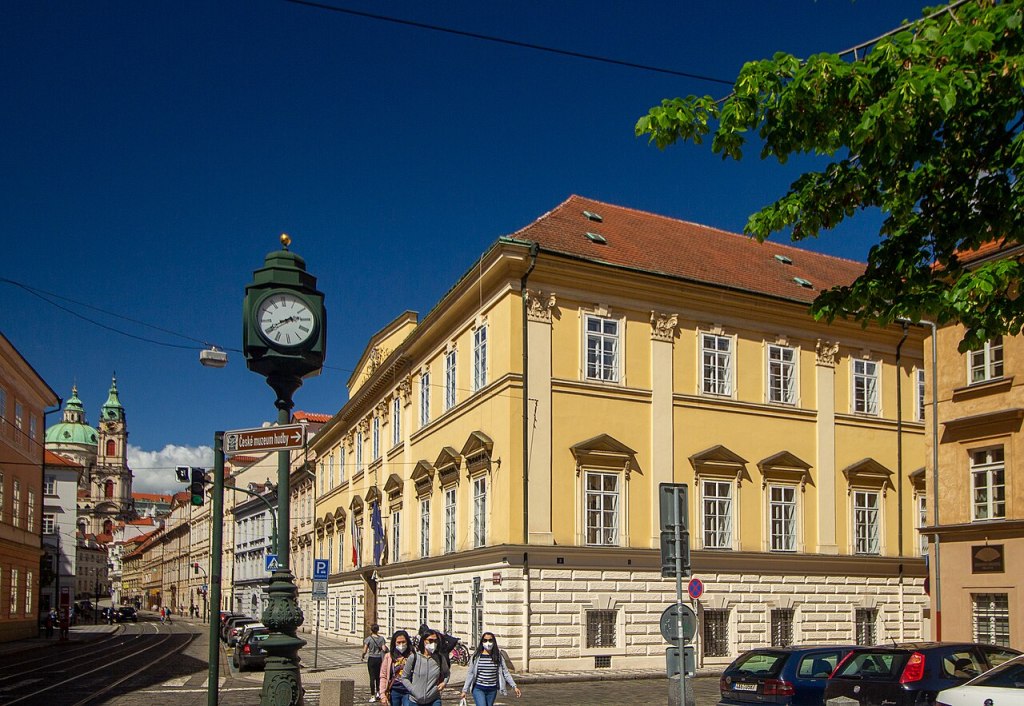
Princess Pauline has a much less colourful story, though still far from scandal-free. In 1800, she married another prince, Friedrich of Hohenzollern-Hechingen. He inherited this small principality in Swabia from his father in 1810, but by that point had already separated from his wife since she had had an affair with her brother-in-law Louis de Rohan in 1805 (with whom she had a daughter, Marie). Unlike his pro-Austrian wife and sister-in-law, The Prince of Hechingen travelled to France to fight in service of Napoleon, while the Princess moved to Vienna to live with her older sister Wilhelmine. In 1838 Pauline inherited the Duchy of Sagan from her sister and sold off the remaining properties in Bohemia like Náchod. She died in Vienna in 1845.

Princess Joanna, raised like her sisters at Sagan, had an affair at 16 with one of her father’s musicians, an Italian man named Arnoldi. They tried to elope to America, but were prevented and she was disinherited; in 1800 she was held in the Courland Palace in Prague and forced to send letters to Arnoldi which led to his arrest and murder. They did have a son, Friedrich von Piattoli, who was taken away to be raised by others. Within a year, the exiled Queen Caroline of Naples arranged for Joanna to marry a senior courtier from Naples, Francesco Pignatelli, Duke of Acerenza. They separated in 1806, and she lived with her mother at Löbichau where she died in 1876, at nearly 92 years old!
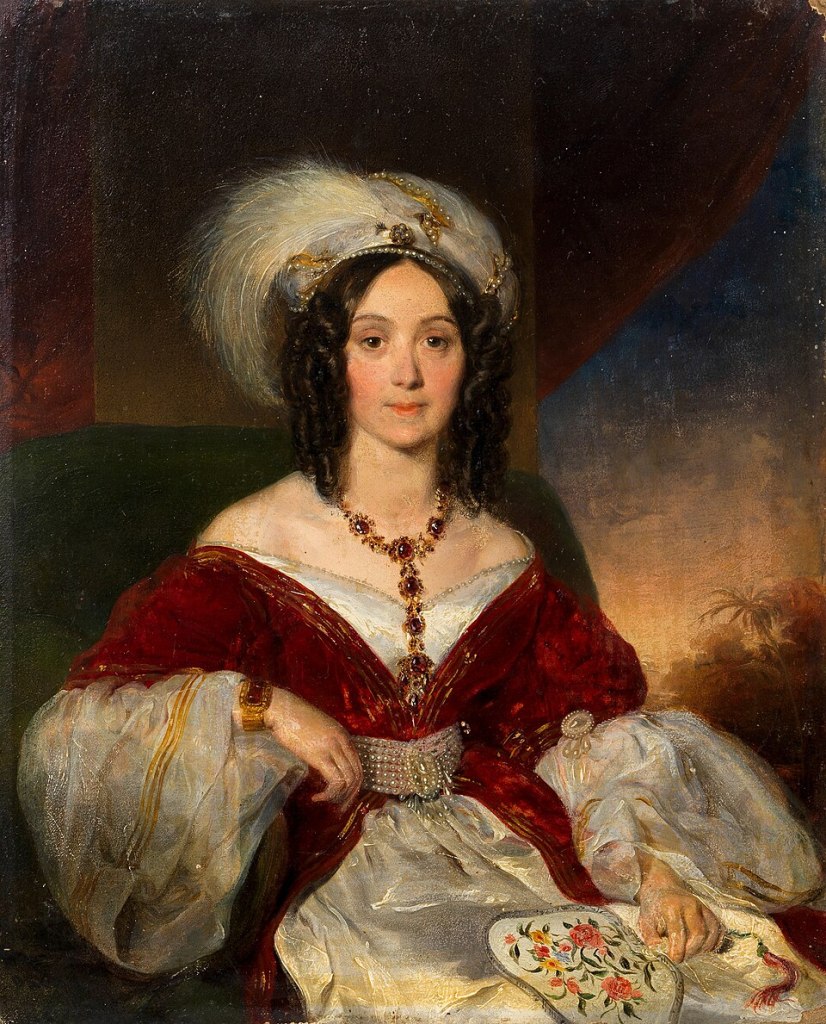
Finally, Princess Dorothea, perhaps the most intriguing of these four interesting women. Born a decade after her sisters (and as we’ve seen, probably from a different father), she led a life mostly in France in contrast to her Viennese or Berliner sisters. She is mostly known in history as Dorothée de Dino, from her Neapolitan duchy created for her powerful uncle Prince Talleyrand. By 1809, her mother had become friendly with Talleyrand, the former Foreign Minister of the French Empire and now a key diplomat connecting Napoleon to the rulers of Prussia, Austria and Russia. Indeed, it was Alexander I who urged a union between Dorothea and Talleyrand’s nephew Count Edmond. The new Countess de Talleyrand-Périgord became a Catholic and grew apart from her Lutheran and anti-French sisters; she may even have taken over from her mother as a lover of Prince Talleyrand himself. She accompanied him to Austria for the Congress of Vienna in 1814 and was known to be amongst his confidantes—so it is interesting to consider that her relationship with Talleyrand and her sister Wilhelmine’s relationship with Metternich surely affected the discussions reshaping post-Napoleonic Europe!

Back in France, Talleyrand was created Duke of Talleyrand by the restored Louis XVIII in 1814, a title that would later pass to Edmond. In 1817, he was also given the title ‘Duke of Dino’ by Ferdinand, King of the Two Sicilies (grateful for being restored to his thrones), named for an uninhabited island off the coast of Calabria. Talleyrand immediately transferred the title to his nephew and niece—who formally separated about this time. In 1818, Talleyrand purchased for his niece the Château de Bouges, near Châteauroux, south of the Loire valley. This chocolate box château had been built in 1765 for the master of royal forges and cloth factories in Châteauroux by Louis XV’s chief architect Gabriel, modelled on the Petit Trianon. In the twentieth century it was owned by Paris department store magnates the Viguier family who then gave it to the state in 1968. It is still famous for its gardens.
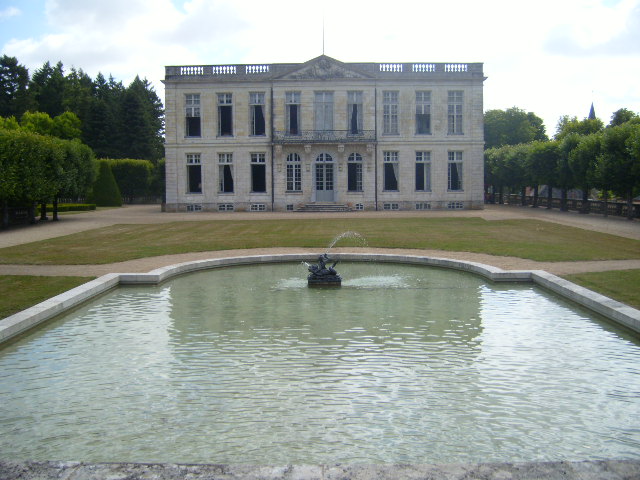
Meanwhile, Dorothée de Dino moved in with her uncle-in-law in 1820 at his nearby country château of Valençay. She raised her two sons Napoléon-Louis (who became known as the ‘Duc de Valençay’ from 1829 in anticipation of his inheritance from his great-uncle) and Alexandre (later known as ‘Duc de Dino’), and gave birth to a daughter Pauline, who is considered by most to be the daughter of Prince Talleyrand himself. She accompanied the Prince to London as well when he became Ambassador to the United Kingdom. In 1828, she purchased another château, further to the north in Touraine: Rochecotte. This castle had been built in the ‘Louis XVI’ style of the 1770s on a hillside overlooking the Loire valley by the Marquis de Rochecotte. He was executed during a royalist uprising in 1798, and the castle passed through various hands before being purchased by the Duchess of Dino. She improved the gardens, notably by importing hydraulic pumps, newly invented in England. The older Talleyrand stayed here a lot, hosting his famous political gatherings.
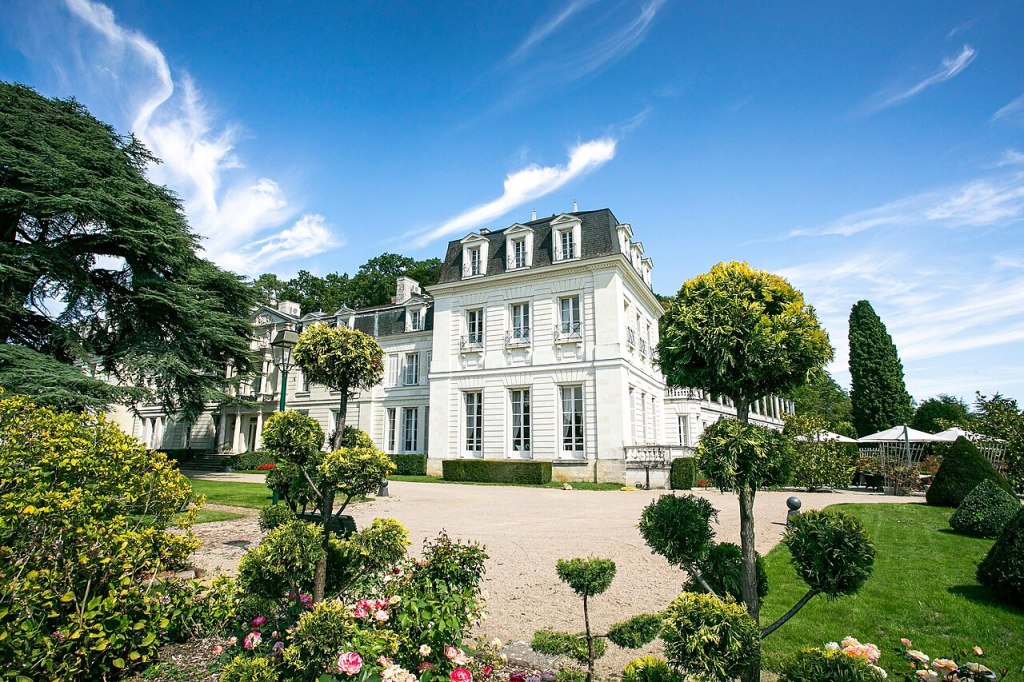
When the older Talleyrand died in 1838, his estates passed mainly to his nephew Edmond, who now became Duc de Talleyrand (see a future blog post on the Talleyrand-Périgord family for more on this title), while his wife inherited some of his uncle’s personal property like the magnificent Hôtel de Saint-Florentin in Paris, which she sold to the Rothschilds, and the Château de Valençay which she preserved for her son (though separated, they were not legally divorced, so she now became the Duchess of Talleyrand). In 1845, her sister Pauline died which meant she became Duchess of Sagan in Silesia as well (Joanna was passed over, having been disinherited by their father). So Dorothée moved there, and gave Rochecotte to her daughter Pauline who passed it on to her descendants in the Castellane family—they finally sold it in 1978; and in the 1980s it was turned into a luxury hotel. The last Duchess of Sagan died in Silesia a carriage accident in 1862.
The duchies of Sagan and Dino continued to pass through the line of Talleyrand-Périgord: Sagan was recognised formally as a French dukedom by Napoleon III, and passed in the mid-twentieth century to the family of Pourtalès; Dino was held by the junior branch, confirmed by the King of Italy in 1912 and passed after 1968 to the family Gonzalez de Andia then (since 2015) to the Villegas family.
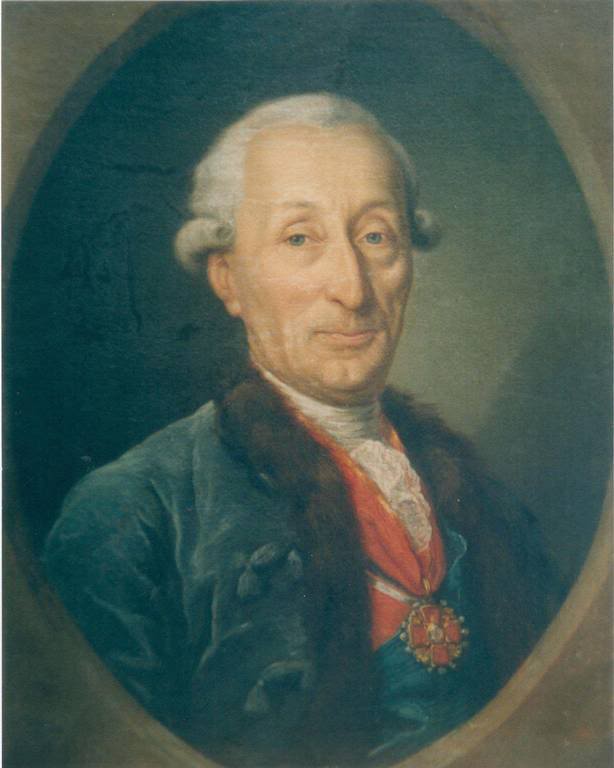
The House of Biron seemingly had some to end…but wait, there’s more! Ernst Johann von Biron, Duke of Courland and Semigallia, had a younger son, Karl Ernst, born in Mitau in 1728. When his father rose to the height of his powers as chief favourite of Empress Anna, Karl benefitted of course and was named Captain of the Preobrazhensky Life Guard Regiment, 1732. Exiled along with the rest of his family in 1741, he was briefly re-established in the Russian military in 1762 by unfortunately backing the wrong horse: Peter III. When the latter was deposed a few months later, Karl Biron left Russia and travelled around western Europe. In 1771, he formally renounced his claims to the succession to Courland, and in return was given a smaller property his father had acquired in Silesia in 1734: Wartenberg.
Wartenberg had initially been the Polish town of Syców (and would return to that name after the Second World War), but was renamed when German settlers were settled here by the local prince in the thirteenth century. Located within the Duchy of Oels (Oleśnica), another one of the Silesian duchies (like Sagan), it was always quite close to the border with Poland and had a larger Polish population than other Silesian towns—so for a long time it was called ‘Polish Wartenberg’ to distinguish it from ‘German Wartenberg’ (today’s Otyń), which, interestingly, was purchased by Karl’s older brother Duke Peter in 1786 and held by the senior branch of the Biron family in the nineteenth century as part of their Sagan estates. Polish Wartenberg is also interesting as a feudal estate since it had been granted, back in 1489, by the King of Bohemia (as Duke of Silesia) to the Haugwitz family as a ‘free lordship’, with similar rights to the semi-sovereign duchies of Silesia like Sagan. This was held by the Dohna family (who will have their own blog post as princes at some point) from 1592 until sold to Biron in 1734. A thirteenth-century castle existed here, and the Dohna built a baroque palace next door in the seventeenth; this burned in 1813, so the Biron-Wartenberg family built a new neo-gothic castle in its place in 1853 (and pulled down the ‘real’ gothic castle). This was burned by the Red Army in 1945 and demolished in 1952. The Biron family still use the (now empty) title ‘Free Lord of Syców’.

Karl Ernst was succeeded in Wartenberg in 1801 by his son Gustav Calixt. He had been considered briefly to replace his uncle Peter in a re-created Russian duchy of Courland in 1795 by Catherine II, but this idea did not materialise. Duke Peter having died in 1800 leaving only daughters, Gustav reached a settlement with Tsar Alexander I in 1802 for any residual claims to Courland by means of a large pension. He took the title Prince Biron of Courland, which was acknowledged as a title within the Russian Empire (with the style ‘Serene Highness’), and, according to some sources (but not others) by the Holy Roman Emperor. He obtained a position at court as a chamberlain and became a lieutenant in the Russian army. By 1807, however, he had shifted loyalties to Prussia and began a distinguished career in its war against Napoleon. At the end of the war, he was appointed Governor of Glatz in Silesia and spent the rest of his life cultivating his estates in Silesia and his family ties there, having married a von Maltzen countess, with kinship links to the local nobility and to the Prussian high command.
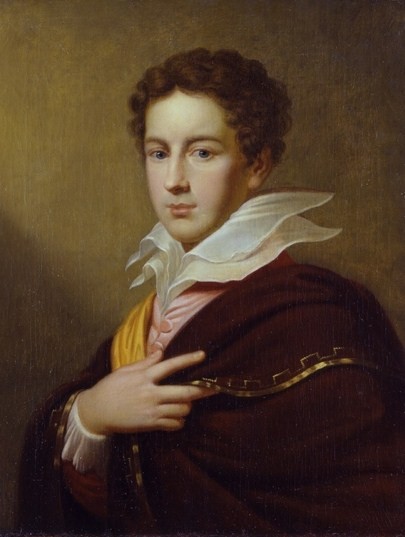
Gustav’s eldest son Karl Freidrich was a Prussian cavalry captain and married very well into the high imperial aristocracy (a Countess of Lippe-Biesterfeld), but died without children in 1848. His brother Calixt, in contrast, had maintained his family’s historic ties with Russia through marriage to Princess Yelena Meshcherskaya. But his career was spent in Berlin, as Royal Cupbearer at court and from 1854 a hereditary member of the Prussian House of Lords for Wartenberg. He was also a hereditary member of the Silesian parliament in Breslau, and from 1867 to 1871, represented Breslau in the Reichstag of the North German Confederation. These political roles passed in 1882 to his son Prince Gustav Peter who also married within the high Imperial aristocracy (a Löwenstein princess), but after she died in childbirth in 1890, he remarried a Frenchwoman, Françoise, daughter of the politician the Comte de Jaucourt, who bore him several children.
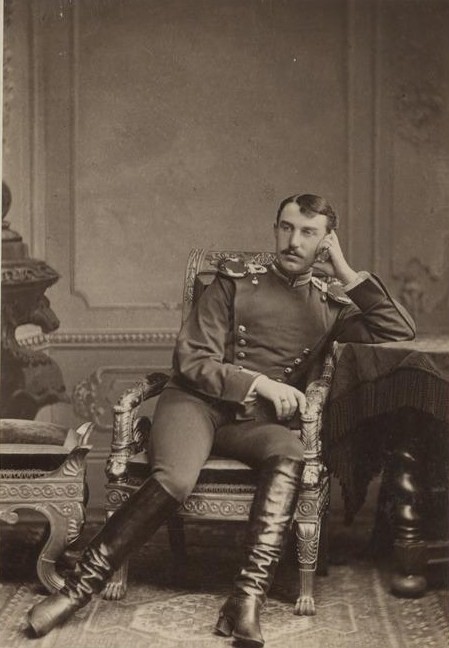
Returning our focus to Courland for a moment, as World War I came to its climax, there had been a brief attempt to resurrect the Duchy of Courland and Semigallia, between March and September 1918, under the German Kaiser’s direct rule. This was then subsumed within a ‘United Baltic Duchy’ ruled by Duke Adolf Friedrich of Mecklenburg-Schwerin, September to November. There’s no indication Prince Biron was ever considered as duke for these ephemeral states, and by November 1918 the Republic of Latvia was proclaimed. Prince and Princess Biron of Courland moved west when the estate of Wartenberg was divided by the Treaty of Versailles of 1919, with half of it incorporated into a newly established Poland. They had purchased a house in the spa town of Baden-Baden, the Villa Eden, renamed the Villa Biron. Already known as a high spot for aristocratic society in ‘Europe’s Summer Capital’, the villa had hosted Emperor Franz Joseph of Austria and ‘Sisi’, the German Kaiser and his wife, and Otto von Bismarck, amongst many others. The Biron von Kurland couple resided here until 1939 when they sold the villa (though still today called the ‘Palais Biron’, housing offices of the Chamber of Industry and Commerce and hosting grand conferences) and returned to a re-unified Wartenberg estate. The Prince died here in 1941, and after the war the Princess settled once again in the west with her children.
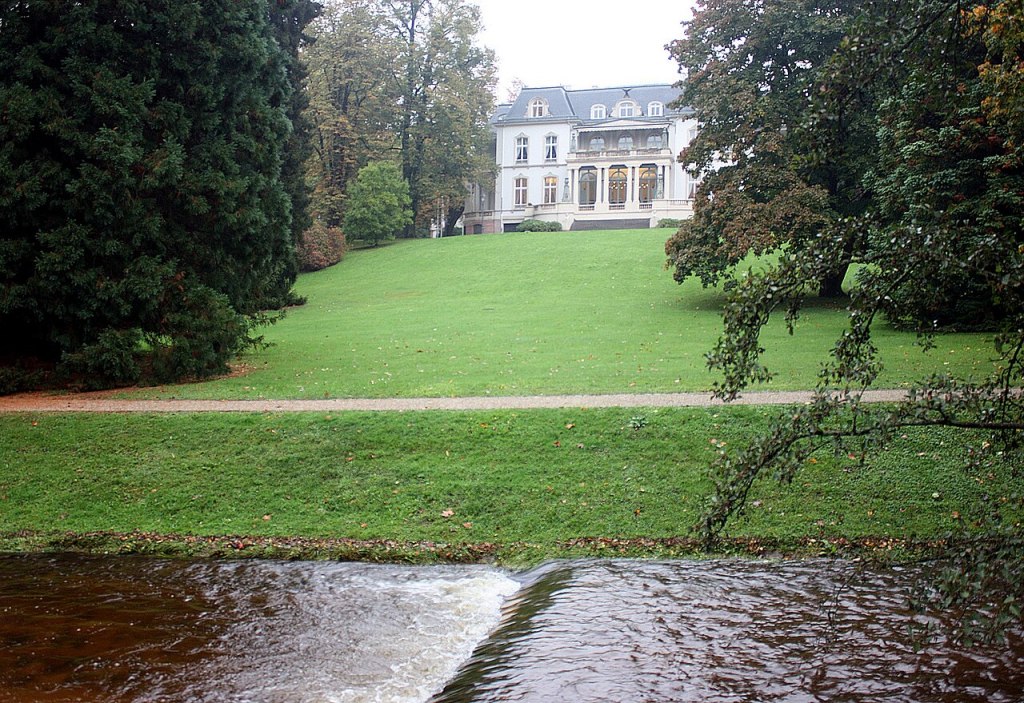
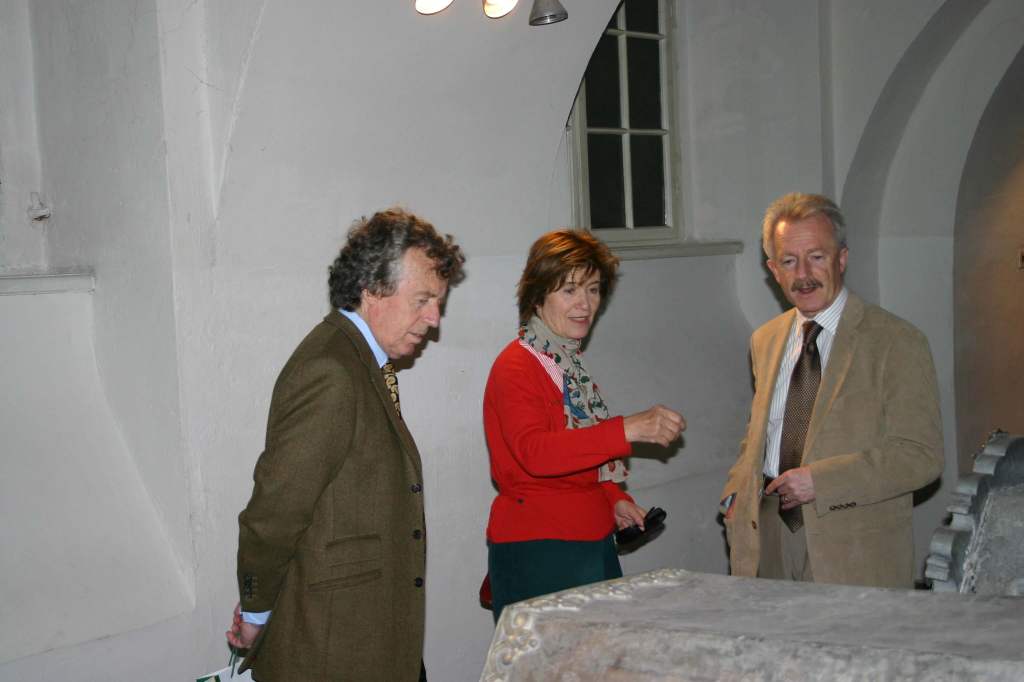
The younger son, Prince Friedrich Franz, was based in Bonn where he served as President of the Association of German Nobles from 1978 to 1986. The older son, Prince Karl, had married a granddaughter of the former Kaiser in 1938, Princess Herzeleide of Prussia, and settled with his family in Munich. He was active in charities and became a Commander of the Order of St John. In 1982 the headship of the family passed to their eldest son Ernst Johann who has been active in the restoration projects at the Palace of Rundāle in Latvia, and died only a few weeks ago in June 2026. The current head is his brother Michael, Prince Biron von Kurland, born in 1944, whose son Alexander was born in 1972.

(images Wikimedia Commons)


Wonderful congratulations.
>
LikeLiked by 1 person