On the northern edge of the deep forested valleys of the Ardennes in what is now eastern Belgium was an ancient fortress overlooking a bend in the River Meuse, not far from the town of Huy between Namur and Liège. It seems to have had an attractive aspect so was called the bellum forte or Beaufort. The castle is long gone, destroyed by troops moving through the area in about 1430, but its ruins have been dated to the early 11th century. It is thought that the noble family called Beaufort took its name from the castle and early on split into multiple branches. One of these became counts of Beaufort in the 17th century then merged with another local family in the 18th century to become Liedekerke-Beaufort; another became the dukes of Beaufort-Spontin from 1782.
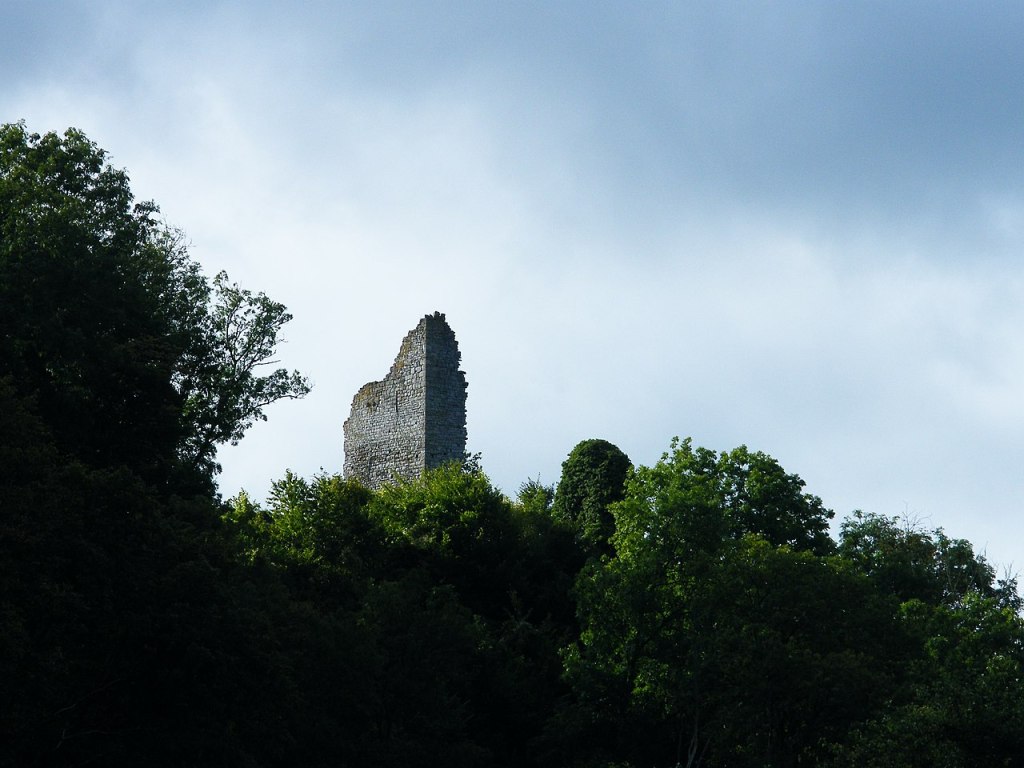
These are not the only dukes of Beaufort in European history. The most famous, dukes in England since 1682, are based in Gloucestershire and derive their name from a castle in Champagne that was held by the dukes of Lancaster in the 14th century. This same castle also gave its name to a dukedom of Beaufort that was given to the mistress of King Henry IV, Gabrielle d’Estrées, and her son, César de Bourbon-Vendôme, in 1598. A post about this Beaufort will follow separately later this summer.
The medieval lords of Beaufort in the Ardennes were vassals of the prince-bishops of Liège. Liège was a semi-independent principality within the Holy Roman Empire that stretched along the length of the Meuse, sandwiched between the territories of the counts of Namur and dukes of Brabant on one side, and the dukes of Luxemburg and Limburg on the other. In about 1260, the Beaufort family was granted another fief by Emperor Henry VII (from Luxemburg): Spontin, a bit further to the southwest, deeper into the Ardennes. This castle was situated in the border zone between the principality of Liège and the county of Namur, so there was frequent military action. The château and estates later (the early 16th century) passed into the hands of the family of Glymes de Florennes, who then (the late 18th century) passed it back to the family Beaufort-Spontin once more (see below). The 16th-century owners had transformed the medieval fortress of Spontin into a more comfortable residence, which was later given to the younger daughter of the 1st Duke of Beaufort-Spontin as part of her dowry, when the Duke’s interests shifted more towards Austria and Bohemia. Today Spontin Castle is held privately, not open to the public.

In the early 15th century, one branch of the Beaufort-Spontin line settled further upriver on the Meuse, near Dinant in the southernmost parts of the principality of Liège, on a riverbend dominated by huge rocks, 100 meters high, where they built a castle called Freÿr. Today this castle is one of the most exceptional tourist sites of Wallonia, boasting terraced walled gardens and the oldest orangerie in the Low Countries, from the early 18th century. The Count of Namur, rival to the Bishop of Liège in this region, gave the castle to Jean de Rochefort-Orjol in 1378; Jean’s grand-daughter Marie married Jacques de Beaufort in 1410 and took the castle with her into marriage. A century and a half later, French troops destroyed the medieval castle at Freÿr, so a new castle was built in what is now called ‘Renaissance Mosane’ (for the Meuse) style. Three large wings were added in the 17th century, but one was removed in the 18th century to add an elaborate gate to create an enclosed space. The terraced gardens were added in the 1760s.

At the Castle of Freÿr in 1675, delegates from France and Spain met to negotiate a deal for trade along the River Meuse, with Louis XIV himself as a guest. According to the castle website, this meeting was where coffee was served for the first time in the region, so the treaty is sometimes called the ‘Coffee Treaty’. As with Spontin, when the family interests shifted to Austria in the early 19th century, Freÿr Castle and its estates were left to a daughter, Herénégilde and through her it eventually passed to the barons Bonaert, who still own it today.
In the early 18th century the Southern Netherlands passed from Spanish to Austrian rule. In 1746, as a reward for his family’s continued loyalty to the Habsburgs, Count Charles-Albert de Beaufort-Spontin (1713-1753) was created Marquis de Beaufort-Spontin, with rank and honours equivalent to the princes of the Empire. He was also titled Marquis de Courcelles and Beauraing, for other estates he held in Wallonia. In 1747 he married Countess Marie-Marguerite de Glymes, heiress of another major noble family in these parts, owners of the Château of Florennes. This ancient castle had also been a fief of the prince-bishops of Liège, held by the Rumigny-Florennes family until the late 13th century, when it passed by marriage to younger son of the Duke of Lorraine, Thibaut, Lord of Neufchâteau. Thibaut then succeeded as Duke of Lorraine himself in 1302, and Florennes remained a northern territorial outpost of this family, rulers of a duchy just to the south of the Ardennes, until 1556. Then it passed to the Lords of Glymes, illegitimate descendants of the medieval dukes of Brabant, until it was inherited by the Beaufort-Spontin in 1771.They lost the castle during the French Revolutionary wars when that conflict spilled into the Southern Netherlands, but recovered it afterwards during the establishment of the Kingdom of Belgium. Sold in 1893, the Château de Florennes became a Jesuit college in the 20th century, and since the 1950s a seminary for girls.

The son of the first Marquis de Beaufort-Spontin, Frédéric-August (1751-1817), became a chamberlain of the Empress Maria Theresa in 1775, represented in the Austrian Netherlands by her brother-in-law, Charles-Alexandre of Lorraine. After Maria Theresa died and was succeeded by her son Emperor Joseph II, Beaufort-Spontin was raised again in rank in 1782, this time to the fairly unusual (in the Low Countries) rank of duke. Why were dukedoms rare here? The disparate provinces that today make up the Kingdom of Belgium (Flanders, Brabant, Namur, etc) were collected together by the dukes of Burgundy in the 14th and 15th centuries, then governed by the kings of Spain in the 16th and 17th, and since the king of Spain’s formal legal title in these provinces remained no higher than duke, the Habsburgs did not elevate many of their subjects to this rank (though they did create a number of princes, like Ligne or Croÿ or Merode). After 1713, Austria took over administration of the region from Spain, and set about creating new titles for families that stayed loyal (as opposed to those who had supported a French takeover) during the War of Spanish Succession. The Beaufort-Spontin family were thus created counts in 1713. Other fiefs they accumulated in the Southern Netherlands included the county of Noyelles and the viscounty of Audenbourg in Flanders (the former now in France); and the Imperial ‘Free Barony’ of Hosden near Huy—this last one was one of those fascinating micro-principalities that owed no feudal loyalty to anybody but the Holy Roman Emperor himself. It is also interesting since, as a ‘German-style’ fief, it was divided between a number of heirs: the Duke of Beaufort-Spontin in fact only held ¼ of the barony and only ¼ of its ‘sovereignty’.

The first Duke of Beaufort-Spontin earned his elevated rank due to his personal links with Emperor Joseph II, the large amount of land he had inherited from both his father’s and his mother’s lineages that made him one of the greatest vassals of the Habsburgs in the Low Countries, and perhaps also due to the impending marriage with the sister of a prominent Spanish aristocrat and politician, the Duke of the Infantado, First Minister of King Carlos III. Beaufort-Spontin’s ducal title was not like others that existed within the Holy Roman Empire, like Brunswick or Saxony; the Austrian Netherlands had slightly different rules to the neighbouring provinces of the Empire, granting him neither any degree of semi-sovereignty within his estates, nor the rank of duke and duchess for all members of the family—only the head of the family and his wife enjoyed this rank, while all others were styled count or countess. In 1789, the 1st Duke was further honoured with the rank of ‘imperial count’, thus solidifying his family’s position within the nobiliary system of the Holy Roman Empire. During the wars of the French Revolution, Frédéric-August was appointed chamberlain to Archduke Charles, a son of Emperor Leopold II, and the last Governor-General of the Austrian Netherlands, 1793-94, before these lands were conquered by France and incorporated first into the French Republic. Beaufort-Spontin served as Grand Marshal of the Archduke’s court in Brussels.
The Duke’s first wife Leopoldina Alvarez de Toledo died in 1792. There had been a son, Pierre, who was heir presumptive to the vast succession of his Spanish grandfather, the Duke of the Infantado (and another five dukedoms and two principalities, in Spain, Naples and Sardinia), but he died before he reached age ten. This grand inheritance thus passed to his eldest sister, Marie-Françoise, who married the Duke of Osuna. Beaufort-Spontin still needed a male heir, so he married for a second time, 1807, Ernestine von Starhemberg, from one of the leading families of the Austrian court in Vienna. A son and heir was born in 1809, Frédéric-Louis. Having been deemed an émigré and thus an enemy of the French Empire, the Duke travelled to Paris to attempt to keep his lands from being confiscated. Napoleon tried to incorporate him into his imperial court, as he had with other Belgian princes, Arenberg and Merode, but Beaufort-Spontin would not forego his loyalty to Vienna, his lands remained confiscated, and he departed once more for Vienna.
But the 1st Duke of Beaufort-Spontin’s career was only just about to reach its pinnacle. After Napoleon’s armies were defeated in 1814, the European Great Powers met to decide what should happen to the former Austrian Netherlands. Present at the Congress of Vienna, the Duke was a vocal advocate for keeping the southern provinces separate, rather than merge them with the Kingdom of the Netherlands. Such was his pre-eminent position, while decisions were being debated, he was named temporary Governor-General of the Southern Netherlands, from February to March 1814—the last person to ever hold this post. The southern provinces were in fact soon incorporated into the new Kingdom of the United Netherlands, and the Duke became Chamberlain and Grand Marshal of the Court of its first king, William I, in 1816. Beaufort-Spontin died the next year in 1817.
His son Frédéric-Louis became the 2nd Duke at age 8. Raised by their Viennese mother, eventually, both he and his younger brother Alfred (b. 1816) decided to transfer the family interests to the heart of the Habsburg empire, which since 1804 had transformed into the Empire of Austria. This Empire also included the Kingdom of Bohemia where their father had purchased in 1813 the castle and estate of Petschau, which today is called Bečov nad Teplou in Czech.
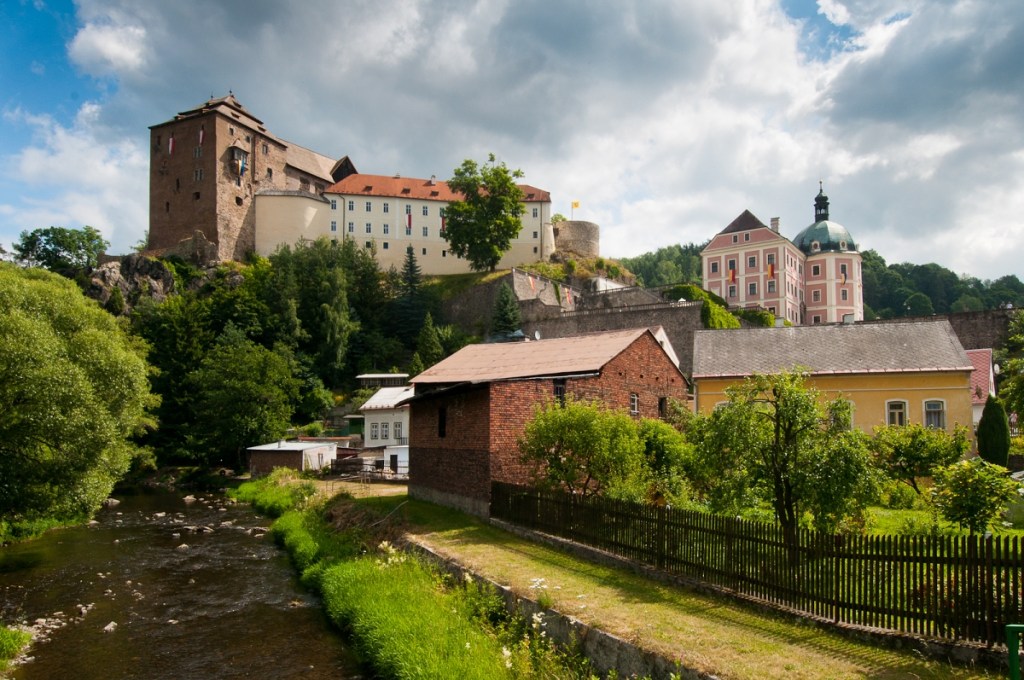
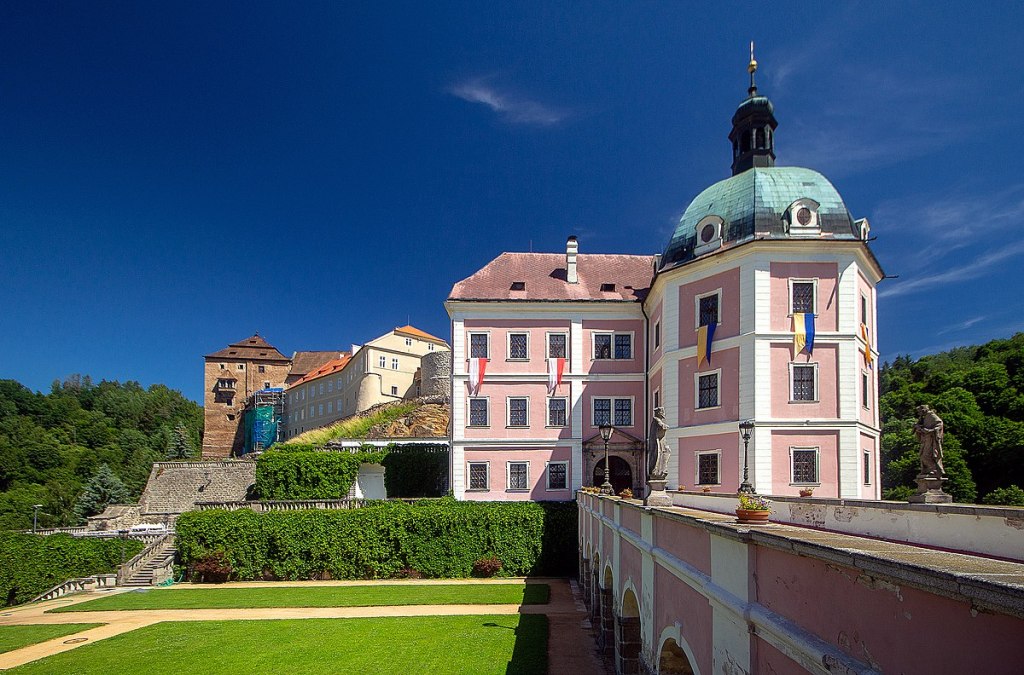
Petschau Castle, built in the early 14th century on the Teplá River in the far west of Bohemia, in Karlovy Vary District. It had been built by the lords of Rýzmburk, then passed through the hands of various families into the lords of Questenberk from 1624, then inherited by the Kaunitz family in 1752. After the purchase by the Duke of Beaufort-Spontin, the family rebuilt the old castle in a neo-gothic romantic style and linked it to the baroque château that had been built next door. Bečov was confiscated by the Communists at the end of World War II and was turned into a school, then became the seat of the local historical institute.
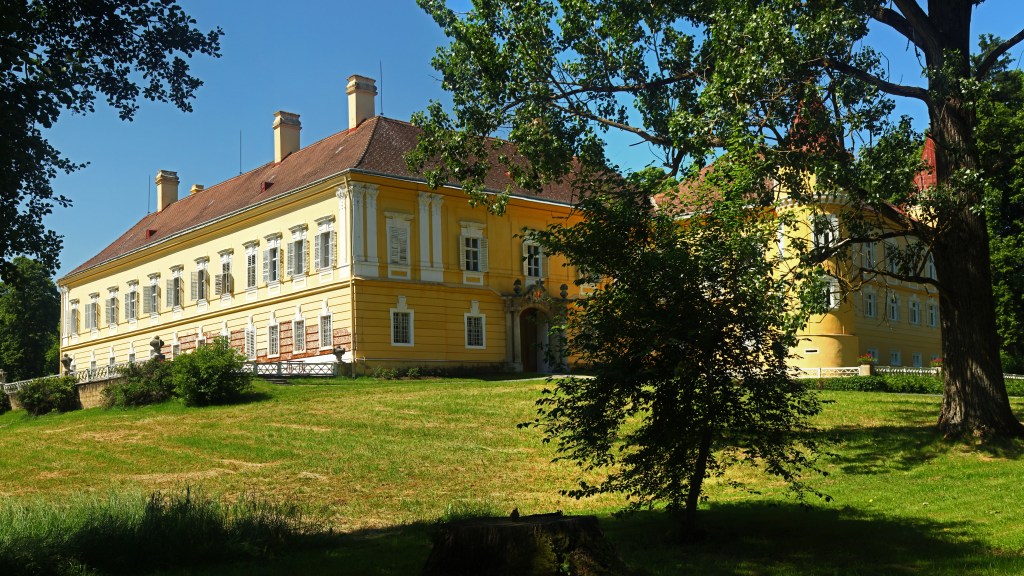
The 2nd Duke died unmarried in 1834. By this point, the family not only lived in their main base at Petschau, they also owned a number of other castles and estates in western Bohemia, and also acquired estates in the province of Lower Austria, on the border with Bohemia, notably the Castle of Weineren (today Weinern), a baroque country house now owned by descendants through a female line. Though most of their ancestral lands in Belgium were now held by female-line cousins (as above), they did retain the Château of Florennes and a grand residence in Brussels, the Hôtel de Beaufort (rue aux Laines, not far from the Royal Palace)—this has, since the 1980s, been redeveloped as a home for the elderly.

The 2nd Duke’s brother Alfred became 3rd Duke of Beaufort-Spontin. He was close to the Habsburgs as an imperial chamberlain and was a member of the estates of both Bohemia and Lower Austria. His family was even more firmly established within the highest ranks of the nobility of Austria-Hungary in 1876 when he was granted a new title, Prince of Beaufort, with the style ‘Serene Highness’ and a hereditary seat in the Austrian House of Lords.

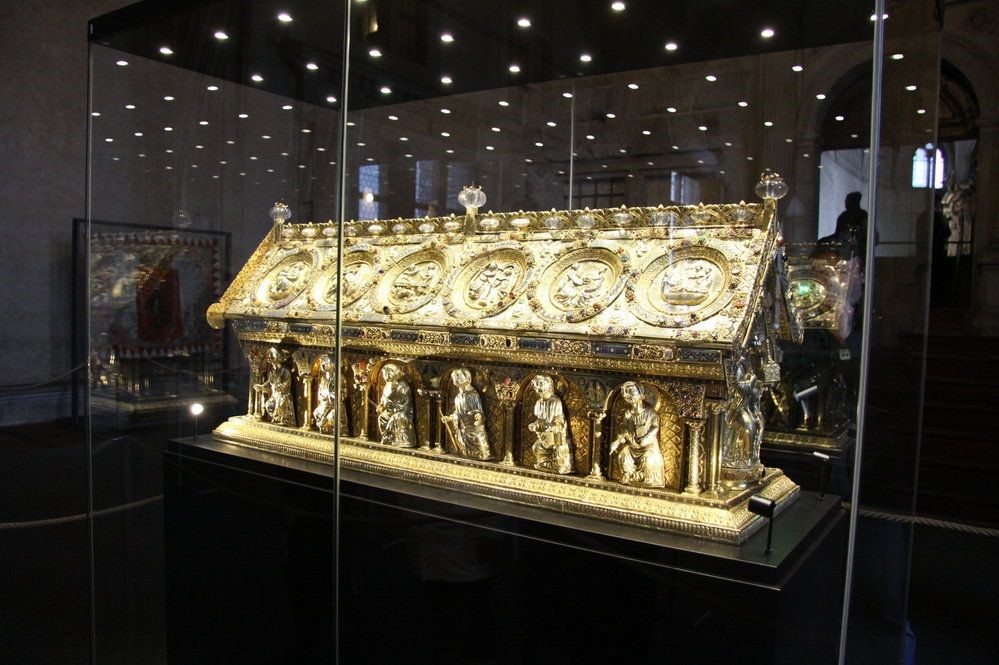
Duke Alfred also brought to Bohemia an ancient treasure: the Reliquary of Saint Maurus. Maurus was a 6th-century disciple of Saint Benedict. This wooden box containing some of his remains was constructed in the early 13th century and covered in gilded silver plate and gemstones. It was held at the Abbey of Florennes for centuries until it was sacked during the French revolutionary wars. Alfred recovered it and restored it in the 1830s, and in the 1880s moved it to his castle at Pletschau. During the Second World War, the family buried it under the floorboards of the castle’s chapel, where it remained mostly forgotten until excavated by an American businessman with support of the Czech government in the 1980s. Despite protests from the Beaufort family, there has been no question that this precious artifact would leave the Czech Republic, and it has been painstakingly restored and placed on display at Bečov since 2002.
Alfred died in 1888 and was succeeded by his son, Friedrich, the 4th Duke of Beaufort-Spontin and 2nd Prince (or Fürst) of Beaufort. Friedrich continued to maintain the family’s links with Belgium through his marriage to a princess from the house of Ligne. He died in Bohemia in 1916 on the eve of the independence of the new state of Czechoslovakia.
The 5th Duke of Beaufort-Spontin, and 3rd Prince of Beaufort, Heinrich (1880-1966) worked as a young man in the Habsburg government in Bohemia; he was part of the progressive circle of Archduke Franz Ferdinand, who, as heir to the Austro-Hungarian thrones had plans to reform the Empire to grant more autonomy to Slavic minorities to keep them loyal to the Habsburgs. As we know, the Archduke never got the chance to put any of his ideas to the test, and as Duke Heinrich aged, he grew more attracted to German nationalism as a counter-force to the Czech nationalism that dominated Czechoslovakia after World War One; by the 1930s, he was a member of the pro-German Sudeten Party and supported the Nazis after their takeover of Sudetenland in 1938/39. His sons fought in the German armies, so when the Second World War concluded, their properties were confiscated, and, unlike some other aristocratic families were not restored in the 1990s.
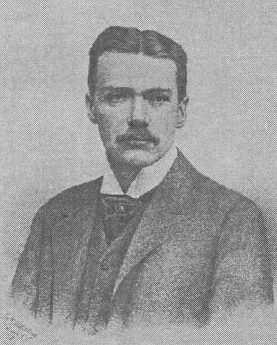
The 5th Duke of Beaufort-Spontin moved with his family to Austria and died near Graz in 1966. His son Friedrich, the 6th Duke and 4th Prince, headed the house until 1998. The family is still listed amongst the princely houses of Belgium, though the link with their ancestral home is fairly thin. Today the 7th Duke, another Friedrich (b. 1944), the last to be born at Petschau / Bečov, became a professor of medicine (radiology) at Graz University. His younger brother, Count Christian (b. 1947), was Director of the Weapons Collection of the Museum of Applied Arts in Vienna. Both of them made a widely publicised visit to Bečov in July 2018.

Neither of the brothers has a son, only daughters, so the titles of the House of Beaufort-Spontin will soon be extinguished. They no longer own the Austrian castles on the northern frontier in Lower Austria, but instead live in Styria, outside its capital of Graz, in an old manorhouse called Gallmannsegg, near the town of Kainach. Here they host an annual car festival.

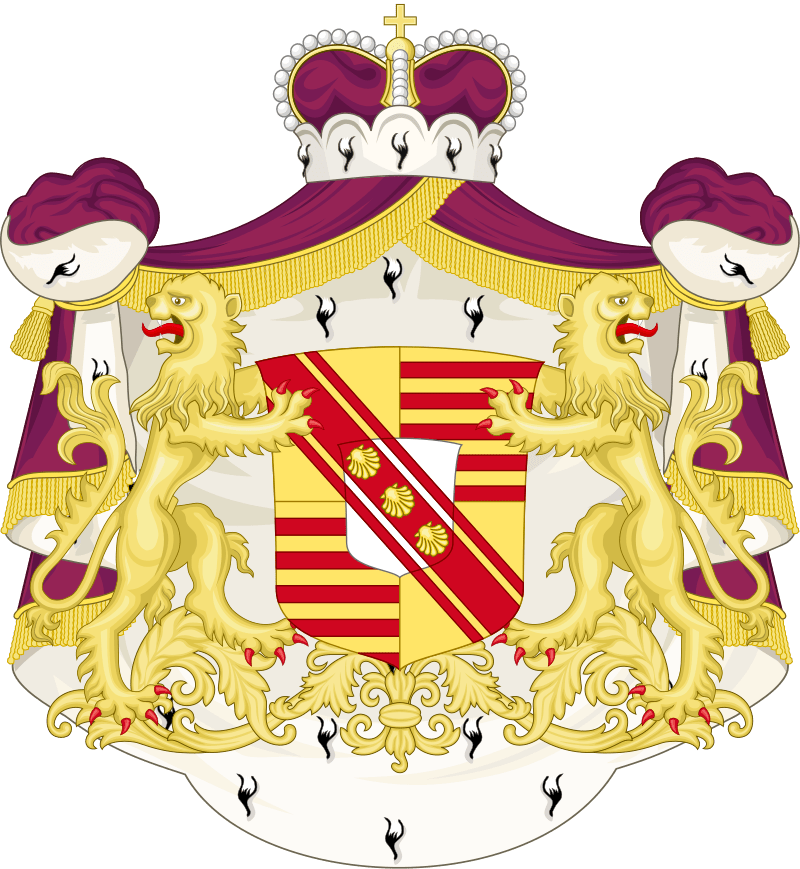
The arms of Beaufort-Spontin are quartered with those of the Counts of Looz (another powerful feudal dynasty from the region of the principality of Liège), from whom they claimed descent. Behind the shield is a princely mantle and a princely coronet,
(images Wikimedia Commons)
 Dukes and Princes
I am from Graz, Austria, and have been friends with Dr.Friedrich Beaufort since our student days. When my husband and I lived in Belgium he would sometimes visit. We went to Spontin and Florennes together. Thank you for compiling this information across the centuries. Myself, I have been living in Mexico for a larger part of my adult life. Even here, the Habsburgs had their influence while Archduke Maximilian’s tragic end has held meaning for me ever since my schoolgirl days when my parents took us to Castello Miramare, near Trieste.
LikeLike