The Kingdom of Poland, a remarkably egalitarian society, officially had no title rankings within its nobility. It therefore had very few families with the titles duke or princes within its borders—those that did bear higher titles received them from foreign powers, either the Holy Roman Empire or Russia. Amongst these, one stands out as also receiving recognition as ‘foreign prince’ from the King of France, and even further, as a ‘cousin du roi’, a rare accolade for anyone who wasn’t royalty: Jabłonowski.

The status of ‘prince étranger’ (foreign prince) and ‘cousin du roi’, was a great honour in France, but its precise privileges were only vaguely defined. It provided premier access to exclusive spaces within France’s royal palaces, privileges regarding sitting in the presence of the Queen or keeping on your hat in the presence of the King, but also precedence over dukes in ceremonies, and, more tangibly, privileged access to places in military academies or elite convents for your children, or posts within the royal household. So why did a relatively obscure family from Poland (not even one of the most well-known magnate families, like Czartoryski, Sapieha, or Radziwiłł) receive such honours from one of the grandest courts of Europe? All because of a curious marriage arranged for Louis XV in 1725—about which more below.
The Jablonowskis were not the grandest Polish magnate family; nor were they ‘ancient’ when compared to many of their peers. But once they arrived at the premier level of aristocratic society in the last quarter of the seventeenth century, they remained prominent for the next century and a half, then faded away again. (correctly spelled as Jabłonowski in Polish, I’ll ‘Frenchify’ it for this post).
In the sixteenth century, a family with the surname Wichulski purchased an estate called Jabłonowo in the southern borderlands of what was then known as ‘Royal Prussia’, the part of Prussia that was held directly by the Crown, and not by the Knights of the Teutonic Order. This estate was close to the Vistula river, downriver from Warsaw, close to the town of Chełmno. The family took the name of the estate as their new surname. They also adopted one of the ‘herbs’, the heraldic signs shared by inter-related clans of the Polish nobility. This one is referred to as ‘Prus III’, indicating that its bearers had (or claimed to have) connections to the ancient people of this region of the Baltic coast, the Borussians (or Prussians). There were two elements in this coat-of-arms: the silver double-cross on red was said to come from an ancient Borussian prince who converted to Christianity; while the horseshoe and cross on blue, a pobog (‘for God’), was a symbol for luck.

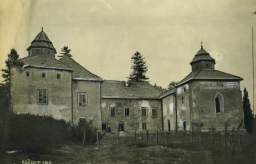
The family first rose to prominence in the 1670s with Stanisław Jan Jablonowski, the son of Jan Stanisław, Sword-Bearer of the Polish Crown, and Anna Ostrozanka, daughter of a senior courtier and governor, Jan Ostoróg. As a young man, Stanisław Jan gained a reputation fighting in wars against Sweden in the 1650s, and was appointed to official ranks at court and in the field, notably, Grand Guard of the Crown, 1660, a senior military officer that accompanied the king to war. In 1664, he was appointed Voivode or Governor of Ruthenia, one of the eastern territories of the Kingdom of Poland (now western Ukraine), with its capital at Lwów (today’s Lviv). Here he acquired new lands to enable his family to rise to magnate status, for example Zawałów, in the region of Galicia (now Zavaliv in Ukraine). The castle had been built by the Makowiewski family in the early seventeenth century, destroyed by invading Turkish armies in 1675, then purchased and rebuilt by Jablonowski. By the nineteenth century it was part of the Austrian Empire and belonged to the Raczyński family, then was destroyed in World War I.
In 1668, Stanisław Jan supported the election of the Prince of Condé (Louis de Bourbon) in the elections to the Polish throne, an unsuccessful bid against the more local candidate, Michal Korybut Wiśniowiecki. This was thus the family’s first strong connection to France. Turning his attentions again towards the east, Jablonowski took part in the important battle of Chocim (Khotyn) in western Ukraine, 1673, that solidly defeated the Ottoman armies. He was appointed Field Hetman of the Crown in 1676, then Grand Hetman of the Crown in 1683—these were the senior positions of the Polish army, second only to the king. As such he commanded one wing of the army led by King Jan Sobieski in the defence of Vienna against the Turks in 1683. This was followed by another victory, over the Tatars at Lwów in 1695, and in 1696 was a candidate for the throne of Poland-Lithuania itself when Sobieski died (and potentially the hand in marriage of his widow).
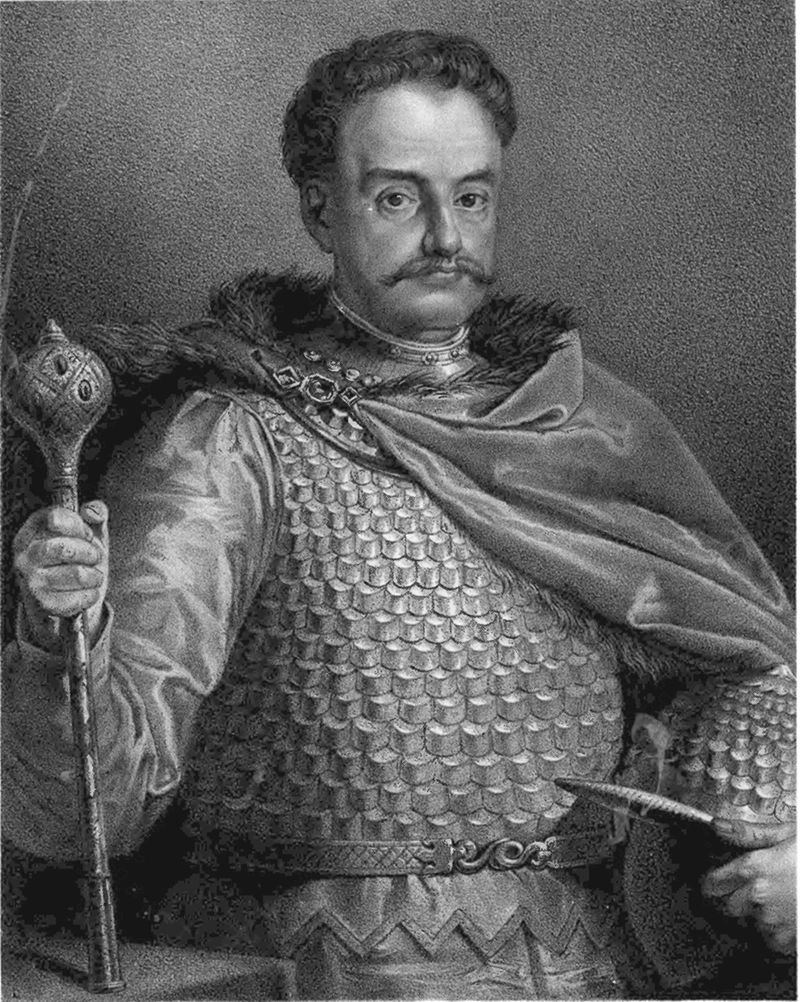
In 1698, he was created Prince of the Holy Roman Empire by Emperor Leopold I, in the hopes of luring him out of the pro-French camp and instead support the Austrian candidate for the Polish throne, Augustus of Saxony. Grand Hetman Jablonowski did initially support Augustus, but he and his family did not long stay in the pro-Austria faction, as we shall see. He died in 1702 in Lwów, the city of his great victory, and he was honoured there with a prominent statue. His princely title being only a personal one, it died with him.

Another estate acquired by Stanisław Jan in Galicia was an ancient town he renamed Mariampol (Mariiampil today), after an icon of the Virgin Mary he supposedly had carried with him in the defence of Vienna. Here he built a fortified residence, with towers and moats. Over the next century this remained one of the main Jablonowski strongholds, with a new palace built in the 1730s, alongside a Capuchin monastery, to which the Pope sent precious relics of Saint Victor in 1740 (remember, these were Catholic nobles in a sea of Orthodox vassals). The entire town of Mariampol still had its ramparts when it became part of the Austrian Empire in the early nineteenth century until the Habsburg authorities ordered them dismantled in 1817. The remaining palace was partly destroyed in World War I, then nationalised and demolished in World War II.

Just two years after the 1st Prince Jablonowski’s death, in 1704, his grandson and namesake, Stanisław Leszczyński, became King of Poland and Grand Duke of Lithuania in a French-backed coup against Augustus of Saxony. The Leszczyński family were also Polish magnates, from further west, taking their name from the estate of Leszno. Like Stanisław Jan, Rafał Leszczyński had also risen through the ranks in courtly and administrative positions, notably as voivode of several western provinces, and in 1676 married Anna Jablonowska. Their son Stanisław was born a year later. Already by this point both families were aligned as members of the pro-French faction in Polish politics.
The eldest son of Prince Jablonowski, Jan Stanisław, sustained the family’s prominent place in the Polish-Lithuanian Commonwealth by serving as Voivode of Volhynia, 1693, and of Ruthenia like his father, from 1697. He also solidified the pro-French stance of the family through his marriage in 1693 to Jeanne-Marie de Béthune, whose father was the French ambassador to Poland, and whose mother was the sister of the Queen of Poland (Marie-Casimire de la Grange d’Arquien). Nevertheless, Jan Stanisław did not support the Swedish (and French) coup of 1704 that put his nephew Stanisław Leszczyński onto the throne in place of King Augustus, and he left Poland with the latter to reside at the Saxon court in Dresden. In 1706, once Augustus appeared to be losing ground, he switched sides, returned to Poland and was appointed Royal Chancellor by his nephew. But Leszczyński’s unstable reign came to an end in 1709 when he too was driven off the throne and into exile, meaning Jablonowski lost his job too. The latter tried to mount a coup against the restored Augustus of Saxony in 1713, aiming to restore his nephew with Ottoman help, but was arrested and held prisoner for four years in Saxony. He lived on for another decade and a half, now focusing on patronage of the arts, rebuilding his residences in Lwów and Mariampol, and publishing a number of texts on religious and political thought—he is considered an important pre-Enlightenment thinker in Poland.

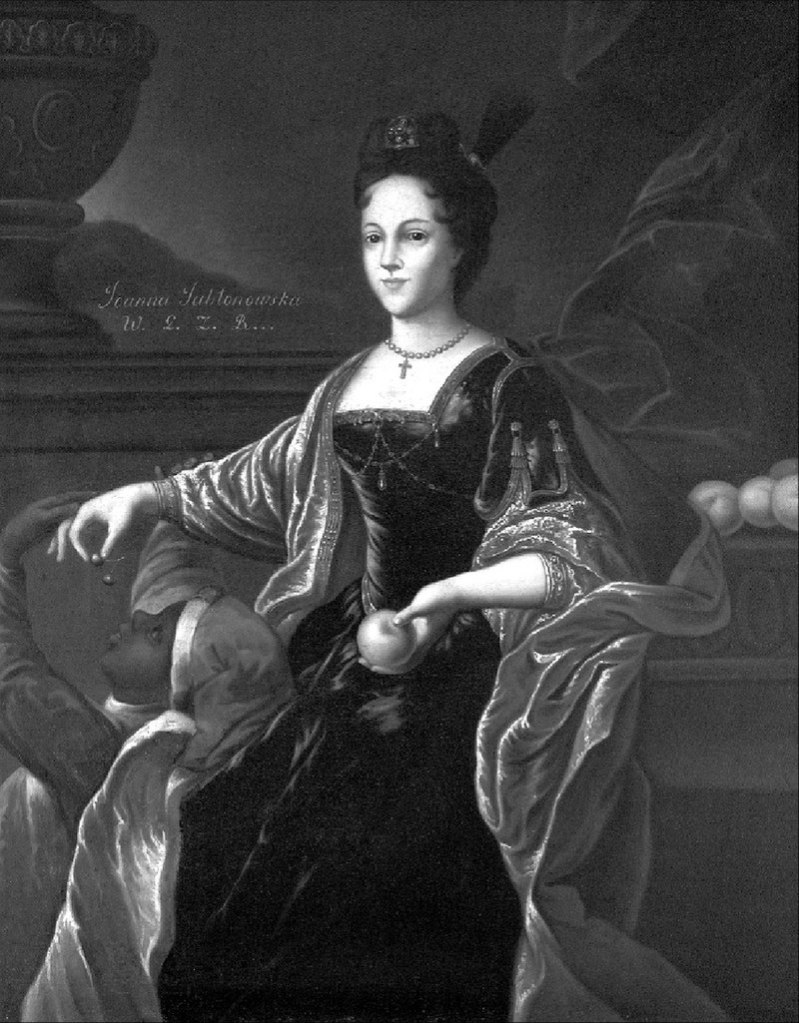
His younger brother, Aleksander Jan, was Grand Standard Bearer of Poland, a high military position, and deserves to be noted here mostly for his excellent portrait.

Their sister, Anna, now mother of the ex-King of Poland, went with Stanislas (as he’s known in western Europe) and his family into exile, first to Sweden, then to the small German duchy of Zweibrücken, and finally to France in 1719. With them was her grand-daughter Maria, whose marriage in 1725 to the young King Louis XV of France surprised royal watchers all over Europe. She was not from one of the major royal families of Europe, and although her father had been a king, he certainly wasn’t one now. Queen Marie Leszczynska is not one of the better remembered queens of France, yet she reigned longer than most (43 years) and was in fact cherished by her subjects as a model of piety and motherhood, a queen who caused no scandals and did not involve herself in politics. Her grandmother Anna Jablonowska lived long enough to see this amazing rise in her family’s fortunes, and died at the Château of Chambord in the Loire valley in 1727. She is buried nearby in the Cathedral of Blois. Queen Marie had several children and grandchildren, including kings Louis XVI, Louis XVIII and Charles X. What this kinship meant for the Jablonowski family we can see below.

The headship of the family now passed to Stanisław Wincenty. He managed his family’s estates in the east, in Volhynia (now northwest Ukraine), building new castles in tiny villages of Krzewín (now Kryvyn), to house his rich art collections, and Płużne (now Pluzhne), where he deposited the Jablonowski family archive. Both were completely destroyed in the early twentieth century. One of the reasons the family was increasingly attracted to this area was because of the extinction in the 1680s of the princely house of Ostrogski, one of the four main landowners in what is now western Ukraine (see Radziwill and Wiśniowiecki). The principal Ostrogski lands were based here, in and around the town of Ostróg (now Ostroh), sometimes considered an independent duchy or principality in the pre-modern period. Although the main claims to the Ostrogski estates passed to the princely Lubomirski family, this was disputed, and litigation continued all the way through the eighteenth century. Sometimes the family members in the eighteenth century are referred to as ‘Prince Ostróg’ or ‘Duke of Ostróg’, but this wasn’t formally recognised by anyone, and most claims disappeared by the time this area became part of the Russian Empire after 1793.

But Stanisław Wincenty never became a major public figure in Poland-Lithuania. He was a voivode, but of a smaller province in the centre of Poland (Rawa). He supported the re-election once again of his cousin Stanislas Leszcynski in 1733, which sparked the War of Polish Succession, really a proxy war between France and Spain versus Austria and Russia—in the end, the latter were the stronger and imposed King Augustus III in Poland, while Leszczynski limped back to France. Stanisław Wincenty Jablonowski stayed out of politics, and focused on writing and poetry. He visited the French court several times to visit his cousin the Queen, who honoured him as a ‘cousin du roi’, granting him access to her cabinet as if he was a prince of the blood, and arranged in 1741 for him to be presented with the Order of the Golden Fleece sent to France by King Philip V of Spain. On another visit in 1750, he was given the Order of the Holy Spirit by Louis XV himself. Meanwhile, in 1744, the pro-French Emperor Charles VII (of Bavaria) reinstated his grandfather’s princely rank, but this time extended it to all his brothers and cousins and made into a hereditary title. This was confirmed a few decades later by Emperor Joseph II (of Austria), in 1773, about the time of the first partition of Poland, when it was a useful tactic to gain allies in his new Galician territories (the Russians would also confirm the princely title, but not until the 1840s, see below).

Stanisław Wincenty had two brothers, Jan Kajetan and Dimityr Hippolyte, and two sisters who maintained the connection with France. Of the sisters, Catherine-Dorothée married Franciszek (François) Ossolinski, who as Grand Treasurer of Poland had been one of King Stanislas Leszczynski’s chief court officers, and moved with him to Nancy when he became reigning Duke of Lorraine in 1736. ‘Duc Ossolinski’ (as he was called in France) became Grand Master of the Household of Lorraine, while his wife became one of King Stanislas’s many mistresses; she died at the Lorraine summer palace at Lunéville. Meanwhile Marie-Louise Jablonowska married Anne-Charles de la Trémoille, Prince de Talmond, from a cadet line of his family. The La Trémoille family were also recognised at the French court as ‘foreign princes’, so together with the Jablonowskis they had a lot of clout, whether in Versailles or Lunéville. The Princesse de Talmond became a member of the close circle of Queen Marie Leszczynska at Versailles, and a go-between with their cousin, King Stanislas at Lunéville. She was, like her brother, treated as a princess of the blood, with rights to sit in the Queen’s presence with a ‘chair with a back’ (ie, better than duchesses who were given only a stool). In the 1740s she had a short and tumultuous relationship with the exiled Stuart Pretender, Bonnie Prince Charlie, and tried to prevent (unsuccessfully) his expulsion from France. As she aged, Marie-Louise was known by the Paris salonnières as a woman of spirit, a beauty and a wit admired by Voltaire, who was ‘truly Sarmatian’ in her pride, a reference to the adopted ‘horse-warrior’ identity of the Polish nobles.
[I’d love it if someone could a find a portrait of the Princesse de Talmond for me!]
Prince Jan Kajetan became the eldest male of the clan in 1754, and the same year (having reconciled with King Augustus III), was appointed Voivode of Bracław, another large province of south-eastern Poland (now Braclav, Ukraine), and later served as an Austrian Field Marshal. He supposedly considered himself to be of royal rank due to his cousinage with the French royal family, and by the 1770s used the title ‘Duke of Ostróg’.
But it was his wife, Princess Anna Jablonowska who made more of a mark on history—regarded by many as one of the most significant women in eighteenth-century Poland. The daughter of Prince Kazimierz Sapieha, and an heiress of one of the grandest of Polish magnate houses, she became known as a widow for improvements on her estates (building textile factories, schools and hospitals) as well as social advances, working to transform serfs (which she freed) into rent-paying tenants, for example via a generous loan fund. She set up a printing press and opened a midwifery school. She was passionate about science and known for her natural history collection kept in her castle at Kock. Princess Jablonowska also got involved in politics, a leader of the opposition of the reign of King Stanislas Poniatowski (elected in 1764), and a member of the Bar Confederation, which in 1768 attempted to remove this king (and Russian influence) through ties with Vienna (and more remotely, with Versailles). When this noble revolt was suppressed in 1772, Anna retired from action and died in Ostróg (by now in the Russian Empire) in 1800.

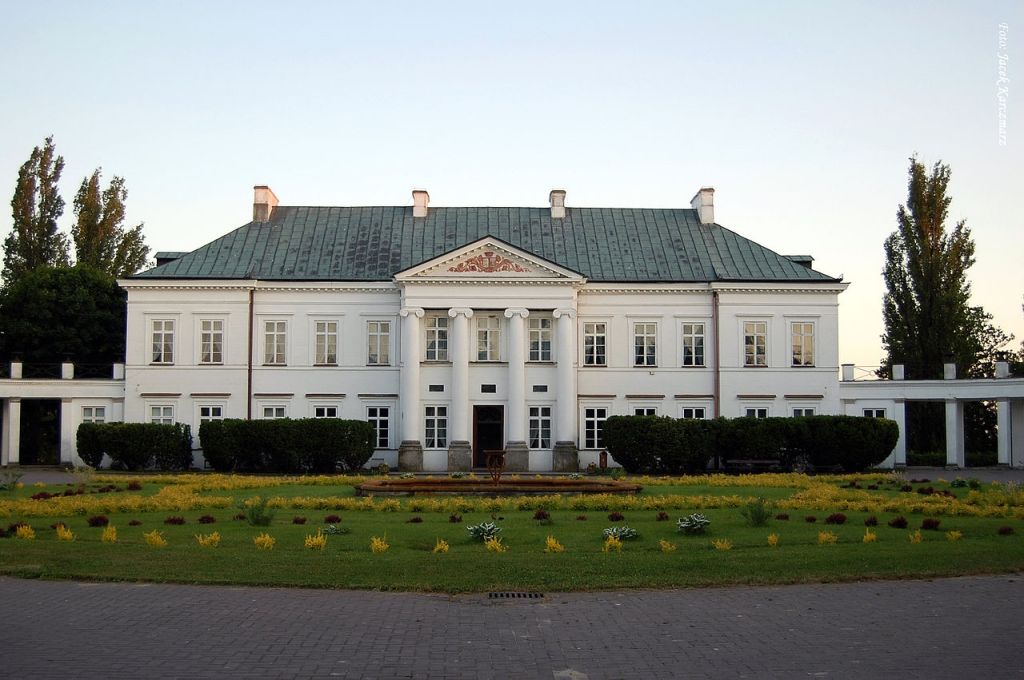
Princess Anna Jablonowska’s efforts were mostly focused on the old Sapieha estates of Siemiatycze in Podlasie and Kock near Lublin (both now close to the eastern frontiers of Poland). In Siemiatycze she had a palace built in 1773, which was destroyed by a fire in the 1860s. More well known was her castle at Kock. Under an older form of the name, Koczsko, the estate had been owned by the powerful Firlej family, Protestant magnates in the sixteenth century. In the mid-seventeenth century, they died out and their estates passed through various hands. In the 1770s, the Princess erected a new palace here, a main central house with two wings. She also constructed a town hall, market square and an elegant Catholic church for the town. Her work attracted the attention of monarchs: both Emperor Joseph II and the future Tsar Paul visited in the 1780s. After her death, the Jablonowski Palace and the rest of Kock passed back to the Sapieha family, then soon into other hands. A new Classical front was added in the 1820s. Kock was once more in centre stage on 6 October 1939 when the last remnants of the independent Polish army surrendered in the castle courtyard to the Germans. After the war, the house served as a school until it was transformed into a social care home in the 1980s.
Also prominent in the eighteenth century was a cousin, Józef Aleksander, son of Aleksander Jan. He too was raised to the rank of Imperial prince in 1744, and at the same time was given the prominent court office of Stolnik of the Grand Duchy of Lithuania (equivalent to a ‘pantler’ in western courts, who served a monarch at table). In 1755, like his cousin, he was appointed to a large voivodeship in Lithuania, Nowogródek (now Novogrudok, Belarus), and the next year was honoured by Louis XV with the Order of the Holy Spirit. Like his cousins, he visited France numerous times in the 1730s-60s, and left written accounts of some of his observations of the court of Versailles. At one point in the 1730s, he considered marriage to a French princess (Mlle de Bouillon) and settling in France. But by the 1760s, his interests shifted away from France and towards the reigning Saxon dynasty, though in 1764 the heir, Elector Frederick Christian, failed to be elected to succeed his father in Poland-Lithuania. The Elector nevertheless extended his protection to a new scholarly endeavour: the Jablonowski Scientific Society at the University of Leipzig in Saxony, one of the main centres of learning in Central Europe. Founded in 1768, the Society’s aims were to promote the study of history (primarily of the Poles and other Slavs), mathematics and economics, with new works being published in the journal Acta Societatis Jablonovianae. Prince Jablonowski died in Leipzig in 1777, but the Scientific Society continues.

Prince Józef Aleksander’s particular interest in history was shown in his own large-scale publications about Poland and the Cossacks, and a Jablonowski genealogy (full of mythical ancestors), as well as his patronage of other scholarly works, notably the first major atlas of Poland, published in 1772. In 1761, his love for sixteenth-century Polish poet Jan Kochanowski led him to purchase his family estate, Czarnolas, in Lesser Poland (on the left bank of the Vistula, south of Warsaw). The villa here was rebuilt by the Jablonowskis in the nineteenth century in a neoclassical style—and still exists today as the Kochanowski Museum.

But the Prince certainly didn’t lack other places to stay: by the end of his life he owned at least eighteen castles all over the Polish-Lithuanian Commonwealth, though by that point, much of these lands had been annexed by Russia or Austria in the First Partition of 1773.
Two of these were prominent: Lisianka and Lachowce. The first was built in the 1730s by Józef Aleksander, on the river Tykich, in the Dnieper Uplands of what is now Central Ukraine (further east than what we’ve encountered so far). He donated the older castle here to a group of Franciscans—and indeed, like many of his family members, he built several Catholic churches and convents all over this region. Lisianka Castle burned down in 1842. Lachowce Castle was an older fortification on an island in the river Horyń, in Volhynia, built in wood in the later seventeenth century; here Prince Józef Aleksander built a new residence in brick, and imported some of the ceremonial practices he had witnessed on his trips to Versailles. This building passed to the Sapieha family by marriage in the early nineteenth century, but was confiscated by the Tsar for a later family member’s participation in the Decembrist Uprisings against Russian rule in 1825. Today there is no trace of the palace.
To add even more to these, Józef Aleksander inherited some estates from his wife, another Sapieha heiress, including a village with an incredible spelling: Szczeczyce. Perhaps understandably, he renamed the estate Jabłonów. Located on the Neman river near Grodno (now Hrodna, on the western borders of Belarus), he enhanced the existing noble palace and added a family burial chapel (in the 1760s). The estate passed out of the family by the end of the century (but retained the name) and became part of Russia (with the Russian spelling of the name, Yablonov). Today the village is gone, but the ruined chapel remains. Incidentally, there is another village that was named Jabłonów, further south in Galicia, though it had no direct link to the Jablonowski family. Today it is called Yabluniv in Ukraine.


In the next generation, the head of the family became Prince Antoni Barnaba, son of Stanisław Wincenty. Like his forebears, he was a governor, as Voivode of Poznań (in west-central Poland) from 1760, and Castellan of Krakow from 1782. Usually a Polish kasztelan was a lower rank than a voivode, but Krakow, the former royal capital, was an exception. His position here placed him in a key location during the time of the dismemberment of the Polish-Lithuanian Commonwealth between 1773 and 1795. Already in 1764 he had made his anti-Russian sentiments known when he joined the Confederation of Bar and was sent to Vienna as the rebel group’s envoy. In 1788, he joined the Patriotic Party whose aims were to halt further partitions and create a constitution for Poland. Despite nominal support from Revolutionary France, Russian armies loomed in the region of Krakow, and Antoni Barnaba Jablonowski took part in the Kościuszko Uprising against this threat in 1794. It failed, and a year later Krakow was annexed by its former supporter Austria. The Prince died a few years later in 1799 in Warsaw, temporarily part of the Kingdom of Prussia.

By this point the Jablonowski princes were amongst the greatest magnates in Poland, with two major urban palaces in which to put on a magnificent display. In the old capital, Krakow, the family took over the Zbaraski Palace in the 1770s. Built in the 1540s, linking together several townhouses on the south side of the city’s Main Market Square, the palace passed through many magnate families, Zbaraskis, Wiśniowieckis, Potockis … and finally to the Jablonowskis, who added a neoclassical façade and a new wing (expanding into the house next door). In the nineteenth century it passed into other hands, then back to the Jablonowskis then back to the Potockis.

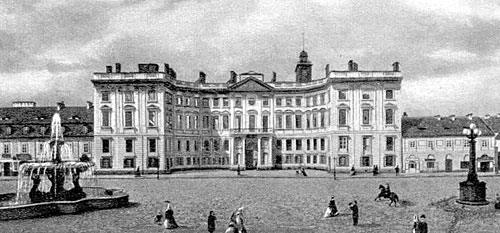
A much grander palace was built in the country’s new capital, Warsaw, by Prince Antoni Barnaba between 1773 and 1785. Located on one of the two grand boulevards of the old town that converge close to the Royal Castle (Senatorska Street), Jablonowski Palace was one of the grandest buildings in the city, directly across from the Grand National Theatre, built in the 1820s. By that point, the palace had been nationalised by Russian authorities and rebuilt as Warsaw’s city hall. Its characteristic tower was added in the 1860s. Destroyed like so much of Warsaw in 1944, it was rebuilt in the 1990s to prewar designs. Today it houses a major international bank.
Meanwhile, Antoni Barnaba’s cousin from a collateral (non-princely) branch, Konstanty Aleksander, had a son who is worth mentioning here. Władysław Franciszek was referred to by contemporaries as ‘the black one’ (czarny), and many historians now are certain that he was the product of an extra-marital liaison by his mother, and celebrate him as Poland’s first African general. If he was illegitimate, he was accepted by his father as his own. Of more interest to us here was how he re-asserted his family’s connection to France once again, though in a very different context. He was sent to France to study at the military academy in 1783, where he was classmates with Napoleon Bonaparte. On graduation, he was commissioned as a lieutenant in the Regiment-Royal Allemand, in 1789 (age twenty), then served in Poland in the Kościuszko Uprising of 1794, before returning to France as a soldier in the Revolutionary army in 1798. Appointed a general of the Polish Legion in 1799, he served in Italy then was sent on an expedition to Saint-Domingue (modern Haïti) in 1802 where he (ironically if his African origins are true) fought to put down a major slave rebellion. He died there of yellow fever, as did so many French officers that year.

In the aftermath of the partitions of Poland-Lithuania, the Jablonowski family found itself divided into two branches, Russian and Austrian (though they themselves retained a Polish identity). The Russian branch was headed by Stanisław Pawel and his half-brother Maksymilian (and are sometimes seen with the Russian spelling, Yablonovsky). Born over two decades apart, their roles to play in Polish history were quite different. Stanisław Pawel was a commander in the Polish-Lithuanian army in the 1780s, rising to the rank of major-general and head of the Foot Guards Regiment, before the independent army was taken over by Russia in 1794. In 1807, Napoleon liberated much of central Poland and created a new ‘Grand Duchy of Poland’, nominally ruled by the new King of Saxony. Prince Jablonowski, reliably pro-French and married to a relative of Marie Walewska—Napoleon’s mistress and advisor at this time—was appointed ‘Senator Castellan’, a new rank in this attempt at reviving an independent Poland, then ‘Senator Voivode’ in 1812. That year, however, Napoleon marched into Russia to disastrous consequences, and Poland was abandoned to its fate, and once again partitioned between Russia and Prussia. The Prince died in 1822.
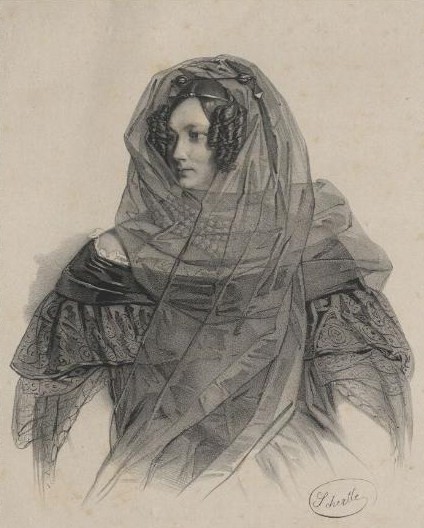
Prince Maksymilian, on the other hand, was much more fully integrated into the power structures of the Russian Empire. He was given the rank of an Imperial chamberlain as early as 1804, and in 1820 was appointed a Senator-Castellan of the new Kingdom of Poland (part of Russia). In 1825, the Tsar appointed him Voivode of Poland, and in 1829, a chamberlain of the Polish court—which still existed in Warsaw, with the Russian emperor as its king. After the failure of the Polish Uprising of 1830-31, he was appointed to the Royal State Council and Grand Chamberlain of court, and eventually President of the Heraldic Court of Poland (the regulatory body of the Polish nobility). In 1844, the Tsar confirmed his title of prince (legally transforming his title Prince of the Holy Roman Empire to Prince of the Russian Empire); and a year later this title was formally recognised in the Kingdom of Poland. He died in 1846 on his estates in Volhynia. Prince Maximilian’s wife, Teresa (born a Princess Lubomirska), was considered one of the great beauties of Warsaw and hostess of her own fashionable salon.
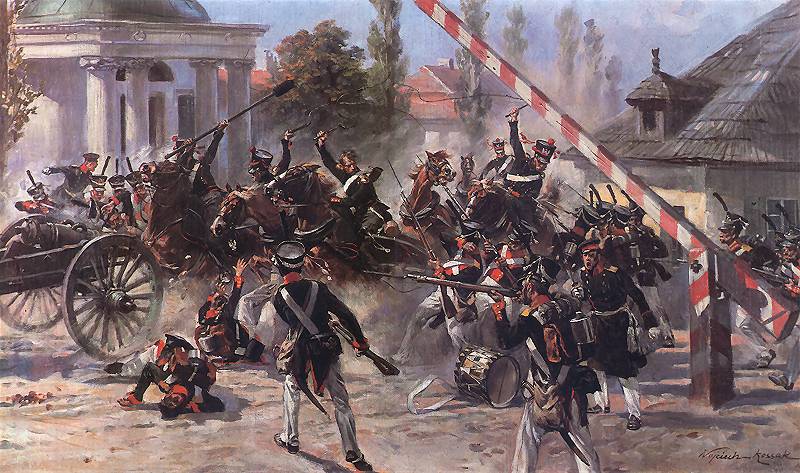
The Prince’s nephews, however, were not so malleable to Russian interests. Prince Antoni held the rank, like his uncle, of chamberlain of the court of Poland, and held a minor administrative position in the government. But he was a member of Polish nationalist secret societies, and in 1825 took part in the Decembrist Uprising against Russian rule—he was arrested and sent to prison in Saint Petersburg where he was sentenced to twenty years of hard labour. He was pardoned by the Tsar, for giving names and was sent to live in a remote corner of Russia for the next decade, after which he was allowed to return to his estates in eastern Poland where he died in 1855. His brother Stanisław was at first more pro-Russian, and joined the army in the fight against Napoleon. But he too joined a nationalist uprising, this one 1830-31 (during which his troops defended one of Warsaw’s gates), and was exiled. He died in Krakow (in Austrian territory) in 1878, the last of this branch.
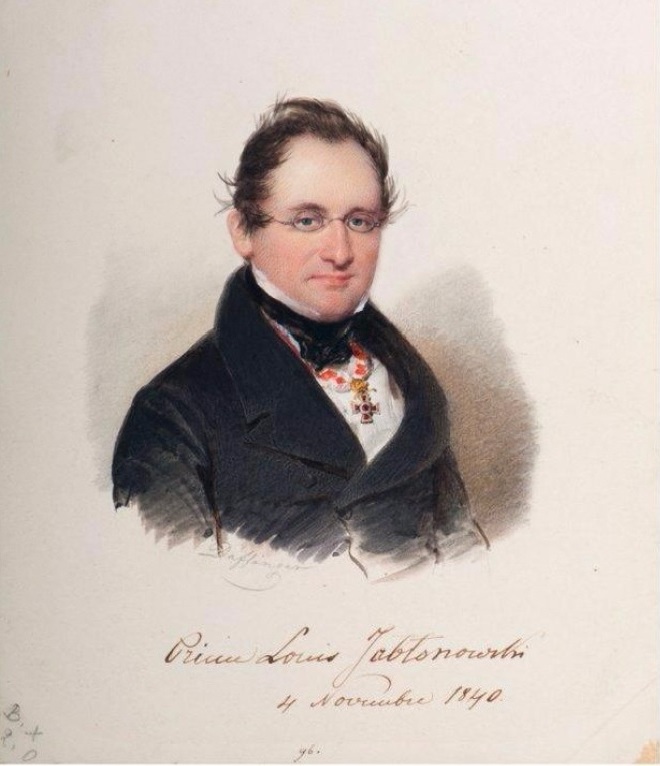
The younger Jablonowski branch held lands now incorporated into the Austrian Empire, so focused their identities towards Vienna. Already during the Congress of Vienna of 1815, Prince Ludwik Jablonowski demonstrated his loyalty to the Habsburg dynasty, and in 1816 was appointed Ambassador to the Kingdom of the Two Sicilies. After his return to Vienna in 1820 he was confirmed in the rank of Fürst, then was rewarded with the offices of Imperial chamberlain (1831), privy councillor (1833) and Grand Equerry of the Kingdom of Galicia (1834)—Galicia having been erected into a kingdom ruled by the Austrian emperor, as a counterpoint to the Russian kingdom of Poland.
The 2nd Prince Jablonowski of the Austrian branch, Karol (or Karl) became a conservative politician in the House of Lords of the Austrian Empire, representing the great Polish landowners who were now part of a much wider empire. He helped establish a separate Privy Council for Galicia, based in Lwow (or Lemberg, as it was called in German) in the year of nationalist uprisings, 1848, and worked to ensure measures were taken to improve the Galician economy (notably its railroads), and opposed land reforms and the abolition of serfdom. His younger brother, Alexander, was an Austrian Field Marshal-Lieutenant who helped pacify Vienna in 1848.
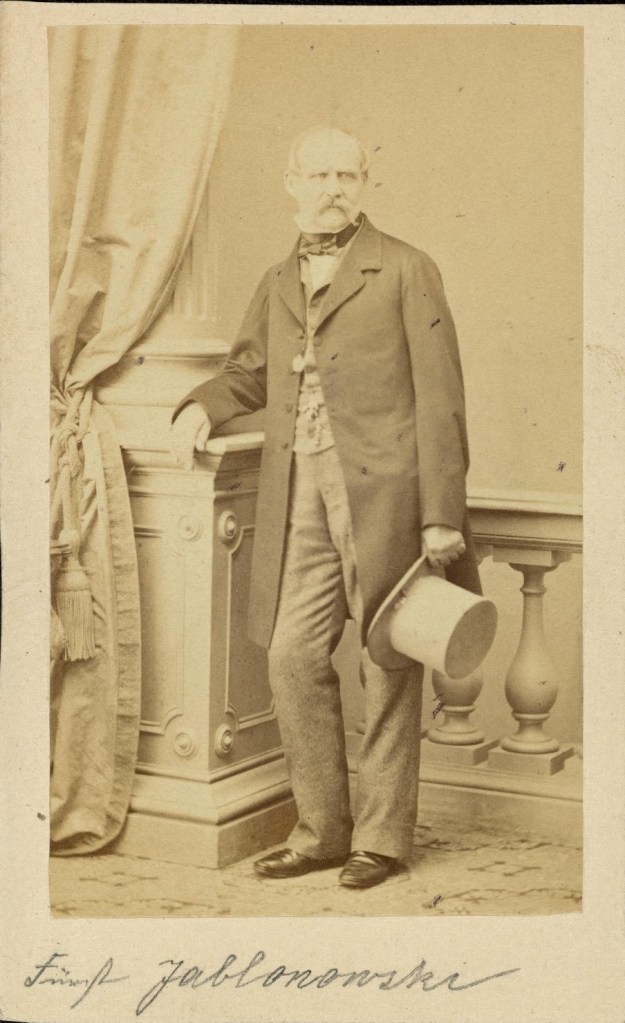
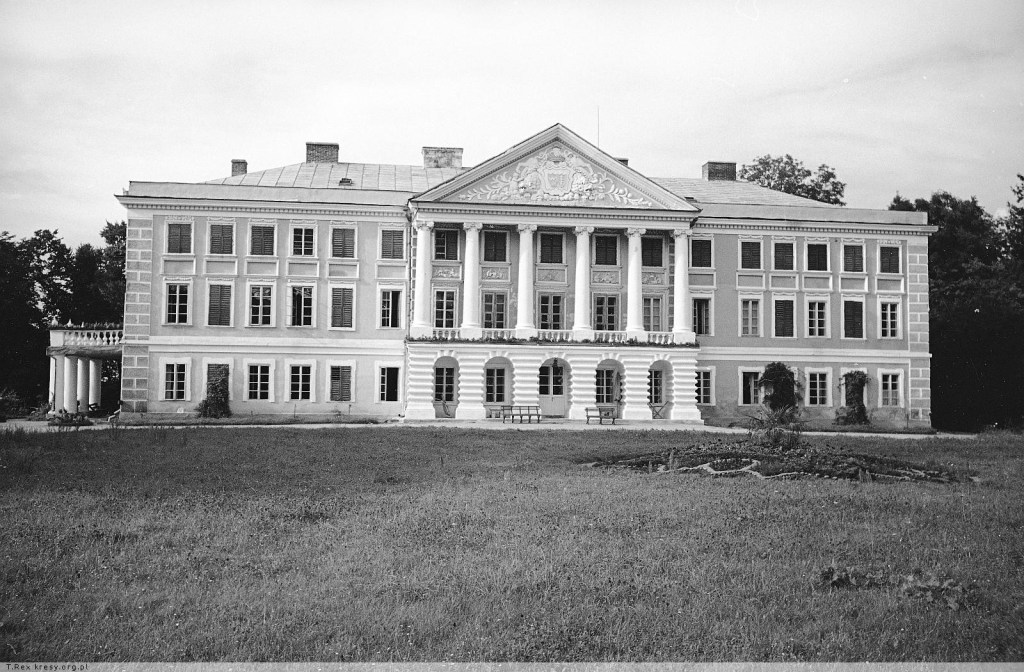
In 1834, Prince Karol married an heiress of the Skarbek family who had built a grand palace in Galicia at Bursztyn (now Burshtyn in Ukraine). This property, formerly the seat of the powerful Sieniawski family who died out in the mid-eighteenth century, became the Galician branch’s principal seat until they were driven out of the area at the end of the Second World War. The Bursztyn Palace was demolished in 1944, though a family burial chapel remains.
Prince Karol died in 1885 and was succeeded by his son, Stanisław Maria Ferdynand, 3rd Prince Jablonowski, whose rank was augmented by Emperor Franz Josef with the style ‘Serene Highness’ in 1905. In 1909 his son Stanisław Maria Ludwik became the 4th Prince—neither the 3rd or 4th prince played much active role in public life. The latter married a daughter of a Polish nobleman, Zygmunt Mineyko, an engineer and cartographer who helped develop the newly independent Greek kingdom in the late nineteenth century, and whose other daughter married Georgios Papandreou, a strongly anti-monarchist Greek politician who later Prime Minister at the end of World War II. When the 4th Prince died in 1921, he left only daughters, who carried on the family tradition from exile after the Communists expropriated their estates in Poland and Ukraine—the last died in London in 2004. The princely title had passed to a cousin, Karol Ludwik, who died a few years later in Graz, Austria, in 1925. The princely branches of the House of Jablonowski passed out of existence. There are many others who bear this name in Poland (and Yablonovsky in Russia), but these come from other more distant branches, or indeed from other families who bore the same name (but a different coat of arms).

(images Wikimedia Commons; thanks to interesting articles by Katarzyna Kosior on the Franco-Polish relations for the family in the eighteenth century; and to Rafe Heydel-Mankoo for assistance with information about the Austrian branch)
 Dukes and Princes
Hi. I am interested in Jablonowski and want to know more about. Do you know any sites where I can find more information?
LikeLike
hi Valeri. Unfortunately I didn’t find a good source for this family, but pulled together various bits and pieces from published genealogy books, an article about the family at Versailles in French, and other online sites, including Polish Wikipedia (which is very incomplete).
LikeLike